1. If A = { a, b, c, d, e }, B = { c, d, e, f }, C = { b, d }, D = { a, e } then which of the following statements are true and which are false?
- C ⊆ B
- A ⊆ D
- D ⊆ B
- D ⊆ A
- B ⊆ A
- C ⊆ A
Solution:
- C ⊆ B: False
- A ⊆ D: False
- D ⊆ B: False
- D ⊆ A: True
- B ⊆ A: False
- C ⊆ A: True
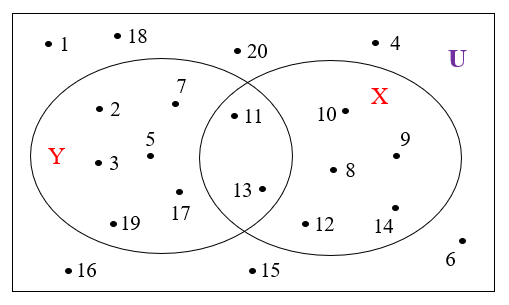
2. Take the set of natural numbers from 1 to 20 as a universal set and show set X and Y using Venn Diagram.
- X = { x | x ∈ N, and 7 < x < 15 }
- Y = { y | y ∈ N, y is a prime number from 1 to 20 }
Solution:
First, let's write the given sets in the list form:
U = {1, 2, 3, 4, 5, 6, 7, 8, 9, 10, 11, 12, 13, 14, 15, 16, 17, 18, 19, 20}
X = {8, 9, 10, 11, 12, 13, 14}
Y = {2, 3, 5, 7, 11, 13, 17, 19}
The completed Venn Diagram is given below:
3. U = { 1, 2, 3, 7, 8, 9, 10, 11, 12} P = { 1, 3, 7, 10 } then,
(i) show the sets U, P and P' by Venn Diagram
(ii) Verify (P')' = P
Solution:
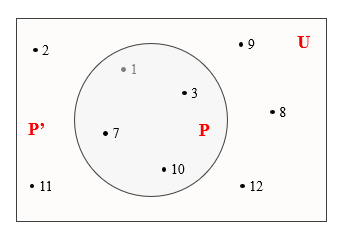
Now, P' = { 2, 8, 9, 11, 12 }
and (P')' = { 1, 3, 7, 10 }
∴ (P')' = P
4. A = { 1, 3, 2, 7 } then write any three subsets of A.
Solution:
All the subsets of A are given below. You can write any three:
- {1}
- {2}
- {3}
- {7}
- {1, 2}
- {1, 3}
- {1, 7}
- {2, 3}
- {2, 7}
- {3, 7}
- {1, 2, 3}
- {1, 2, 7}
- {1, 3, 7}
- {2, 3, 7}
- {1, 2, 3, 7}
- φ
5 (i) Write the subset relation between the sets:
- P is the set of all residents in Pune
- M is the set of all residents in Madhya Pradesh
- I is the set of all residents in Indore
- B is the set of all residents in India
- H is the set of all residents in Maharashtra
Solution:
The subset relations are as follows:
- P ⊆ H
- P ⊆ B
- I ⊆ M
- I ⊆ B
- H ⊆ B
- M ⊆ B
Now, every set is a subset of itself:
- P ⊆ P
- M ⊆ M
- I ⊆ I
- B ⊆ B
- H ⊆ H
Also, an empty set is a subset of every set:
- φ ⊆ P
- φ ⊆ M
- φ ⊆ I
- φ ⊆ B
- φ ⊆ H
5 (ii) Which set can be the universal set for the above sets?
Solution:
The set of all residents in India (B), can be the universal set for the above sets.
6 (i): Which set of numbers could be the universal set for the sets given below?
- A = the set of multiples of 5
- B = the set of multiples of 7
- C = the set of multiples of 12
Solution:
Set N, Set W, Set I
(You can write any one of them)
6 (ii): P = the set of integers which are multiples of 4, T = the set of all even square numbers
Solution:
Set N, Set W, Set I
(You can write any one of them)
7. Let, all the students of a class be the Universal set. Let, set A be the students who secure 50% or more marks in Maths.
Then write the complement of set A.
Solution:
The set of students getting less than 50% marks in Maths.
This page was last modified on
17 April 2026 at 10:45