1. If n (A) = 15, n (A ∪ B) = 29, n (A ∩ B) = 7 then n (B) = ?
Solution:
Using the formula: n (A ∪ B) = n (A) + n (B) − n (A ∩ B)
29 = 15 + n (B) − 7
29 = 8 + n (B)
29 − 8 = n (B)
21 = n (B)
i.e. n (B) = 21
2. In a hostel there are 125 students, out of which 80 drink tea, 60 drink coffee and 20 drink tea and coffee both. Find the number of students who do not drink tea or coffee.
Solution:
Let, T be the set of students who drink tea and C be the set of students who drink coffee.
Now,
n (T) = 80, n (C) = 60 and n (T ∩ C) = 20, n (T ∪ C) = ?
Using the formula:
n (T ∪ C) = n (T) + n (C) − n (T ∩ C)
∴ n (T ∪ C) = 80 + 60 − 20
∴ n (T ∪ C) = 120 ... (i)
120 students drink either tea or coffee or both.
But, there are 125 students in the hostel.
∴ The number of students who drink neither tea nor coffee
= Total number of students − n (T ∪ C)
= 125 − 120
= 5
∴ 5 students drink neither tea nor coffee.
3. In a competitive exam, 50 students passed in English, 60 students passed in Mathematics, 40 students passed in both the subjects. None of them fail in both the subjects. Find the number of students who passed in at least one of the subjects.
Solution:
Let, E be the set of students who passed in English and M be the set of students who passed in Mathematics.
Now,
n (E) = 50, n (M) = 60 and n (E ∩ M) = 40, n (E ∪ M) = ?
Using the formula:
n (E ∪ M) = n (E) + n (M) − n (E ∩ M)
∴ n (E ∪ M) = 50 + 60 − 40
∴ n (E ∪ M) = 70 ... (i)
∴ The number of students who passed in at least one of the subjects is 70.
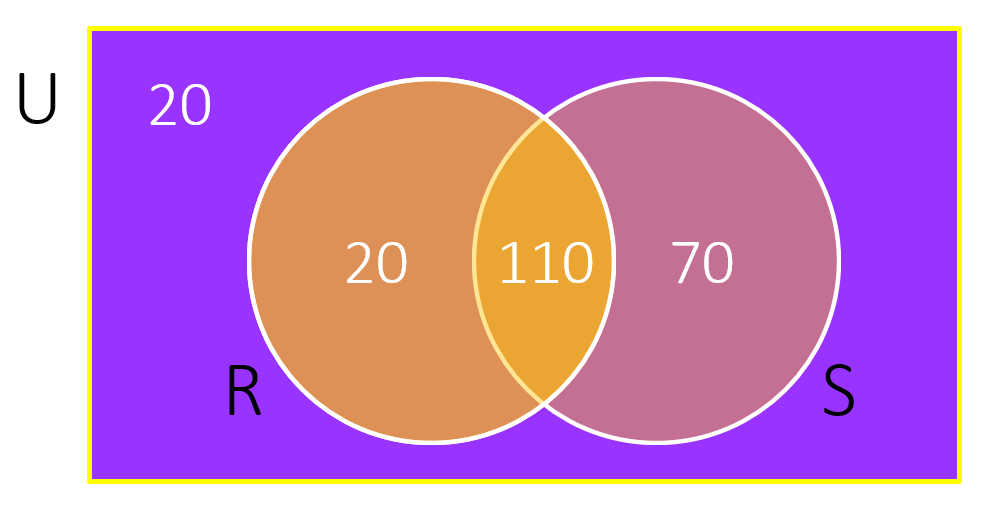
4. A survey was conducted to know the hobby of 220 students of class IX. Out of which 130 students informed about their hobby as rock climbing and 180 students informed about their hobby as sky watching. There are 110 students who follow both the hobbies. Then how many students do not have any of the two hobbies? How many of them follow the hobby of rock climbing only? How many students follow the hobby of sky watching only?
Solution:
Let, R be the set of students interested in rock climbing and S be the set of students interested in sky watching.
Now,
n (U) = 220, n (R) = 130, n (S) = 180 and n (R ∩ S) = 110, n (R ∪ S) = ?
Using the formula:
n (R ∪ S) = n (R) + n (S) − n (R ∩ S)
∴ n (R ∪ S) = 130 + 180 − 110
∴ n (R ∪ S) = 200 ... (i)
∴ The number of students who follow at least one of the hobbies is 200.
Therefore, the number of students who do not have any of the two hobbies is:
n (U) − n (R ∪ S) = 220 − 200 = 20 ... (ii)
The number of students who follow the hobby of rock climbing only is:
n (R) − n (R ∩ S) = 130 − 110 = 20 ... (iii)
The number of students who follow the hobby of sky watching only is:
n (S) − n (R ∩ S) = 180 − 110 = 70 ... (iv)
This is better understood using a Venn Diagram which is given below:
5. Observe the given Venn diagram and write the following sets:
- A
- B
- A ∪ B
- U
- A'
- B'
- (A ∪ B)'
Solution:

- A = {x, y, z, m, n}
- B = {p, q, r, m, n}
- A ∪ B = {x, y, z, m, n, p, q, r}
- U = {x, y, z, m, n, p, q, r, s, t}
- A' = {p, q, r, s, t}
- B' = {x, y, z, s, t}
- (A ∪ B)' = {s, t}
This page was last modified on
17 April 2026 at 11:00