- Choose the correct alternative answer for each of the following questions:
Click on the question to view the answer
Click on the question to view the answer
Let’s solve this by taking sets as given in the problem.
Let, P = {5, 6, 9}
and M = {5, 6, 7, 8, 9}
Here, it is clear that P ⊆ M
Now, P ∪ M = {5, 6, 7, 8, 9}
and P ∩ (P ∪ M) = {5, 6, 9}
∴ P ∩ (P ∪ M) = P
∴ The correct answer is: (A) P
(A) Set of intersecting points of parallel lines
- Find the correct option for the given questions:
Click on the question to view the answer
Click on the question to view the answer
(A) Colours of the rainbow
(A) {0, 1, 2, 3, ...}
(B) {i, n, d, a}
(C) {1, 2, 3, 4, 5, 7, 8}
3. Out of 100 persons in a group, 72 persons speak English and 43 persons speak French. Each one out of 100 persons speaks at least one language. Then how many speak only English? How many speak only French? How many of them speak English and French both?
Solution:
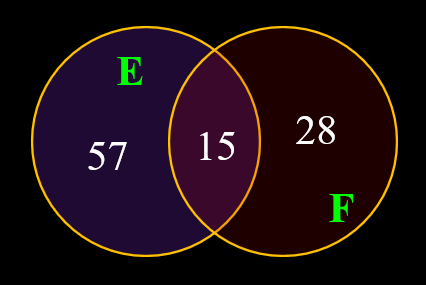
Let, E be the set of persons who speak English and F be the set of people who speak French.
Here,
n (E) = 72, n (F) = 43 and n (E ∪ F) = 100, n (E ∩ F) = ?
Using the formula:
n (E ∪ F) = n (E) + n (F) − n (E ∩ F)
∴ 100 = 72 + 43 − n (E ∩ F)
∴ 100 = 115 − n (E ∩ F)
∴ n (E ∩ F) = 115 − 100
∴ n (E ∩ F) = 15 ... (i)
∴ 15 persons speak English and French both. ... (ii)
Now, the number of persons who speak only English
= n (E) − n (E ∩ F)
= 72 − 15
= 57
∴ 57 persons speak only English. ... (iii)
And, the number of persons who speak only French
= n (F) − n (E ∩ F)
= 43 − 15
= 28
∴ 28 persons speak only French. ... (iv)
A Venn Diagram of this is shown below:
4. 70 trees were planted by Parth and 90 trees were planted by Pradnya on the occasion of Tree Plantation Week. Out of these; 25 trees were planted by both of them together. How many trees were planted by Parth or Pradnya ?
Solution:
Let, B be the set of trees planted by Parth and G be the set of trees planted by Pradnya.
Here,
n (B) = 70, n (G) = 90 and n (B ∩ G) = 25, n (B ∪ G) = ?
Using the formula:
n (B ∪ G) = n (B) + n (G) − n (B ∩ G)
∴ n (B ∪ G) = 70 + 90 − 25
∴ n (B ∪ G) = 135 ... (i)
∴ 135 trees were planted by Parth or Pradnya.
5. If n (A) = 20, n (B) = 28 and n (A ∪ B) = 36 then n (A ∩ B) =?
Solution:
Using the formula:
n (A ∪ B) = n (A) + n (B) − n (A ∩ B)
∴ 36 = 20 + 28 − n (A ∩ B)
∴ 36 = 48 − n (A ∩ B)
∴ n (A ∩ B) = 48 − 36
∴ n (A ∩ B) = 12 ... (i)
6. In a class, 8 students out of 28 have a dog as their pet animal at home, 6 students have a cat as their pet animal. 10 students have dog and cat both, then how many students do not have a dog or cat as their pet animal at home?
Solution:
Method I:
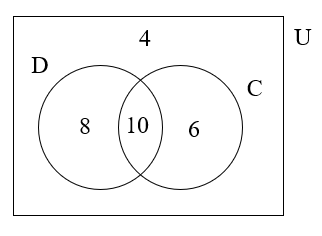
Let U be the set of all students in the class (Universal Set), let D be the set of students having a dog as their pet animal at home, and let C be the set of students having a cat as their pet animal at home.
Here,
n (U) = 28, and
n (D ∩ C) = 10
Now, n (D) = 8 + n (D ∩ C)
∴ n (D) = 8 + 10 = 18 ... (i)
Also, n (C) = 6 + n (D ∩ C)
∴ n (C) = 6 + 10 = 16 ... (ii)
Using the formula:
n (D ∪ C) = n (D) + n (C) − n (D ∩ C)
∴ n (D ∪ C) = 18 + 16 − 10
∴ n (D ∪ C) = 34 − 10
∴ n (D ∪ C) = 24 ... (iii)
∴ Students who do not have a dog or a cat as their pet animal at home
= n (U) − n (D ∪ C)
= 28 − 24
= 4
Method II:
We can also solve this using a different method.
Students having only dog = 8
Students having only cat = 6
Students having both dog and cat = 10
∴ Students having dog or cat or both the pets = 8 + 6 + 10 = 24
And total number of students in the class = 28
∴ Students who do not have a dog or cat as their pet animal at home = 28 − 24 = 4
For your understanding, a Venn Diagram is given below:
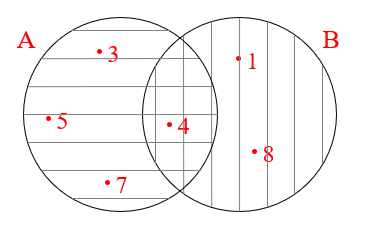
7. Represent the union of two sets by Venn diagram for each of the following:
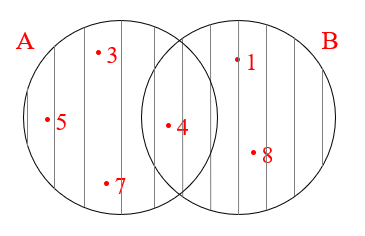
(i) A = {3, 4, 5, 7}, B = {1, 4, 8}
Solution:
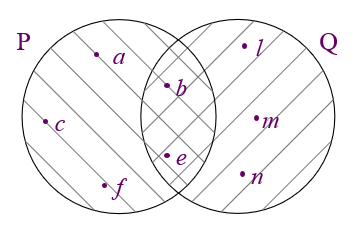
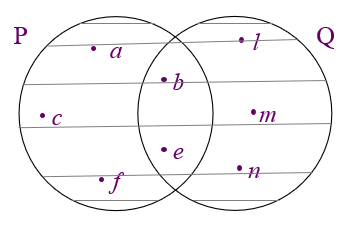
(ii) P = { a, b, c, e, f }, Q = { l, m, n, e, b }
Solution:
(iii)
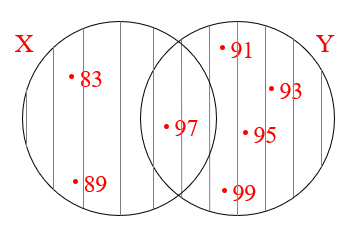
X = { x | x is a prime number between 80 and 100}
Y = { y | y is an odd number between 90 and 100}
Solution:
First, let's find the elements of each set:
X = {83, 89, 97}
Y = {91, 93, 95, 97, 99}
Now, we can represent the union of sets X ∪ Y using a Venn diagram:
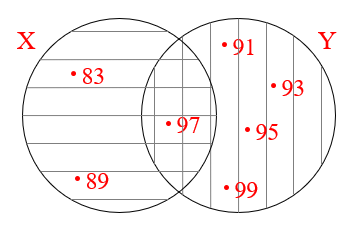
The above answers are given in the textbook. However, they do not correctly depict the union of two sets.
The correct answers are as follows:
(i)
(ii)
(iii)
8. Write the subset relations between the following sets:
X = set of all quadrilaterals
Y = set of all rhombuses
S = set of all squares
T = set of all parallelograms
V = set of all rectangles
Solution:
All rhombuses, squares, parallelograms, and rectangles are subsets of the set of all quadrilaterals.
Hence,
- Y ⊆ X
- S ⊆ X
- T ⊆ X
- V ⊆ X
A square has all the properties of a parallelogram, a rectangle and a rhombus.
Hence,
- S ⊆ Y
- S ⊆ T
- S ⊆ V
A rhombus has all the properties of a parallelogram.
Hence,
- Y ⊆ T
A rectangle has all the properties of a parallelogram.
Hence,
- V ⊆ T
Moreover, every set is a subset of itself.
Hence,
- X ⊆ X
- Y ⊆ Y
- S ⊆ S
- T ⊆ T
- V ⊆ V
Also, an empty set is a subset of every set.
Hence,
- ∅ ⊆ X
- ∅ ⊆ Y
- ∅ ⊆ S
- ∅ ⊆ T
- ∅ ⊆ V
9. If M is any set, then write M ∪ ∅ and M ∩ ∅.
Solution:
M ∪ ∅ = M
[Refer to property (6) on textbook page 14]
M ∩ ∅ = ∅
[Refer to property (7) on textbook page 12]
10. Observe the Venn diagram and write the given sets U, A, B, A ∪ B and A ∩ B.
Solution:
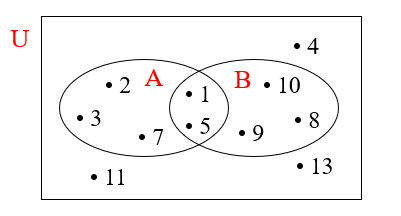
U = {1, 2, 3, 4, 5, 7, 8, 9, 10, 11, 13}
A = {1, 2, 3, 4, 5, 7}
B = {1, 5, 8, 9, 10}
A ∪ B = {1, 2, 3, 5, 7, 8, 9, 10}
A ∩ B = {1, 5}
11. If n (A) = 7, n (B) = 13 and n (A ∩ B) = 4 then n (A ∪ B) = ?
Solution:
Using the formula:
n (A ∪ B) = n (A) + n (B) − n (A ∩ B)
∴ n (A ∪ B) = 7 + 13 − 4
∴ n (A ∪ B) = 16 ... (i)