1. Show that \(\displaystyle 4\sqrt 2\) is an irrational number.
Solution:
Let’s assume that \(\displaystyle 4\sqrt 2\) is a rational number.
A rational number can be expressed in the form \(\displaystyle \frac {p}{q}\).
∴ \(\displaystyle 4\sqrt 2\) = \(\displaystyle \frac {p}{q}\) ... (say)
(Here, p, q ∈ I and q ≠ 0)
∴ \(\displaystyle \sqrt 2\) = \(\displaystyle \frac {p}{4q}\) ... (i)
Now, \(\displaystyle \frac {p}{q}\) is a rational number.
∴ \(\displaystyle \frac {p}{4q}\) is also a rational number.
Now, LHS of equation (i) is an irrational number while the RHS is a rational number.
But, this is contradictory.
∴ Our assumption that \(\displaystyle 4\sqrt 2\) is a rational number is incorrect.
∴ \(\displaystyle 4\sqrt 2\) is an irrational number.
2. Show that \(\displaystyle 3 + \sqrt 5\) is an irrational number.
Solution:
Let’s assume that \(\displaystyle 3 + \sqrt 5\) is a rational number.
A rational number can be expressed in the form \(\displaystyle \frac {p}{q}\).
∴ \(\displaystyle 3 + \sqrt 5\) = \(\displaystyle \frac {p}{q}\) ... (say)
(Here, p, q ∈ I and q ≠ 0)
∴ \(\displaystyle \sqrt 5\) = \(\displaystyle \frac {p}{q} - 3\) ... (i)
Now, \(\displaystyle \frac {p}{q}\) is a rational number.
∴ \(\displaystyle \frac {p}{q} - 3\) is also a rational number.
Now, LHS of equation (i) is an irrational number while the RHS is a rational number.
But, this is contradictory.
∴ Our assumption that \(\displaystyle 3 + \sqrt 5\) is a rational number is incorrect.
∴ \(\displaystyle 3 + \sqrt 5\) is an irrational number.
3. Represent \(\displaystyle \sqrt {5}\) and \(\displaystyle \sqrt {10}\) on a number line.
Explanation:
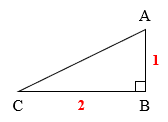
In right \(\triangle\)ABC,
AC² = AB² + BC² ... (Pythogoras’ Theorem)
∴ AC² = 1² + 2²
∴ AC² = 1 + 4
∴ AC² = 5
∴ AC = \(\sqrt 5\)
Thus, if we have a triangle as shown, it’s hypotenuse is \(\sqrt 5\).
So, we construct a similar triangle on a number line as shown.
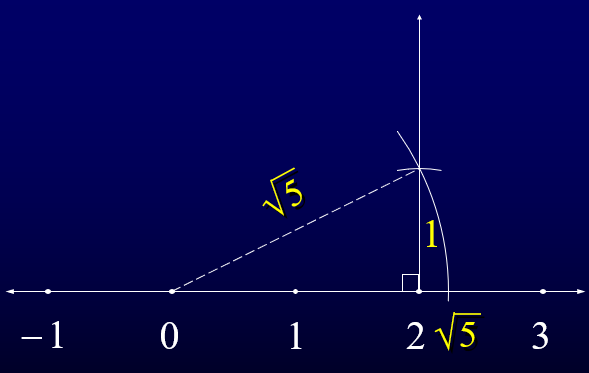
Explanation:
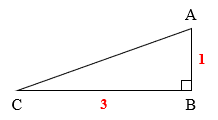
In right \(\triangle\)ABC,
AC² = AB² + BC² ... (Pythogoras’ Theorem)
∴ AC² = 1² + 3²
∴ AC² = 1 + 9
∴ AC² = 10
∴ AC = \(\sqrt {10}\)
Thus, if we have a triangle as shown, it’s hypotenuse is \(\sqrt {10}\).
So, we construct a similar triangle on a number line as shown.
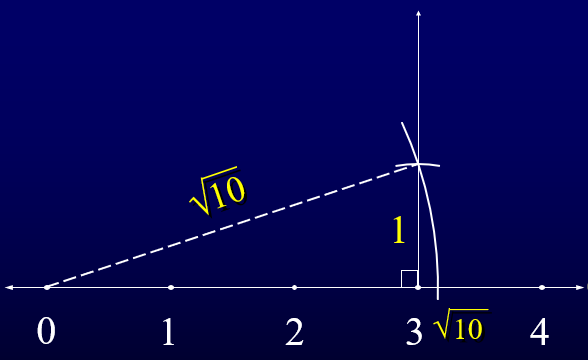
4. Write any three rational numbers between the two numbers given below:
There are infinite rational numbers between any two rational numbers.
(i) 0.3 and − 0.5
Solution:
Method I:
Let’s consider these numbers on a number line as shown:

Now, it is easy to write the numbers.
0.2 , 0.1 , 0 , − 0.1, − 0.2
(You can write any three.)
Method II:
We can write 0.3 as \(\displaystyle \frac {3}{10}\) and − 0.5 as \(\displaystyle \frac {-5}{10}\).
We can write these numbers as \(\displaystyle \frac {30}{100}\) and \(\displaystyle \frac {-50}{100}\).
So, we need to find three rational numbers between \(\displaystyle \frac {-50}{100}\) and \(\displaystyle \frac {30}{100}\).
We can choose any three numbers from \(\displaystyle \frac {-49}{100}, \frac {-48}{100}, \dots, \frac {0}{100}, \dots, \frac {29}{100}\).
Let’s choose \(\displaystyle \frac {-1}{10}, \frac {0}{10}, \frac {1}{10}\).
Thus, three rational numbers between 0.3 and − 0.5 are \(\displaystyle \frac {-1}{10}, \frac {0}{10}, \frac {1}{10}\).
[Please follow the method taught in your school. This is just for your understanding.]
(ii) − 2.3 and − 2.33
Solution:
We can consider the given numbers as follows:
− 2.3 = − 2.300
and − 2.33 = − 2.33
Now, it is easy to write the numbers.
The required numbers are:
− 2.301, − 2.302, − 2.303, ... , − 2.327, − 2.328, − 2.329
(You can write any three.)
(iii) 5.2 and 5.3
Solution:
We can consider the given numbers as follows:
5.2 = 5.20
and 5.3 = 5.30
Now, it is easy to write the numbers.
The required numbers are:
5.21, 5.22, 5.23, 5.24, 5.25, 5.26, 5.27, 5.28, 5.29
(You can write any three.)
(ii) − 4.5 and − 4.6
Solution:
We can consider the given numbers as follows:
− 4.5 = − 4.50
and − 4.6 = − 4.60
Now, it is easy to write the numbers.
The required numbers are:
− 4.51, − 4.52, − 4.53, ... , − 4.57, − 4.58, − 4.59
(You can write any three.)
This page was last modified on
19 April 2026 at 14:05