1. State whether the given algebraic expressions are polynomials. Justify:
(i) \(\displaystyle y + \frac {1}{y}\)
Solution:
\(\displaystyle y + \frac {1}{y}\)
= \(\displaystyle y + y^{-\:1}\)
Here, the powers of the variables are not whole numbers.
∴ This is not a polynomial.
(ii) \(\displaystyle 2\:-\:5\:\sqrt{x}\)
Solution:
\(\displaystyle 2\:-\:5\:\sqrt{x}\)
= \(\displaystyle 2\:-\:5\:x^{\frac{1}{2}}\)
Here, the powers of the variables are not whole numbers.
∴ This is not a polynomial.
(iii) \(\displaystyle x^2 + 7x + 9\)
Solution:
\(\displaystyle x^2 + 7x + 9\)
Here, the powers of the variables are whole numbers.
∴ This is a polynomial.
(iv) \(\displaystyle 2m^{-\:2} + 7m - 5\)
Solution:
\(\displaystyle 2m^{-\:2} + 7m - 5\)
Here, the powers of the variables are not whole numbers.
∴ This is not a polynomial.
(v) \(\displaystyle 10\)
Solution:
\(\displaystyle 10\)
= \(\displaystyle 10x^0\)
Here, the powers of the variables are whole numbers.
∴ This is a polynomial.
(2) Write the coefficient of \(\displaystyle m^3\) in each of the given polynomial:
(i) \(\displaystyle m^3\)
Solution:
\(\displaystyle m^3\)
Coefficient of \(\displaystyle m^3 = 1\)
(ii) \(\displaystyle \frac {-\:3}{2} + m\: -\:\sqrt{3}m^3\)
Solution:
\(\displaystyle \frac {-\:3}{2} + m\: -\:\sqrt{3}m^3\)
Coefficient of \(\displaystyle m^3 = \: -\:\sqrt{3}\)
(iii) \(\displaystyle \frac {-\:2}{3}m^3 \:-\:5m^2 + 7m\:-\:1\)
Solution:
\(\displaystyle \frac {-\:2}{3}m^3 \:-\:5m^2 + 7m\:-\:1\)
Coefficient of \(\displaystyle m^3 = -\: \frac {2}{3}\)
(3) Write the polynomial in \(\displaystyle x\) using the given information:
(i) Monomial with degree 7
Answer:
- \(\displaystyle x^7\)
- \(\displaystyle -\:5x^7\)
- \(\displaystyle \sqrt{2}x^7\)
- \(\displaystyle \frac {1}{2}x^7\)
[You can write any polynomial like these.]
(ii) Binomial with degree 35.
Answer:
- \(\displaystyle 2x^{35} \:-\:7\)
- \(\displaystyle \sqrt{7}x^{35} \:-\:3x^2\)
- \(\displaystyle 1\:-\:x^{35}\)
- \(\displaystyle 35x^{35}\:-\:33x^{33}\)
[You can write any polynomial like these.]
(iii) Trinomial with degree 8.
Answer:
- \(\displaystyle x^{8} \:-\:2x^{5} + 3\)
- \(\displaystyle 5x^{8} \:-\:3x^{2} + 1\)
- \(\displaystyle 5\:-\:\sqrt{2}x^{8} \:-\:x^{4}\)
[You can write any polynomial like these.]
(4) Write the degree of the given polynomials:
(i) \(\displaystyle \sqrt {5}\)
Solution:
\(\displaystyle \sqrt {5}\)
= \(\displaystyle 5x^{0}\)
Degree = 0
(ii) \(\displaystyle x^{0}\)
Solution:
\(\displaystyle x^{0}\)
Degree = 0
(iii) \(\displaystyle x^{2}\)
Solution:
\(\displaystyle x^{2}\)
Degree = 2
(iv) \(\displaystyle \sqrt {2}\:m^{10}\:-\:7\)
Solution:
\(\displaystyle \sqrt {2}\:m^{10}\:-\:7\)
Degree = 10
(v) \(\displaystyle 2p\:-\:\sqrt {7}\)
Solution:
\(\displaystyle 2p\:-\:\sqrt {7}\)
Degree = 1
(vi) \(\displaystyle 7y\:-\:y^{3}\:+\:y^{5}\)
Solution:
\(\displaystyle 7y\:-\:y^{3}\:+\:y^{5}\)
Degree = 5
(vii) \(\displaystyle xyz\:+\:xy\:-\:z\)
Solution:
\(\displaystyle xyz\:+\:xy\:-\:z\)
Degree = 3
Degree of a polynomial in more than one variable: The highest sum of the powers of variables in each term of the polynomial is the degree of the polynomial.
(viii) \(\displaystyle m^{3}n^{7}\:-\:3m^{5}n\:+\:mn\)
Solution:
\(\displaystyle m^{3}n^{7}\:-\:3m^{5}n\:+\:mn\)
Degree = 10
Degree of a polynomial in more than one variable: The highest sum of the powers of variables in each term of the polynomial is the degree of the polynomial.
(5) Classify the following polynomials as linear, quadratic and cubic polynomials:
(i) \(\displaystyle 2x^{2}\:+\:3x\:+\:1\)
Solution:
This is a quadratic polynomial.
(ii) \(\displaystyle 5p\)
Solution:
This is a linear polynomial.
(iii) \(\displaystyle \sqrt {2}y\:-\:\frac{1}{2}\)
Solution:
This is a linear polynomial.
(iv) \(\displaystyle m^{3}\:+\:7m^{2}\:+\:\frac {5}{2}m\:-\:\sqrt {7}\)
Solution:
This is a cubic polynomial.
(v) \(\displaystyle a^{2}\)
Solution:
This is a quadratic polynomial.
(vi) \(\displaystyle 3r^{3}\)
Solution:
This is a cubic polynomial.
(6) Write the following polynomials in standard form:
(i) \(\displaystyle m^{3}\:+\:3\:+\:5m\)
Answer:
The standard form is:
\(\displaystyle m^{3}\:+\:5m\:+\:3\:\)
(ii) \(\displaystyle -\:7y\:+\:y^{5}\:+3y^{3}\:-\:\frac{1}{2}\:+\:2y^{4}\:-\:y^{2}\)
Answer:
The standard form is:
\(\displaystyle y^{5}\:+\:2y^{4}\:+3y^{3}\:-\:y^{2}\:-\:7y\:-\:\frac{1}{2}\:\)
(7) Write the following polynomials in coefficient form:
(i) \(\displaystyle x^{3}\:-\:2\)
Answer:
\(\displaystyle x^{3}\:-\:2\)
= \(\displaystyle 1x^{3}\:+\:0x^{2}\:+\:0x\:-\:2\)
∴ The coefficient form is: (1, 0, 0, − 2)
(ii) \(\displaystyle 5y\)
Answer:
\(\displaystyle 5y\)
= \(\displaystyle 5y\:+\:0\)
∴ The coefficient form is: (5, 0)
(iii) \(\displaystyle 2m^{4}\:-\:3m^{2}\:+\:7\)
Answer:
\(\displaystyle 2m^{4}\:-\:3m^{2}\:+\:7\)
= \(\displaystyle 2m^{4}\:+\:0m^{3}\:-\:3m^{2}\:+\:0m\:+\:7\)
∴ The coefficient form is: (2, 0, − 3, 0, 7)
(iv) \(\displaystyle -\:\frac{2}{3}\)
Answer:
\(\displaystyle -\:\frac{2}{3}\)
= \(\displaystyle -\:\frac{2}{3}x^{0}\)
∴ The coefficient form is: \(\displaystyle \left(-\:\frac {2}{3}\:\right)\)
(8) Write the polynomials in standard form:
(i) \(\displaystyle (1, 2, 3)\)
Answer:
\(\displaystyle (1, 2, 3)\)
The standard form is:
\(\displaystyle 1x^{2}\:+\:2x\:+\:3\)
= \(\displaystyle x^{2}\:+\:2x\:+\:3\)
(ii) \(\displaystyle (-\:2,\:2,\:-\:\:2,\:2)\)
Answer:
\(\displaystyle (-\:2,\:2,\:-\:\:2,\:2)\)
The standard form is:
\(\displaystyle -\:2x^{3}\:+\:2x^{2}\:-\:2x\:+\:2\)
(9) Write the appropriate polynomials in the boxes:
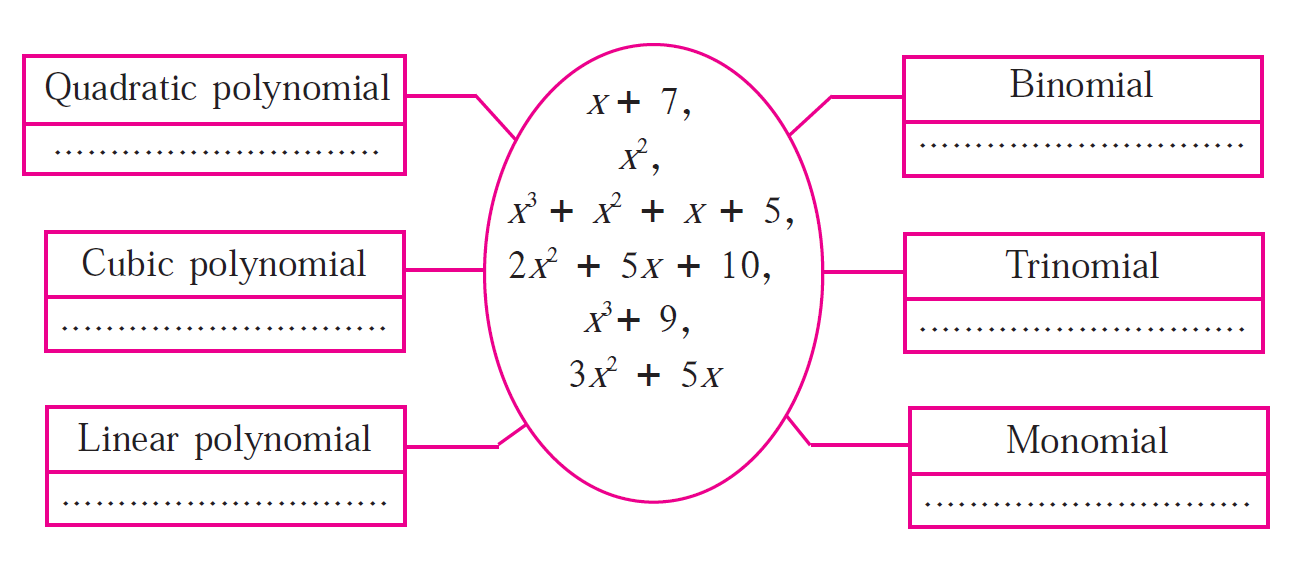
Solution:
Quadratic Polynomials:
- \(\displaystyle x^{2}\)
- \(\displaystyle 2x^{2}\:+\:5x\:+\:10\)
- \(\displaystyle 3x^{2}\:+\:5x\)
Cubic Polynomials:
- \(\displaystyle x^{3}\:+\:x^{2}\:+\:x\:+\:5\)
- \(\displaystyle x^{3}\:+\:9\)
Linear Polynomial:
- \(\displaystyle x\:+\:7\)
Binomials:
- \(\displaystyle x\:+\:7\)
- \(\displaystyle x^{3}\:+\:9\)
- \(\displaystyle 3x^{2}\:+\:5x\)
Trinomial:
- \(\displaystyle 2x^{2}\:+\:5x\:+\:10\)
Monomial:
- \(\displaystyle x^{2}\)
This page was last modified on
25 April 2026 at 19:19