(1) Divide each of the following polynomials by synthetic division method and also by linear division method. Write the quotient and the remainder:
(i) \((2m^{2} - 3m + 10) \div (m - 5)\)
Solution:
Synthetic Division:
Let’s write the dividend in the coefficient form.
Coefficient form: (2, − 3, 10)
Divisor: \(m - 5\)
Opposite of − 5 is 5.
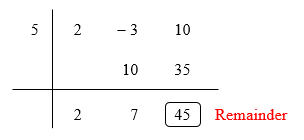
Coefficient form of the quotient is (2, 7)
∴ Quotient = \(2m + 7\)
and Remainder = 45
Linear Division:
\(2m^{2} - 3m + 10\)
= \(2m(m - 5) + 7m + 10\)
= \(2m(m - 5) + 7(m - 5) + 45\)
= \((m - 5)(2m + 7) + 45\)
∴ Quotient = \(2m + 7\)
and Remainder = 45
(ii) \((x^{4} + 2x^{3} + 3x^{2} + 4x + 5) \div (x + 2)\)
Solution:
Synthetic Division:
Let’s write the dividend in the coefficient form.
Coefficient form: (1, 2, 3, 4, 5)
Divisor: \(x + 2\)
Opposite of 2 is − 2.
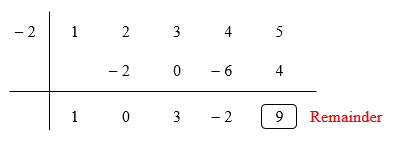
Coefficient form of the quotient is (1, 0, 3 − 2)
∴ Quotient = \(x^{3} + 0x^{2} + 3x - 2\)
i.e. Quotient = \(x^{3} + 3x - 2\)
and Remainder = 9
Linear Division:
\(x^{4} + 2x^{3} + 3x^{2} + 4x + 5\)
= \(x^{3}(x + 2) + 3x^{2} + 4x + 5\)
= \(x^{3}(x + 2) + 3x(x + 2) - 2x + 5\)
= \(x^{3}(x + 2) + 3x(x + 2) - 2(x + 2) + 9\)
= \((x + 2)(x^{3} + 3x - 2) + 9\)
∴ Quotient = \(x^{3} + 3x - 2\)
and Remainder = 9
(iii) \((y^{3} - 216) \div (y - 6)\)
Solution:
Synthetic Division:
Let’s write the dividend in the index form:
Dividend = \(1y^{3} +0y^{2} + 0y - 216\)
Now, let’s write the dividend in the coefficient form.
Coefficient form: (1, 0, 0, − 216)
Divisor: \(y - 6\)
Opposite of − 6 is 6.
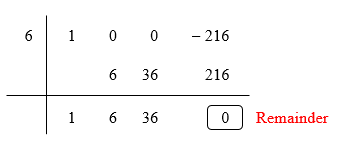
Coefficient form of the quotient is (1, 6, 36)
∴ Quotient = \(y^{2} + 6y + 36\)
and Remainder = 0
Linear Division:
\(y^{3} - 216\)
= \(y^{2}(y - 6) + 6y^{2} - 216\)
= \(y^{2}(y - 6) + 6y(y - 6) + 36y - 216\)
= \(y^{2}(y - 6) + 6y(y - 6) + 36(y - 6) + 0\)
= \((y - 6)(y^{2} + 6y + 36) + 0\)
∴ Quotient = \(y^{2} + 6y + 36\)
and Remainder = 0
(iv) \((2x^{4} + 3x^{3} + 4x - 2x^{2}) \div (x + 3)\)
Solution:
Synthetic Division:
First, let’s write the dividend in the standard form:
Dividend = \(2x^{4} + 3x^{3} - 2x^{2} + 4x\)
Now, let’s write the dividend in the index form:
Dividend = \(2x^{4} + 3x^{3} - 2x^{2} + 4x + 0\)
Now, let’s write the dividend in the coefficient form.
Coefficient form: (2, 3, − 2, 4, 0)
Divisor: \(x + 3\)
Opposite of 3 is − 3.
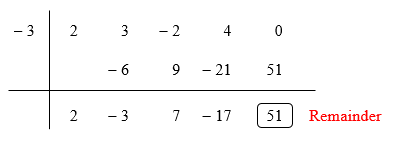
Coefficient form of the quotient is (2, − 3, 7, − 17)
∴ Quotient = \(2x^{3} - 3x^{2} + 7x - 17\)
and Remainder = 51
Linear Division:
\(2x^{4} + 3x^{3} - 2x^{2} + 4x\)
= \(2x^{3}(x + 3) - 3x^{3} - 2x^{2} + 4x\)
= \(2x^{3}(x + 3) - 3x^{2}(x + 3) + 7x^{2} + 4x\)
= \(2x^{3}(x + 3) - 3x^{2}(x + 3) + 7x(x + 3) - 17x\)
= \(2x^{3}(x + 3) - 3x^{2}(x + 3) + 7x(x + 3) - 17(x + 3) + 51\)
= \((x + 3)(2x^{3} - 3x^{2} + 7x - 17) + 51\)
∴ Quotient = \(2x^{3} - 3x^{2} + 7x - 17\)
and Remainder = 51
(v) \((x^{4} - 3x^{2} - 8) \div (x + 4)\)
Solution:
Synthetic Division:
First, let’s write the dividend in the index form:
Dividend = \(1x^{4} + 0x^{3} - 3x^{2} + 0x - 8\)
Now, let’s write the dividend in the coefficient form.
Coefficient form: (1, 0, − 3, 0, − 8)
Divisor: \(x + 4\)
Opposite of 4 is − 4.
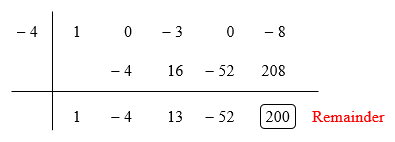
Coefficient form of the quotient is (1, − 4, 13, − 52)
∴ Quotient = \(x^{3} - 4x^{2} + 13x - 52\)
and Remainder = 200
Linear Division:
\(x^{4} - 3x^{2} - 8\)
= \(x^{3}(x + 4) - 4x^{3} - 3x^{2} - 8\)
= \(x^{3}(x + 4) - 4x^{2}(x + 4) + 13x^{2} - 8\)
= \(x^{3}(x + 4) - 4x^{2}(x + 4) + 13x(x + 4) - 52x - 8\)
= \(x^{3}(x + 4) - 4x^{2}(x + 4) + 13x(x + 4) - 52(x + 4) + 200\)
= \((x + 4)(x^{3} - 4x^{2} + 13x - 52) + 200\)
∴ Quotient = \(x^{3} - 4x^{2} + 13x - 52\)
and Remainder = 200
(vi) \((y^{3} - 3y^{2} + 5y - 1) \div (y - 1)\)
Solution:
Synthetic Division:
Let’s write the dividend in the coefficient form.
Coefficient form: (1, − 3, 5, − 1)
Divisor: \(y - 1\)
Opposite of − 1 is 1.
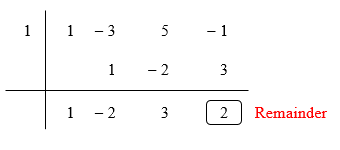
Coefficient form of the quotient is (1, − 2, 3)
∴ Quotient = \(y^{2} - 2y + 3\)
and Remainder = 2
Linear Division:
\(y^{3} - 3y^{2} + 5y - 1\)
= \(y^{2}(y - 1) - 2y^{2} + 5y - 1\)
= \(y^{2}(y - 1) - 2y(y - 1) + 3y - 1\)
= \(y^{2}(y - 1) - 2y(y - 1) + 3(y - 1) + 2\)
= \((y - 1)(y^{2} - 2y + 3) + 2\)
∴ Quotient = \(y^{2} - 2y + 3\)
and Remainder = 2
This page was last modified on
28 April 2026 at 14:36