(1) Write the correct alternative answer for each of the following questions:
(Click on the question to view the answer)
The correct option is: (D) \(\displaystyle \sqrt{2}x^{2} + 7\)
The correct option is: (D) \(\displaystyle 0\).
The correct option is: (C) Any real number.
The correct option is: (A) 3.
The correct option is: (C) (1, 0, 0, − 1).
Solution:
\(p(x) = x^{2} - 7\sqrt{7}x + 3\)
∴ \(p(7\sqrt{7}) = (7\sqrt{7})^{2} - 7\sqrt{7} \times 7\sqrt{7} + 3\)
∴ \(p(7\sqrt{7}) = 49 \times 7 - 49 \times 7 + 3\)
∴ \(p(7\sqrt{7}) = 49 \times 7 - 49 \times 7 + 3\)
∴ \(p(7\sqrt{7}) = \cancel{343} - \cancel{343} + 3\)
∴ \(p(7\sqrt{7}) = 3\)
∴ The correct option is: (A) \(3\).
Solution:
Let, \(p(x) = 2x^{3} + 2x\)
∴ \(p(- 1) = 2(- 1)^{3} + 2 \times - 1\)
∴ \(p(- 1) = 2 \times - 1 - 2\)
∴ \(p(- 1) = - 2 - 2\)
∴ \(p(- 1) = - 4\)
∴ The correct option is: (D) − 4.
Solution:
Let, \(p(x) = 3x^{2} + mx\)
\(x - 1\) is a factor of \(p(x)\).
∴ \(p(1) = 0\)
∴ \(3(1)^{2} + m \times 1 = 0\)
∴ \(3 + m = 0\)
∴ \(m = - 3\)
The correct option is: (C) − 3.
Solution:
Let, \(p(x) = (x^{2} - 3)(2x - 7x^{3} + 4)\)
The degree of the first polynomial \((x^{2} - 3)\) is 2.
The degree of the second polynomial \((2x - 7x^{3} + 4)\) is 3.
The degree of the product of two polynomials is the sum of their individual degrees.
∴ The degree of the product \(p(x)\) is \(2 + 3 = 5\).
The correct option is: (A) 5.
The correct option is: (A) \(x + 5\).
(2) Write the degree of the polynomial in each of the following:
(i) \(5 + 3x^{4}\)
Degree = 4
(ii) 7
Solution:
\(7 = 7x^{0}\)
∴ Degree = 0
(iii) \(ax^{7} + bx^{9} \text{ (}a, b \text{ are constants)}\)
Degree = 9
Degree of a polynomial in more than one variable: The highest sum of the powers of variables in each term of the polynomial is the degree of the polynomial.
(3) Write the following polynomials in standard form:
(i) \(4x^{2} - 7x^{4} - x^{3} - x + 9\)
Solution:
The standard form
= \(- 7x^{4} - x^{3} + 4x^{2} - x + 9\)
(ii) \(p + 2p^{3} + 10p^{2} + 5p^{4} - 8\)
Solution:
The standard form
= \(5p^{4} + 2p^{3} + 10p^{2} + p - 8\)
(4) Write the following polynomials in coefficient form:
(i) \(x^{4} + 16\)
Solution:
Let’s first write the given polynomial in the index form
= \(x^{4} + 0x^{3} + 0x^{2} + 0x + 16\)
∴ The Coefficient form
= \((1, 0, 0, 0, 16)\)
(ii) \(m^{5} + 2m^{2} + 3m + 15\)
Solution:
Let’s first write the given polynomial in the index form
= \(m^{5} + 0m^{4} + 0m^{3} + 2m^{2} + 3m + 15\)
∴ The Coefficient form
= \((1, 0, 0, 2, 3, 15)\)
(5) Write the index form of the polynomials using variable \(x\) from its coefficient form:
(i) \((3, -\ 2, 0, 7, 18)\)
Solution:
Index form
= \(3x^{4} - 2x^{3} + 0x^{2} + 7x + 18\)
(ii) \((6, 1, 0, 7)\)
Solution:
Index form
= \((6x^{3} + x^{2} + 0x + 7)\)
(iii) \((4, 5, -\ 3, 0)\)
Solution:
Index form
= \((4x^{3} + 5x^{2} - 3x + 0)\)
(6) Add the following polynomials:
(i) \(7x^{4} - 2x^{3} + x + 10;\ 3x^{4} + 15x^{3} + 9x^{2} - 8x + 2\)
Solution:
\(\bbox[lightcyan, 5pt, border: 2px dotted red]{7x^{4}} \bbox[lemonchiffon, 5pt, border: 2px dotted red]{- 2x^{3}}\bbox[khaki, 5pt, border: 2px dotted red]{ + x}\bbox[plum, 5pt, border: 2px dotted red]{ + 10 }\bbox[lightcyan, 5pt, border: 2px dotted red]{+ 3x^{4}}\bbox[lemonchiffon, 5pt, border: 2px dotted red]{ + 15x^{3}} + 9x^{2}\bbox[khaki, 5pt, border: 2px dotted red]{ - 8x} \bbox[plum, 5pt, border: 2px dotted red]{+ 2}\)
= \(10x^{4} + 13x^{3} + 9x^{2} - 7x + 12\)
(ii) \(3p^{3}q + 2p^{2}q + 7;\ 2p^{2}q + 4pq - 2p^{3}q\)
Solution:
\(\bbox[lightcyan, 5pt, border: 2px dotted red]{3p^{3}q} \bbox[plum, 5pt, border: 2px dotted red]{+ 2p^{2}q} + 7\bbox[plum, 5pt, border: 2px dotted red]{+ 2p^{2}q} + 4pq \bbox[lightcyan, 5pt, border: 2px dotted red]{- 2p^{3}q}\)
= \(p^{3}q + 4p^{2}q + 4pq + 7\)
(7) Subtract the second polynomial from the first:
(i) \(5x^{2} - 2y + 9;\ 3x^{2} + 5y - 7\)
Solution:
\((5x^{2} - 2y + 9) - (3x^{2} + 5y - 7)\)
= \(\bbox[lightcyan, 5pt, border: 2px dotted red]{5x^{2}}\bbox[plum, 5pt, border: 2px dotted red]{ - 2y}\bbox[yellow, 5pt, border: 2px dotted red]{ + 9} \bbox[lightcyan, 5pt, border: 2px dotted red]{- 3x^{2}}\bbox[plum, 5pt, border: 2px dotted red]{ - 5y}\bbox[yellow, 5pt, border: 2px dotted red]{ + 7}\)
= \(2x^{2} - 7y + 16\)
(ii) \(2x^{2} + 3x + 5;\ x^{2} - 2x + 3\)
Solution:
\((2x^{2} + 3x + 5) -\ (x^{2} - 2x + 3)\)
\(\bbox[lightcyan, 5pt, border: 2px dotted red]{2x^{2}}\bbox[plum, 5pt, border: 2px dotted red]{ + 3x} \bbox[yellow, 5pt, border: 2px dotted red]{+ 5} \bbox[lightcyan, 5pt, border: 2px dotted red]{- x^{2}}\bbox[plum, 5pt, border: 2px dotted red]{ + 2x} \bbox[yellow, 5pt, border: 2px dotted red]{- 3}\)
= \(x^{2} + 5x + 2\)
(8) Multiply the following polynomials:
(i) \((m^{3} - 2m + 3)\ (m^{4} - 2m^{2} + 3m + 2)\)
Solution:
\((m^{3} - 2m + 3)\ (m^{4} - 2m^{2} + 3m + 2)\)
= \(m^{3}(m^{4} - 2m^{2} + 3m + 2) - 2m(m^{4} - 2m^{2} + 3m + 2) +\nobreak3(m^{4}\nobreak-\nobreak2m^{2}\nobreak+\nobreak3m\nobreak+\nobreak2)\)
= \(m^{7} - 2m^{5} + 3m^{4} + 2m^{3} - 2m^{5} + 4m^{3} - 6m^{2} - 4m +\nobreak3m^{4}\nobreak-\nobreak6m^{2}\nobreak+\nobreak9m\nobreak+\nobreak6\)
= \(m^{7} - 4m^{5} + 6m^{4} + 6m^{3} - 12m^{2} + 5m + 6\)
(ii) \((5m^{3} - 2)\ (m^{2} - m + 3)\)
Solution:
\((5m^{3} - 2)\ (m^{2} - m + 3)\)
= \(5m^{3}(m^{2} - m + 3) - 2(m^{2} - m + 3)\)
= \(5m^{5} - 5m^{4} + 15m^{3} - 2m^{2} + 2m - 6\)
(9) Divide the polynomial \(3x^{3} - 8x^{2} + x + 7\) by \(x - 3\) using synthetic method and write the quotient and remainder.
Solution:
Let’s write the dividend in the coefficient form.
Coefficient form: (3, − 8, 1, 7)
Divisor: \(x - 3\)
Opposite of − 3 is 3.
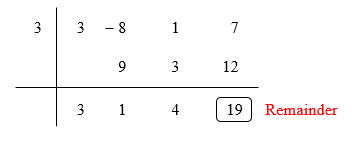
Coefficient form of the quotient is (3, 1, 4)
∴ Quotient = \(3x^{2} + x + 4\)
and Remainder = 19
(10) For which value of \(m\), \(x + 3\) is the factor of the polynomial \(x^{3}\nobreak-\nobreak2mx\nobreak+\nobreak21\)?
Solution:
\(x + 3\) is a factor of \(x^{3}\nobreak-\nobreak2mx\nobreak+\nobreak21\) ... (Given)
∴ By factor theorem,
\(p(- 3) = 0\)
∴ \((- 3)^{3} - 2m(- 3) + 21 = 0\)
∴ \(- 27 + 6m + 21 = 0\)
∴ \(- 6 + 6m = 0\)
∴ \(6m = 6\)
∴ \(\displaystyle m = \frac{\cancel{6}}{\cancel{6}}\)
∴ \(\displaystyle m = 1\)
∴ For \(m = 1\), \(x + 3\) is the factor of the polynomial \(x^{3}\nobreak-\nobreak2mx\nobreak+\nobreak21\)
(11) At the end of the year 2016, the population of villages Kovad, Varud, Chikhali is \(5x^{2} - 3y^{2}\), \(7y^{2} + 2xy\) and \(9x^{2} + 4xy\) respectively. At the beginning of the year 2017, \(x^{2} + xy - y^{2}\), \(5xy\) and \(3x^{2} + xy\) persons from each of the three villages respectively went to another village for education. Then what is the remaining total population of these three villages?
Solution:
Total population of 3 villages at the end of 2016:
= \((5x^{2} - 3y^{2}) + (7y^{2} + 2xy) + (9x^{2} + 4xy)\)
= \(5x^{2} - 3y^{2} + 7y^{2} + 2xy + 9x^{2} + 4xy\)
= \(14x^{2} + 4y^{2} + 6xy\) ... (i)
Total number of people who went to other villages at the beginning of 2017:
= \((x^{2} + xy - y^{2}) + (5xy) + (3x^{2} + xy)\)
= \(x^{2} + xy - y^{2} + 5xy + 3x^{2} + xy\)
= \(4x^{2} - y^{2} + 7xy\) ... (ii)
∴ Total remaining population of 3 villages:
= \((14x^{2} + 4y^{2} + 6xy) - (4x^{2} - y^{2} + 7xy)\)
= \(14x^{2} + 4y^{2} + 6xy - 4x^{2} + y^{2} - 7xy\)
= \(10x^{2} + 5y^{2} - xy\) ... (iii)
∴ Total remaining population of 3 villages is \(10x^{2} + 5y^{2} - xy\).
(12) Polynomials \(bx^{2} + x + 5\) and \(bx^{3}\nobreak-\nobreak 2x\nobreak+\nobreak5\) are divided by the polynomial \(x\nobreak-\nobreak3\) and the remainders are \(m\) and \(n\) respectively. If \(m\nobreak-\nobreak n\nobreak=\nobreak0\), then find the value of \(b\).
Solution:
Let, \(p(x) = bx^{2} + x + 5\)
and \(q(x) = bx^{3} - 2x + 5\)
Now, when \(p(x)\) is divided by \(x - 3\), the remainder is \(m\).
∴ \(p(3) = m\)
∴ \(b \times 3^{2} + 3 + 5 = m\)
∴ \(9b + 8 = m\)
i.e. \(m = 9b + 8\) ... (i)
Also, when \(q(x)\) is divided by \(x - 3\), the remainder is \(n\).
∴ \(q(3) = n\)
∴ \(b \times 3^{3} - 2 \times 3 + 5 = n\)
∴ \(27b - 6 + 5 = n\)
∴ \(27b - 1 = n\)
i.e. \(n = 27b - 1\) ... (ii)
And, \(m - n = 0\) ... (Given)
∴ \((9b + 8) - (27b - 1) = 0\) ... [From (i) and (ii)]
∴ \(9b + 8 - 27b + 1 = 0\)
∴ \(- 18b + 9 = 0\)
∴ \(- 18b = - 9\)
i.e. \(18b = 9\)
∴ \(\displaystyle b = \frac{\cancelto{1}{9}}{\cancelto{2}{18}}\)
∴ \(\displaystyle b = \frac{1}{2}\)
(13) Simplify: \((8m^{2} + 3m - 6) - (9m - 7) + (3m^{2}\nobreak-\nobreak2m\nobreak+\nobreak4)\)
Solution:
\((8m^{2} + 3m - 6) - (9m - 7) + (3m^{2} - 2m + 4)\)
= \(8m^{2} + 3m - 6 - 9m + 7 + 3m^{2} - 2m + 4\)
= \(11m^{2} - 8m + 5\)
(14) Which polynomial is to be subtracted from \(x^{2} + 13x + 7\) to get the polynomial \(3x^{2} + 5x - 4\)?
Solution:
Let that polynomial be \(p(x)\).
∴ \((x^{2} + 13x + 7) - p(x) = (3x^{2} + 5x - 4)\)
∴ \((x^{2} + 13x + 7) - (3x^{2} + 5x - 4) = p(x)\)
i.e. \(p(x) = (x^{2} + 13x + 7) - (3x^{2} + 5x - 4)\)
∴ \(p(x) = x^{2} + 13x + 7 - 3x^{2} - 5x + 4\)
∴ \(p(x) = - 2x^{2} + 8x + 11\)
∴ The polynomial to be subtracted is \(- 2x^{2} + 8x + 11\).
(15) Which polynomial is to be added to \(4m + 2n + 3\) to get the polynomial \(6m + 3n + 10\)?
Solution:
Let that polynomial be \(\text{P}\).
∴ \((4m + 2n + 3) + \text{P} = (6m + 3n + 10)\)
∴ \(\text{P} = (6m + 3n + 10) - (4m + 2n + 3)\)
∴ \(\text{P} = 6m + 3n + 10 - 4m - 2n - 3\)
∴ \(\text{P} = 2m + n + 7\)
∴ The polynomial to be added is \(2m + n + 7\).
This page was last modified on
05 May 2026 at 12:48