1. Find the distances with the help of the number line given below.

The distance between two points on a number line is calculated by subtracting the smaller co-ordinate from the greater co-ordinate.
(i) d (B, E)
Co-ordinate of B: 2
Co-ordinate of E: 5
Now, 2 < 5
∴ d (B, E) = 5 − 2
∴ d (B, E) = 3
(ii) d (J, A)
Co-ordinate of J: − 2
Co-ordinate of A: 1
Now, − 2 < 1
∴ d (J, A) = 1 − (− 2)
∴ d (J, A) = 1 + 2
∴ d (J, A) = 3
(iii) d (P, C)
Co-ordinate of P: − 4
Co-ordinate of C: 3
Now, − 4 < 3
∴ d (P, C) = 3 − (− 4)
∴ d (P, C) = 3 + 4
∴ d (P, C) = 7
(iv) d (J, H)
Co-ordinate of J: − 2
Co-ordinate of H: − 1
Now, − 2 < − 1
∴ d (J, H) = − 1 − (− 2)
∴ d (J, H) = − 1 + 2
∴ d (J, H) = 1
(v) d (K, O)
Co-ordinate of K: − 3
Co-ordinate of O: 0
Now, − 3 < 0
∴ d (K, O) = 0 − (− 3)
∴ d (K, O) = 0 + 3
∴ d (K, O) = 3
(vi) d (O, E)
Co-ordinate of O: 0
Co-ordinate of E: 5
Now, 0 < 5
∴ d (O, E) = 5 − 0
∴ d (O, E) = 5
(vii) d (P, J)
Co-ordinate of P: − 4
Co-ordinate of J: − 2
Now, − 4 < − 2
∴ d (P, J) = − 2 − (− 4)
∴ d (P, J) = − 2 + 4
∴ d (P, J) = 2
(viii) d (Q, B)
Co-ordinate of Q: − 5
Co-ordinate of B: 2
Now, − 5 < 2
∴ d (Q, B) = 2 − (− 5)
∴ d (Q, B) = 2 + 5
∴ d (Q, B) = 7
2. If the co-ordinate of A is x and that of B is y, find d (A, B).
(i) x = 1, y = 7
Co-ordinate of A: 1
Co-ordinate of B: 7
Now, 1 < 7
∴ d (A, B) = 7 − 1
∴ d (A, B) = 6
(ii) x = 6, y = − 2
Co-ordinate of A: 6
Co-ordinate of B: − 2
Now, 6 > − 2
∴ d (A, B) = 6 − (− 2)
∴ d (A, B) = 6 + 2
∴ d (A, B) = 8
(iii) x = − 3, y = 7
Co-ordinate of A: − 3
Co-ordinate of B: 7
Now, − 3 < 7
∴ d (A, B) = 7 − (− 3)
∴ d (A, B) = 7 + 3
∴ d (A, B) = 10
(iv) x = − 4, y = − 5
Co-ordinate of A: − 4
Co-ordinate of B: − 5
Now, − 4 > − 5
∴ d (A, B) = − 4 − (− 5)
∴ d (A, B) = − 4 + 5
∴ d (A, B) = 1
(v) x = − 3, y = − 6
Co-ordinate of A: − 3
Co-ordinate of B: − 6
Now, − 3 > − 6
∴ d (A, B) = − 3 − (− 6)
∴ d (A, B) = − 3 + 6
∴ d (A, B) = 3
(vi) x = 4, y = − 8
Co-ordinate of A: 4
Co-ordinate of B: − 8
Now, 4 > − 8
∴ d (A, B) = 4 − (− 8)
∴ d (A, B) = 4 + 8
∴ d (A, B) = 12
3. From the information given below, find which of the point is between the other two. If the points are not collinear, state so.
(i) d (P, R) = 7, d (P, Q) = 10, d (Q, R) = 3
Solution:
d (P, Q) = 10 ... (i)
and d (P, R) + d (Q, R) = = 7 + 3 = 10 ... (ii)
From (i) and (ii),
d (P, Q) = d (P, R) + d (Q, R)
∴ Point R is between Point P and Point Q.
∴ P – R – Q
(ii) d (R, S) = 8, d (S, T) = 6, d (R, T) = 4
Solution:
d (R, S) = 8 ... (i)
and d (S, T) + d (R, T) = = 6 + 4 = 10 ... (ii)
From (i) and (ii),
d (R, S) ≠ d (S, T) + d (R, T)
∴ Points R, S and T are not collinear.
(iii) d (A, B) = 16, d (C, A) = 9, d (B, C) = 7
Solution:
d (A, B) = 16 ... (i)
and d (C, A) + d (B, C) = = 9 + 7 = 16 ... (ii)
From (i) and (ii),
d (A, B) = d (C, A) + d (B, C)
∴ Point C is between Point A and Point B.
∴ A – C – B
(iv) d (L, M) = 11, d (M, N) = 12, d (N, L) = 8
Solution:
d (M, N) = 12 ... (i)
and d (L, M) + d (N, L) = = 11 + 8 = 19 ... (ii)
From (i) and (ii),
d (M, N) ≠ d (L, M) + d (N, L)
∴ Points L, M and N are not collinear.
(v) d (X, Y) = 15, d (Y, Z) = 7, d (X, Z) = 8
Solution:
d (X, Y) = 15 ... (i)
and d (Y, Z) + d (X, Z) = = 7 + 8 = 15 ... (ii)
From (i) and (ii),
d (X, Y) = d (Y, Z) + d (X, Z)
∴ Point Z is between Point X and Point Y.
∴ X – Z – Y
(vi) d (D, E) = 5, d (E, F) = 8, d (D, F) = 6
Solution:
d (E, F) = 8 ... (i)
and d (D, E) + d (D, F) = = 5 + 6 = 11 ... (ii)
From (i) and (ii),
d (E, F) ≠ d (D, E) + d (D, F)
∴ Points D, E and F are not collinear.
4. On a number line, points A, B and C are such that d (A, C) = 10, d (C, B) = 8. Find d (A, B) considering all possibilities.
Solution:
Here, we have three possibilities.
1. A – B – C
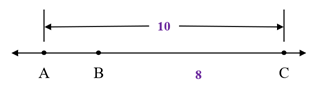
∴ d (A, C) = d (A, B) + d (B, C)
∴ 10 = d (A, B) + 8
∴ 10 − 8 = d (A, B)
∴ 2 = d (A, B)
i.e. d (A, B) = 2
2. A – C – B
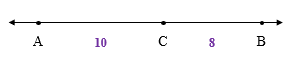
∴ d (A, B) = d (A, C) + d (C, B)
∴ d (A, B) = 10 + 8 = 18
i.e. d (A, B) = 18
3. B – A – C
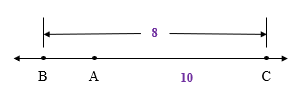
But, this is not possible as
d (A, C) > d (C, B)
∴ d (A, B) = 2 or 18
5. Points X, Y and Z are collinear such that d (X, Y) = 17, d (Y, Z) = 8. Find d (X, Z).
Solution:
Here, we have two possibilities.
1. X – Y – Z
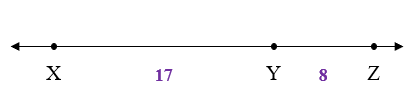
As seen in the figure,
d (X, Z) = d (X, Y) + d (Y, Z)
∴ d (X, Z) = 17 + 8
∴ d (X, Z) = 25 unit
2. X – Z – Y
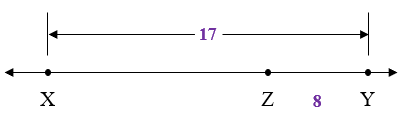
As seen in the figure,
d (X, Z) + d (Z, Y) = d (X, Y)
∴ d (X, Z) + 8 = 17
∴ d (X, Z) = 17 − 8
∴ d (X, Z) = 9 unit
Therefore, d (X, Z) = 25 unit or 9 unit.
6. Sketch proper figure and write the answers of the following questions:
(i) If A – B – C and l (AC) = 11, l (BC) = 6.5, then l (AB) = ?
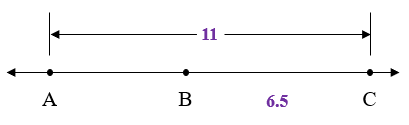
As seen in the figure,
l (AB) + l (BC) = l (AC)
∴ l (AB) + 6.5 = 11
∴ l (AB) = 11 − 6.5
∴ l (AB) = 4.5 unit
(ii) If R – S – T and l (ST) = 3.7, l (RS) = 2.5, then l (RT) = ?
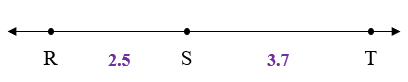
As seen in the figure,
l (RT) = l (RS) + l (ST)
∴ l (RT) = 2.5 + 3.7
∴ l (RT) = 6.2 unit
(iii) If X – Y – Z and l (XZ) = 3\(\sqrt 7\), l (XY) = \(\sqrt 7\), then l (YZ) = ?
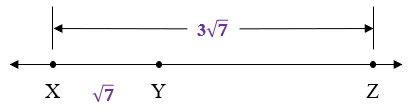
As seen in the figure,
l (XZ) = l (XY) + l (YZ)
∴ 3\(\sqrt 7\) = \(\sqrt 7\) + l (YZ)
∴ 3\(\sqrt 7\) − \(\sqrt 7\) = l (YZ)
∴ 2\(\sqrt 7\) = l (YZ)
i.e. l (YZ) = 2\(\sqrt 7\) unit
7. Which figure is formed by three non-collinear points?
Solution:
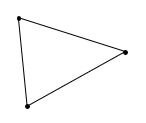
A triangle is formed by three non-collinear points.
This page was last modified on
16 April 2026 at 12:14