- Select the correct alternative from the answers of the questions given below:
Click on the question to view the answer
Click on the question to view the answer
The correct option is: (A) only one
The correct option is: (C) 1
The correct option is: (C) one or three
Solution:
Distance between two points A and B is calculated by subtarcting the smaller co-ordinate from the greater co-ordinate.
d (A, B) = 5 − (−2)
∴ d (A, B) = 5 + 2
∴ d (A, B) = 7
∴ The correct option is: (C) 7
Solution:
P – Q – R
∴ d (P, R) = d (P, Q) + d (Q, R)
∴ 10 = 2 + d (Q, R)
∴ 10 − 2 = d (Q, R)
∴ 8 = d (Q, R)
i.e. d (Q, R) = 8
The correct option is: (B) 8
2. On a number line, co-ordinates of P, Q, R are 3, − 5 and 6 respectively. State with reason whether the following statements are true or false:
- d (P, Q) + d (Q, R) + d (P, R)
- d (P, R) + d (R, Q) + d (P, Q)
- d (R, P) + d (P, Q) + d (R, Q)
- d (P, Q) − d (P, R) + d (Q, R)

Solution:
As seen in the figure:
P: 3, Q: − 5, R: 6
∴ d (R, P) = 6 - 3 = 3 ... (i)
d (P, Q) = 3 − (− 5) = 3 + 5 = 8 ... (ii)
and d (R, Q) = 6 − (− 5) = 6 + 5 = 11 ... (iii)
From (i), (ii) and (iii):
d (R, P) + d (P, Q)
= 8 + 3
= d (R, Q)
Therefore,
- d (P, Q) + d (Q, R) + d (P, R): False
- d (P, R) + d (R, Q) + d (P, Q): False
- d (R, P) + d (P, Q) + d (R, Q): True
- d (P, Q) − d (P, R) + d (Q, R): False
3. Co-ordinates of some pairs of points are given below. Hence find the distance between each pair:
- 3, 6
- − 9, − 1
- − 4, − 5
- 0, − 2
- x + 3, x − 3
- − 25, − 47
- 80, − 85
Solution:
The distance between two points is calculated by subtracting the smaller co-ordinate from the greater co-ordinate.
(i) 3, 6
Let, those points be X and Y respectively.
Now, 3 < 6
∴ d (X, Y) = 6 − 3
∴ d (X, Y) = 3
(ii) − 9, − 1
Let, those points be X and Y respectively.
Now, − 9 < − 1
∴ d (X, Y) = − 1 − (− 9)
∴ d (X, Y) = − 1 + 9
∴ d (X, Y) = 8
(iii) − 4, 5
Let, those points be X and Y respectively.
Now, − 4 < 5
∴ d (X, Y) = 5 − (− 4)
∴ d (X, Y) = 5 + 4
∴ d (X, Y) = 9
(iv) 0, − 2
Let, those points be X and Y respectively.
Now, − 2 < 0
∴ d (X, Y) = 0 − (− 2)
∴ d (X, Y) = 0 + 2
∴ d (X, Y) = 2
(v) x + 3, x − 3
Let, those points be P and Q respectively.
Now, (x − 3) < (x + 3)
∴ d (P, Q) = (x + 3) − (x − 3)
∴ d (P, Q) = x + 3 − x + 3
∴ d (P, Q) = 6
(vi) − 25, − 47
Let, those points be P and Q respectively.
Now, (− 47) < (− 25)
∴ d (P, Q) = (− 25) − (− 47)
∴ d (P, Q) = (− 25) + 47
∴ d (P, Q) = 22
(vii) 80, − 85
Let, those points be P and Q respectively.
Now, (− 85) < 80
∴ d (P, Q) = 80 − (− 85)
∴ d (P, Q) = 80 + 85
∴ d (P, Q) = 165
4. Co-ordinate of point P on a number line is − 7. Find the co-ordinates of points on the number line which are at a distance of 8 units from point P.

Solution:
There are 2 points which are at a distance of 8 from point P.
Let, those points be R and T.
Let, the co-ordinate of T be x and the co-ordinate of R be y.
Now, x > − 7
∴ d (P, T) = x − (− 7)
∴ 8 = x + 7
∴ 8 − 7 = x
∴ 1 = x
i.e. x = 1
∴ The co-ordinate of T is 1.
Also, y < − 7
∴ d (P, R) = (− 7) − y
∴ 8 = − 7 − y
∴ 8 + 7 = − y
∴ 15 = − y
i.e. y = − 15
∴ The co-ordinate of R is − 15.
∴ The co-ordinates of points which are at a distance of 8 from P are 1 and − 15.
5. Answer the following questions:
(i) If A – B – C and d (A, C) = 17, d (B, C) = 6.5 then d (A, B) = ?
Solution:
A – B – C ... (Given)
∴ d (A, B) + d (B, C) = d (A, C)
∴ d (A, B) + 6.5 = 17
∴ d (A, B) = 17 − 6.5
∴ d (A, B) = 10.5
5. Answer the following questions:
(ii) If P – Q – R and d (P, Q) = 3.4, d (Q, R) = 5.7 then d (P, R) = ?
Solution:
P – Q – R ... (Given)
∴ d (P, R) = d (P, Q) + d (Q, R)
∴ d (P, R) = 3.4 + 5.7
∴ d (P, R) = 9.1
6. Co-ordinate of point A on the number line is 1. What are the co-ordinates of points on the number line which are at a distance of 7 units from A?
Solution:

There are 2 points which are at a distance of 7 from point A.
Let, those points be P and Q.
Let, the co-ordinate of Q be x and the co-ordinate of P be y.
The distance between two points is calculated by subtracting the smaller co-ordinate from the greater co-ordinate.
Now, x > 1
∴ d (A, Q) = x − 1
∴ 7 = x − 1
∴ 7 + 1 = x
∴ 8 = x
i.e. x = 8
∴ The co-ordinate of Q is 8.
Also, y < 1
∴ d (A, P) = 1 − y
∴ 7 = 1 − y
∴ y = 1 − 7
∴ y = − 6
∴ The co-ordinate of P is − 6.
∴ The co-ordinates of points which are at a distance of 7 from A are 8 and − 6.
7. Write the following statements in conditional form:
(i) Every rhombus square is a square rhombus.
Solution:
If a quadrilateral is a square, then it is a rhombus.
(ii) The angles in a linear pair are supplementary.
Solution:
If the angles are in linear pair, then they are supplementary.
(iii) A triangle is a figure formed by three segments.
Solution:
If a (closed) figure is formed by three segments, then it is a triangle.
(iv) A number having only two divisors is called a prime number.
Solution:
If a number has only two divisors, then it is a prime number.
8. Write the converse of each of the following statements:
(i) If the sum of the measures of angles in a closed figure is 180°, then the figure is a triangle.
Converse:
If a figure is a triangle, then the sum of the measures of angles in it is 180°.
(ii) If the sum of the measures of two angles is 90°, then they are complements of each other.
Converse:
If two angles are complements of each other, then the sum of their measures is 90°.
(iii) If the corresponding angles formed by a transversal of two lines are congruent, then the two lines are parallel.
Converse:
If two lines are parallel, then the corresponding angles formed by a transversal of the two lines are congruent.
(iv) If the sum of the digits of a number is divisible by 3, then the number is divisible by 3.
Converse:
If a number is divisible by 3, then the sum of its digits is divisible by 3.
9. Write the antecedent (given part) and the consequent (part to be proved) in the following statements:
(i) If all sides of a triangle are congruent, then its all all its angles are congruent.
Given:
In \(\triangle\)ABC,
side AB ≅ side BC ≅ side CA
To Prove:
\(\angle\) A ≅ \(\angle\) B ≅ \(\angle\) C
(ii) The diagonals of a parallelogram bisect each other.
Given:
\(\square\)ABCD is a parallelogram.
Its diagonals AC and BD intersect in point M.
To Prove:
AM = CM and BM = DM.
10*. Draw a labelled figure showing information in each of the following statements and write the antecedent and the consequent:
(i) Two equilateral triangles are similar.
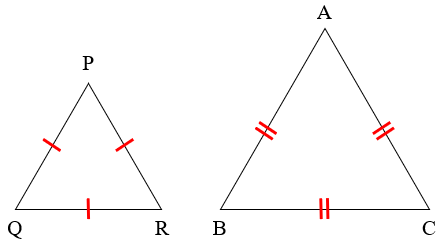
Given:
In \(\triangle\)ABC,
side AB ≅ side BC ≅ side CA
And in \(\triangle\)PQR,
side PQ ≅ side QR ≅ side RP
To Prove:
\(\triangle\) ABC ~ \(\triangle\) PQR
(ii) If angles in a linear pair are congruent then each of them is a right angle.
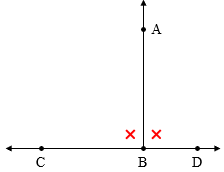
Given:
\(\angle\)ABC and \(\angle\)ABD form a linear pair
and \(\angle\)ABC ≅ \(\angle\)ABD
To Prove:
\(\angle\)ABC = \(\angle\)ABD = 90°
(iii) If the altitudes drawn on two sides of a triangle are congruent, then those two sides are congruent.
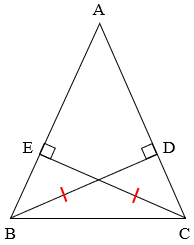
Given:
In \(\triangle\)ABC,
seg BD ⊥ side AC
and seg CE ⊥ side AB
and seg BD ≅ seg CE
To Prove:
side AB ≅ side AC
This page was last modified on
05 July 2026 at 13:15