1. In Fig. 2.5, line RP | | line MS and line DK is their transversal. \(\angle\)DHP = 85°. Find the measures of the following angles:
- \(\angle\)RHD
- \(\angle\)PHG
- \(\angle\)HGS
- \(\angle\)MGK
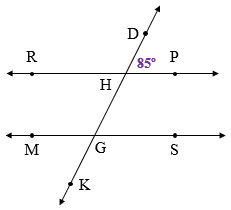
Solution:
\(\angle\)RHD + \(\angle\)DHP = 180° ... (Angles in Linear Pair)
∴ \(\angle\)RHD + 85° = 180° ... (Given)
∴ \(\angle\)RHD = 180° − 85°
∴ \(\angle\)RHD = 95° ... (i)
Also, \(\angle\)PHG = \(\angle\)RHD ... (Vertically Opposite Angles)
But, \(\angle\)RHD = 95° ... [From (i)]
∴ \(\angle\)PHG = 95° ... (ii)
Now, line RP | | line MS and line DK is their transversal
∴ \(\angle\)HGS = \(\angle\)DHP ... (Corresponding Angles)
But, \(\angle\)DHP = 85° ... [Given]
∴ \(\angle\)HGS = 85° ... (iii)
And, \(\angle\)MGK = \(\angle\)HGS ... (Vertically Opposite Angles)
But, \(\angle\)HGS = 85° ... [From (iii)]
∴ \(\angle\)MGK = 85° ... (iv)
2. In Fig. 2.6, line p | | line q and line l and line m are transversals. Measures of some angles are shown. Hence find the measures of \(\angle a\), \(\angle b\), \(\angle c\), \(\angle d\).
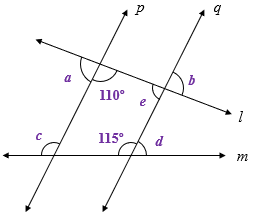
Solution:
\(\angle a\) + 110° = 180° ... (Angles in Linear Pair)
∴ \(\angle a\) = 180° − 110°
∴ \(\angle a\) = 70° ... (i)
Let’s take \(\angle e\) as shown in the figure.
Now, line p | | line q ... (Given)
Consider transversal l.
\(\angle e\) = \(\angle a\) ... (Corresponding Angles)
But, \(\angle a\) = 70° ... [From (i)]
∴ \(\angle e\) = 70° ... (ii)
Also, \(\angle b\) = \(\angle e\) ... (Vertically Opposite Angles)
But, \(\angle e\) = 70° ... [From (ii)]
∴ \(\angle b\) = 70° ... (iii)
Again, line p | | line q ... (Given)
Consider transversal m.
\(\angle c\) = 115° ... (Corresponding Angles) ... (iv)
Finally, \(\angle d\) + 115° = 180° ... (Angles in Linear Pair)
∴ \(\angle d\) = 180° − 115°
∴ \(\angle d\) = 65° ... (v)
3. In Fig. 2.7, line l | | line m and line n | | line p. Find \(\angle a\), \(\angle b\), \(\angle c\) from the given measure of an angle.
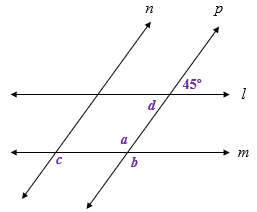
Solution:
Let’s take \(\angle d\) as shown in the figure.
Now, \(\angle d\) = 45° ... (Verticaly Opposite Angles) ... (i)
Also, line l | | line m ... (Given)
Line p is the transversal.
∴ \(\angle d\) + \(\angle a\) = 180° ... (Interior Angles)
∴ 45° + \(\angle a\) = 180° ... [From (i)]
∴ \(\angle a\) = 180° − 45°
∴ \(\angle a\) = 135° ... (ii)
And, \(\angle b\) = \(\angle a\) ... (Verticaly Opposite Angles)
But, \(\angle a\) = 135° ... [From (ii)]
∴ \(\angle b\) = 135° ... (iii)
Finally, line n | | line p ... (Given)
Line m is the transversal.
∴ \(\angle c\) = \(\angle b\) ... (Corresponding Angles)
But, \(\angle b\) = 135° ... [From (iii)]
∴ \(\angle c\) = 135° ... (iv)
4*. In figure 2.8, sides of \(\angle\)PQR and \(\angle\)XYZ are parallel to each other. Prove that, \(\angle\)PQR \(\cong\) \(\angle\)XYZ.
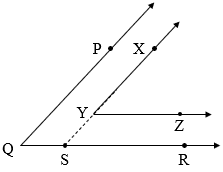
Construction:
Extend ray XY to meet ray QR in point S such that Q – S – R and X – Y – S.
Proof:
PQ | | XY ... (Given)
∴ PQ | | XS ... (\(\because\) X – Y – S)
Consider transversal QR.
∴ \(\angle\)PQR \(\cong\) \(\angle\)XSR ... (Corresponding Angles) ... (i)
Also, QR | | YZ ... (Given)
∴ SR | | YZ ... (\(\because\) Q – S – R)
Consider transversal XS.
∴ \(\angle\)XSR \(\cong\) \(\angle\)XYZ ... (Corresponding Angles) ... (ii)
From (i) and (ii),
\(\angle\)PQR \(\cong\) \(\angle\)XYZ
5. In Fig. 2.9, line AB | | line CD and line PQ is transversal. Measure of one of the angles is given. Find the measures of the following angles:
- \(\angle\)ART
- \(\angle\)CTQ
- \(\angle\)DTQ
- \(\angle\)PRB
Solution:
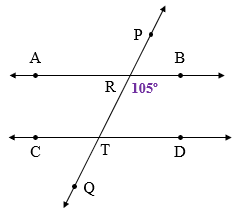
\(\angle\)ART + \(\angle\)BRT = 180° ... (Angles in Linear Pair)
∴ \(\angle\)ART + 105° = 180° ... (Given)
∴ \(\angle\)ART = 180° − 105°
∴ \(\angle\)ART = 75° ... (i)
Also, \(\angle\)CTQ \(\cong\) \(\angle\)ART ... (Corresponding Angles)
But, \(\angle\)ART = 75° ... [From (i)]
∴ \(\angle\)CTQ = 75° ... (ii)
And,, \(\angle\)DTQ \(\cong\) \(\angle\)BRT ... (Corresponding Angles)
But, \(\angle\)BRT = 105° ... (Given)
∴ \(\angle\)DTQ = 105° ... (iii)
Finally, \(\angle\)PRB \(\cong\) \(\angle\)ART ... (Vertically Opposite Angles)
But, \(\angle\)ART = 75° ... [From (i)]
∴ \(\angle\)PRB = 75° ... (iv)
This page was last modified on
12 April 2026 at 09:33