1. In figure 2.18, y = 108° and x = 71°. Are these lines parallel? Justify.
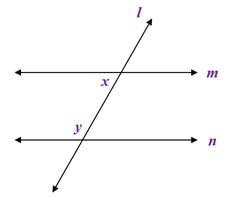
Solution:
\(\angle x + \angle y\) = 71° + 108° ... (Given)
∴ \(\angle x + \angle y\) = 179°
∴ \(\angle x + \angle y\) ≠ 180°
But, x and y are interior angles and they are not supplementary.
∴ line m and line n are not parallel.
2. In figure 2.19, if \(\angle a\) \(\cong\) \(\angle b\) then prove that line l | | line m.
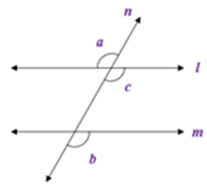
Proof:
Take \(\angle c\) as shown.
Now, \(\angle a\) \(\cong\) \(\angle b\) ... (Given) ... (i)
And, \(\angle a\) \(\cong\) \(\angle c\) ... (Vertically Opposite Angles) ... (ii)
From (i) and (ii),
\(\angle b\) \(\cong\) \(\angle c\)
∴ line l | | line m ... (Corresponding Angles test)
3. In figure 2.20, if \(\angle a \cong \angle b\) and \(\angle x \cong \angle y\) then prove that line l | | line m.
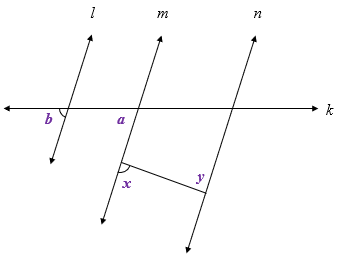
Proof:
\(\angle a \cong \angle b\) ... (Given)
∴ line l | | line m
... (Corresponding Angles Test) ... (i)
∴ line m | | line n
... (Alternate Angles Test) ... (ii)
From (i) and (ii):
∴ line l | | line n ... (Transitivity)
4. In figure 2.21, if ray BA | | ray DE, \(\angle\)C = 50° and \(\angle\)D = 100°. Find the measure of \(\angle\)ABC.
(Hint : Draw a line passing through point C and parallel to line AB.)
Solution:
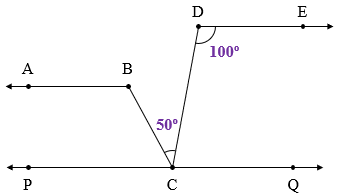
Draw line PQ | | line AB passing through point C such that P – C – Q.
Now, line AB | | line PQ ... (Construction)
and line AB | | line DE ... (Given)
∴ line PQ | | line DE ... (Transitivity)
Consider transversal CD.
\(\angle\)DCQ + \(\angle\)EDC = 180°
... (Interior Angles Theorem)
∴\(\angle\)DCQ + 100° = 180° ... (Given)
∴\(\angle\)DCQ = 180° − 100°
∴\(\angle\)DCQ = 80° ... (i)
Also, \(\angle\)BCQ = \(\angle\)DCQ + \(\angle\)DCB ... (Angle Addition Property)
∴ \(\angle\)BCQ = 80° + 50°
∴ \(\angle\)BCQ = 130° ... (ii)
Finally, line AB | | line PQ ... (Construction)
∴ \(\angle\)ABC = \(\angle\)BCQ ... (Alternate Angles)
But, \(\angle\)BCQ = 130° ... [From (ii)]
∴ \(\angle\)ABC = 130°
5. In figure 2.22, ray AE | | ray BD, ray AF is the bisector of \(\angle\)EAB and ray BC is the bisector of \(\angle\)ABD. Prove that line AF | | line BC.
Proof:
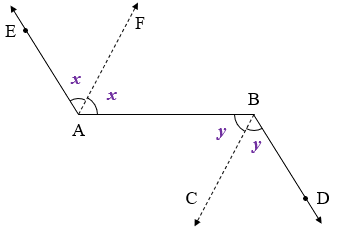
Ray AF is the bisector of \(\angle\)EAB. ... (Given)
∴ \(\angle\)EAF \(\cong\) \(\angle\)BAF = x ... (i)
Also, ray BC is the bisector of \(\angle\)ABD. ... (Given)
∴ \(\angle\)DBC \(\cong\) \(\angle\)ABC = y ... (ii)
Now, ray AE | | ray BD ... (Given)
Consider transversal AB.
\(\angle\)EAB \(\cong\) \(\angle\)ABD ... (Alternate Angles) ... (iii)
∴ \(\angle\)EAF + \(\angle\)BAF = \(\angle\)DBC + \(\angle\)ABC
... (Angle Addition Property)
∴ x + x = y + y ... [From (i) and (ii)]
∴ 2x = 2y
∴ x = y
∴ \(\angle\)BAF = \(\angle\)ABC ... [From (i) and (ii)]
∴ line AF | | line BC ... (Alternate Angles Test)
6. A transversal EF of line AB and line CD intersects the lines at point P and Q respectively. Ray PR and ray QS are parallel and bisectors of \(\angle\)BPQ and \(\angle\)PQC respectively. Prove that line AB | | line CD.
Proof:
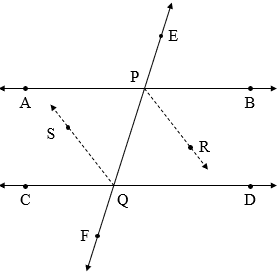
ray PR | | ray QS ... (Given)
Consider transversal EF.
\(\angle\)QPR \(\cong\) \(\angle\)SQP ... (Alternate Angles)
Multiplying both sides by 2,
2\(\angle\)QPR = 2\(\angle\)SQP ... (i)
But, ray PR and ray QS are the bisectors of \(\angle\)BPQ and \(\angle\)PQC respectively. ... (Given)
∴ 2\(\angle\)QPR = \(\angle\)BPQ and 2\(\angle\)SQP = \(\angle\)PQC ... (ii)
From (i) and (ii),
\(\angle\)BPQ \(\cong\) \(\angle\)PQC
∴ line AB | | line CD ... (Alternate Angles Test)
This page was last modified on
10 April 2026 at 22:16