- Select the correct alternative and fill in the blanks in the following statements:
Click on the question to view the answer
Click on the question to view the answer
The correct option is: (C) 180°
Solution:
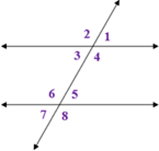
The correct option is: (C) 8
Solution:
The correct option is: (A) 40°
Solution:
In \(\triangle\)ABC,
\(\angle\)A + \(\angle\)B + \(\angle\)C = 180° ... (Theorem)
∴ 76° + 48° + \(\angle\)C = 180°
∴ 124° + \(\angle\)C = 180°
∴ \(\angle\)C = 180° − 124°
∴ \(\angle\)C = 56°
∴ The correct option is: (B) 56°
Solution:
The correct option is: (C) 75°
2*. Ray PQ and ray PR are perpendicular to each other. Points B and A are in the interior and exterior of \(\angle\)QPR respectively. Ray PB and ray PA are perpendicular to each other.
Draw a figure showing all these rays and write:- A pair of complementary angles
- A pair of supplementary angles
- A pair of congruent angles
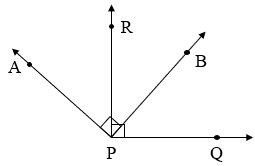
Procedure:
From the given information, let’s draw the figure as per the following instructions:
- Draw ray PQ and ray PR such that they are perpendicular to each other.
- Now, select a point B in the interior of \(\angle\)QPR and a point A in the exterior of \(\angle\)QPR such that the angle between them is 90°.
- Now, draw ray PB and ray PA.
Solution:
(i) A pair of complementary angles is \(\angle\)APR and \(\angle\)RPB.
(ii) A pair of supplementary angles is \(\angle\)APB and \(\angle\)RPQ.
(iii) A pair of congruent angles is \(\angle\)QPB and \(\angle\)RPA.
3. Prove that, if a line is perpendicular to one of the two parallel lines, then it is perpendicular to the other line also.
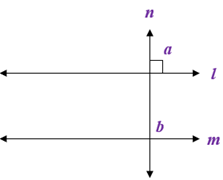
Given:
Line l | | line m and line n is their transversal.
Also, line l \(\perp\) line n.
To Prove:
Line n \(\perp\) line m.
Proof:
Let’s name the angles a and b as shown in the figure.
Now, line l | | line m ... (Given)
∴ \(\angle b\) \(\cong\) \(\angle a\) ... (Corresponding Angles)
But, \(\angle a\) = 90° ... (Given)
∴ \(\angle b\) = 90°
i.e. line n \(\perp\) line m.
4. In figure 2.24, measures of some angles are shown. Using the measures, find \(\angle x\) and \(\angle y\) and hence show that line l | | line m.
Proof:
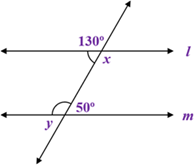
\(\angle x\) = 130°
... (Vertically Opposite Angles)
and \(\angle y\) = 50°
... (Vertically Opposite Angles)
Now, \(\angle x\) + 50°
= 130° + 50°
= 180°
∴ line l | | line m
... (Interior Angles Test)
5. Line AB | | line CD | | line EF and line QP is their transversal. If y ∶ z = 3 ∶ 7, then find the measure of \(\angle x\). (See figure 2.25)
Solution:
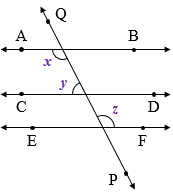
line AB | | line EF ... (Given)
Consider transversal PQ.
∴ \(\angle x\) \(\cong\) \(\angle z\) ... (Alternate angles) ... (i)
But, \(\angle y\) ∶ \(\angle z\) = 3 ∶ 7 ... (Given)
∴ \(\angle y\) ∶ \(\angle x\) = 3 ∶ 7
Now, let the common multiple of these ratios be m.
∴ \(\angle y\) = 3m and \(\angle x\) = 7m ... (ii)
Also, line AB | | line CD ... (Given)
Consider transversal PQ.
∴ \(\angle x\) + \(\angle y\) = 180° ... (Interior angles theorem)
∴ 7m + 3m = 180° ... [From (ii)]
∴ 10m = 180°
∴ m = \(\displaystyle \frac{180°}{10}\)
∴ m = 18° ... (iii)
∴ \(\angle x\) = 7m = 7 × 18°
∴ \(\angle x\) = 126°
6. In figure 2.26, if line q | | line r, line p is their transversal and if a = 80°, find the values of f and g.
Proof:
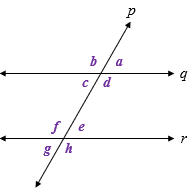
\(\angle g\) \(\cong\) \(\angle a\) ... (Exterior Alternate Angles)
But, \(\angle a\) = 80° ... (Given)
∴ \(\angle g\) = 80° ... (i)
Also, \(\angle f\) + \(\angle g\) = 180° ... (Angles in Linear Pair)
∴ \(\angle f\) + 80° = 180° ... [From (i)]
∴ \(\angle f\) = 180° − 80°
∴ \(\angle f\) = 100° ... (ii)
7. In figure 2.27, if line AB | | line CF and line BC | | line ED, then prove that: \(\angle\)ABC = \(\angle\)FDE.
Proof:
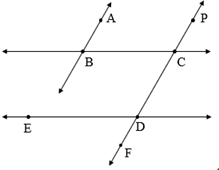
line AB | | line CF ... (Given)
∴ \(\angle\)ABC \(\cong\) \(\angle\)BCD ... (Alternate Angles) ... (i)
Also,
line BC | | line ED ... (Given)
∴ \(\angle\)BCD \(\cong\) \(\angle\)FDE ... (Corresponding Angles) ... (ii)
From (i) and (ii):
\(\angle\)ABC \(\cong\) \(\angle\)FDE ... (Transitivity)
i.e. \(\angle\)ABC = \(\angle\)FDE
8. In figure 2.28, line PS is a transversal of parallel line AB and line CD. If Ray QX, ray QY, ray RX, ray RY are angle bisectors, then prove that \(\Box\)QXRY is a rectangle.
Proof:
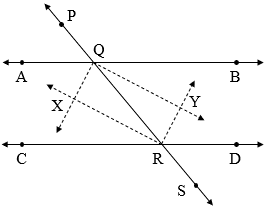
Line AB | | line CD ... (Given)
Consider transversal PS.
∴ \(\angle\)AQR = \(\angle\)DRQ ... (Alternate Angles)
∴ \(\displaystyle \frac{1}{2}\) \(\angle\)AQR = \(\displaystyle \frac{1}{2}\) \(\angle\)DRQ ... (i)
Now, ray QX is the bisector of \(\angle\)AQR ... (Given)
∴ \(\angle\)XQR = \(\displaystyle \frac{1}{2}\) \(\angle\)AQR ... (ii)
Also, ray RY is the bisector of \(\angle\)DRQ ... (Given)
∴ \(\angle\)YRQ = \(\displaystyle \frac{1}{2}\) \(\angle\)DRQ ... (iii)
From (i), (ii) and (iii):
∴ \(\angle\)XQR = \(\angle\)YRQ
∴ QX | | RY ... (Alternate Angles Test) ... (iv)
Similarly, line AB | | line CD ... (Given)
Consider transversal PS.
∴ \(\angle\)BQR = \(\angle\)CRQ ... (Alternate Angles)
∴ \(\displaystyle \frac{1}{2}\) \(\angle\)BQR = \(\displaystyle \frac{1}{2}\) \(\angle\)CRQ ... (v)
Now, ray QY is the bisector of \(\angle\)BQR ... (Given)
∴ \(\angle\)YQR = \(\displaystyle \frac{1}{2}\) \(\angle\)BQR ... (vi)
Also, ray RX is the bisector of \(\angle\)CRQ ... (Given)
∴ \(\angle\)XRQ = \(\displaystyle \frac{1}{2}\) \(\angle\)CRQ ... (vii)
From (v), (vi) and (vii):
∴ \(\angle\)YQR = \(\angle\)XRQ
∴ QY | | RX ... (Alternate Angles Test) ... (viii)
From (iv) and (viii),
\(\Box\)QXRY is a parallelogram. ... (Definition of a Parallelogram) ... (ix)
∴ \(\angle\)BQR + \(\angle\)DRQ = 180° ... (Interior Angles)
Dividing both sides by 2,
\(\displaystyle \frac{1}{2}\) \(\angle\)BQR + \(\displaystyle \frac{1}{2}\) \(\angle\)DRQ = \(\displaystyle \frac{180°}{2}\)
∴ \(\angle\)YQR + \(\angle\)YRQ = 90° ... [From (vi) and (iii)] ... (x)
Now, in \(\triangle\)YQR,
∴ \(\angle\)YQR + \(\angle\)YRQ + \(\angle\)QYR = 180° ... (Theorem)
∴ 90° + \(\angle\)QYR = 180° ... [From (x)]
∴ \(\angle\)QYR = 180° − 90°
∴ \(\angle\)QYR = 90° ... (xi)
A parallelogram is a rectangle if one of its angles is 90°.
∴ \(\Box\)QXRY is a rectangle. ... [From (ix) and (xi)]
This page was last modified on
13 April 2026 at 13:25