1. Diagonals of a parallelogram WXYZ intersect each other at point O. If \(\angle\)XYZ = 135° then what is the measure of \(\angle\)XWZ and \(\angle\)YZW? If l(OY) = 5 cm, then l(WY) = ?
Solution:
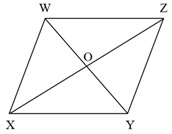
\(\angle\)XWZ \(\cong\) \(\angle\)XYZ
... (Opposite angles of a parallelogram)
But, \(\angle\)XYZ = 135° ... (Given)
∴ \(\angle\)XWZ = 135° ... (i)
Also, \(\angle\)YZW + \(\angle\)XYZ = 180°
... (Adjacent angles of a parallelogram)
∴ \(\angle\)YZW + 135° = 180°
∴ \(\angle\)YZW = 180° − 135°
∴ \(\angle\)YZW = 45° ... (ii)
Now, the diagonals of a parallelogram bisect each other ... (Theorem)
∴ l(WY) = 2 × l(OY)
∴ l(WY) = 2 × 5
∴ l(WY) = 10 cm ... (iii)
2. In a parallelogram ABCD, \(\angle\)A = (3x + 12)°, \(\angle\)B = (2x − 32)° then find the value of x and then find the measures of \(\angle\)C and \(\angle\)D.
Solution:
We know that adjacent angles of a parallelogram are supplementary.
∴ \(\angle\)A + \(\angle\)B = 180°
∴ (3x + 12)° + (2x − 32)° = 180°
∴ 3x + 12 + 2x − 32 = 180°
∴ 5x − 20 = 180
∴ 5x = 180 + 20
∴ 5x = 200
∴ x = \(\displaystyle \frac{200}{5}\)
∴ x = 40 ... (i)
Now, the opposite angles of a parallelogram are congruent. ... (Theorem)
∴ \(\angle\)C = \(\angle\)A
∴ \(\angle\)C = 3x + 12
∴ \(\angle\)C = 3 × 40 + 12
∴ \(\angle\)C = 120 + 12
∴ \(\angle\)C = 132° ... (ii)
Also, \(\angle\)D = \(\angle\)B
∴ \(\angle\)D = 2x − 32
∴ \(\angle\)B = 2 × 40 − 32
∴ \(\angle\)B = 80 − 32
∴ \(\angle\)B = 48° ... (iii)
3. Perimeter of a parallelogram is 150 cm. One of its side is greater than the other side by 25 cm. Find the lengths of all sides.
Solution:
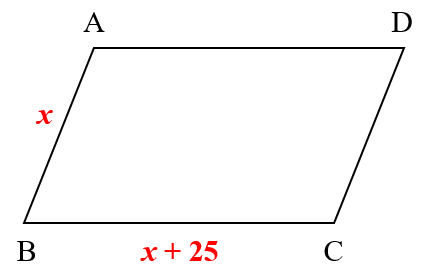
Let, ABCD be the given parallelogram
Let, AB = x cm
Then, BC = (x + 25) cm
Now, the opposite sides of a parallelogram are congruent. ... (Theorem)
∴ AB = CD = x cm
and BC = DA = (x + 25) cm
From the given information:
∴ AB + BC + CD + DA = 150
∴ x + (x + 25) + x + (x + 25) = 150
∴ x + x + 25 + x + x + 25 = 150
∴ 4x + 50 = 150
∴ 4x = 150 − 50
∴ 4x = 100
∴ x = \(\displaystyle \frac{100}{4}\)
∴ x = 25 ... (i)
∴ AB = CD = x = 25 cm
∴ BC = DA = x + 25 = 25 + 25 = 50 cm
∴ The lengths of all sides are 25 cm, 50 cm, 25 cm, and 50 cm.
4. If the ratio of the measures of two adjacent angles of a parallelogram is 1 ∶ 2, find the measures of all angles of the parallelogram.
Solution:
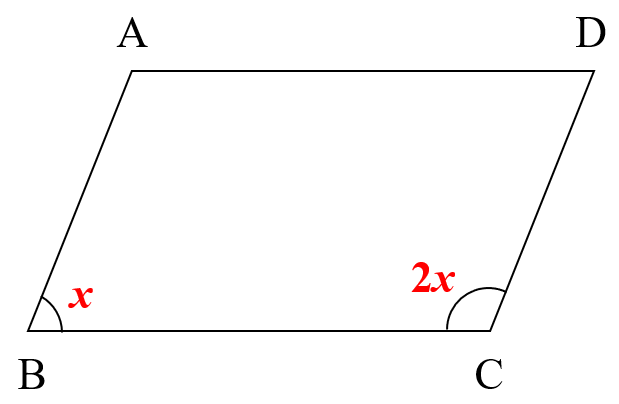
Let, ABCD be the given parallelogram
Let, \(\angle\)A = x
Then, \(\angle\)B = 2x
Now, the adjacent angles of a parallelogram are supplementary. ... (Theorem)
∴ \(\angle\)A + \(\angle\)B = 180°
∴ x + 2x = 180°
∴ 3x = 180°
∴ x = \(\displaystyle \frac{180}{3}\)
∴ x = 60° ... (i)
Also, the opposite angles of a parallelogram are congruent. ... (Theorem)
∴ \(\angle\)A = \(\angle\)C = x = 60°
and \(\angle\)B = \(\angle\)D = 2x = 2 × 60° = 120°
∴ The measures of all angles are 60°, 120°, 60°, and 120°.
5. The diagonals of a parallelogram intersect each other at point O. If AO = 5, BO = 12 and AB = 13, then show that \(\Box\)ABCD is a rhombus.
Solution:
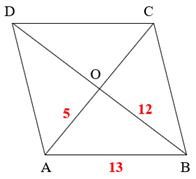
AB = 13 ... (Given)
∴ AB² = 13² = 169 ... (i)
Also, AO = 5 and BO = 12 ... (Given)
∴ AO² = 5² = 25 ... (ii)
∴ BO² = 12² = 144 ... (iii)
∴ AO² + BO² = 25 + 144 = 169 ... (iv)
From (i) and (iv):
∴ AB² = AO² + BO²
∴ \(\triangle\)AOB is a right angled triangle.
... (Converse of Pythagoras’ Theorem)
∴ AO \(\perp\) BO
i.e. diagonal AC \(\perp\) diagonal BD
∴ \(\Box\)ABCD is a rhombus.
[A parallelogram is a rhombus if its diagonals are perpendicular to each other]
6. In the figure 5.12, \(\Box\)PQRS and \(\Box\)ABCR are two parallelograms. If \(\angle\)P = 110°, then find the measures of the remaining angles of \(\Box\)ABCR.
Solution:
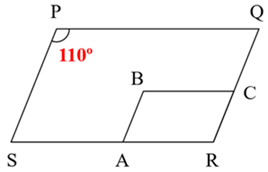
In | |m PQRS,
\(\angle\)QRS \(\cong\) \(\angle\)SPQ
... (Opposite angles of a | |m)
But, \(\angle\)SPQ = 110° ... (Given)
∴ \(\angle\)QRS = 110°
i.e. \(\angle\)CRA = 110° ... (i)
∴ In | |m ABCR,
\(\angle\)ABC \(\cong\) \(\angle\)CRA
... (Opposite angles of a | |m)
But, \(\angle\)CRA = 110° ... [From (i)]
∴ \(\angle\)ABC = 110° ... (ii)
Now, in | |m ABCR,
\(\angle\)BCR + \(\angle\)ABC = 180°
... (Adjacent angles of a | |m)
∴ \(\angle\)BCR + 110° = 180°
∴ \(\angle\)BCR = 180° - 110°
∴ \(\angle\)BCR = 70° ... (iii)
∴ \(\angle\)RAB = 70° ... (iv)
7. In figure 5.13, \(\Box\)ABCD is a parallelogram. Point E is on the ray AB such that BE = AB. Then prove that line ED bisects seg BC at point F.
Proof:
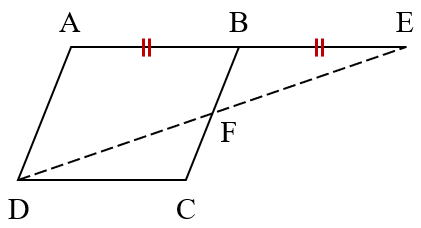
BE = AB ... (Given)
But, AB = DC ... (Opposite sides of a | |m)
∴ BE = DC ... (i)
Also, AB || DC ... (Opposite sides of a | |m)
∴ AE || DC ... (∵ A – B – E)
Consider transversal DE.
∴ \(\angle\)BEF \(\cong\) \(\angle\)CDF ... (Alternate angles) ... (ii)
Consider transversal BC.
∴ \(\angle\)EBF \(\cong\) \(\angle\)DCF ... (Alternate angles) ... (iii)
Now, in \(\triangle\)BEF and \(\triangle\)CDF,
\(\angle\)BEF \(\cong\) \(\angle\)CDF ... [From (ii)]
seg BE \(\cong\) seg CD ... [From (i)]
\(\angle\)EBF \(\cong\) \(\angle\)DCF ... [From (iii)]
∴ \(\triangle\)BEF \(\cong\) \(\triangle\)CDF ... (A S A test)
∴ seg BF \(\cong\) seg CF ... (c s c t)
i.e. F is the midpoint of seg BC.
∴ Line ED bisects seg BC at point F.
This page was last modified on
18 March 2026 at 12:34