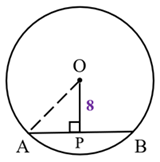
1. Distance of chord AB from the centre of a circle is 8 cm. Length of the chord AB is 12 cm. Find the diameter of the circle.
Solution:
Draw seg OA.
Now, AB = 12 cm ... (Given)
∴ \(\displaystyle \text {AP} = \frac{1}{2} \times \text{AB}\)
... (Perpendicular drawn from the centre of a circle to the chord bisects the chord)
∴ \(\displaystyle \text {AP} = \frac{1}{2} \times 12\)
∴ \(\displaystyle \text {AP} = 6\) cm ... (i)
Now, in right \(\triangle \text{OPA}\),
\(\displaystyle \text {OA}^2 = \text {OP}^2 + \text {AP}^2\) ... (Pythagoras’ Theorem)
∴ \(\displaystyle \text {OA}^2 = 8^2 + 6^2\)
∴ \(\displaystyle \text {OA}^2 = 64 + 36\)
∴ \(\displaystyle \text {OA}^2 = 100\)
∴ \(\displaystyle \text {OA} = \sqrt{100}\)
∴ \(\displaystyle \text {OA} = 10\)
∴ r = 10 cm ... (ii)
∴ d = 2r = 2 × 10 = 20 cm... (iii)
∴ The diameter of the circle is 20 cm.
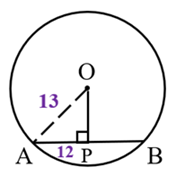
2. Diameter of a circle is 26 cm and length of a chord of a circle is 24 cm. Find the distance of the chord from the centre.
Solution:
d = 26 cm ... (Given)
r = \(\displaystyle \frac{d}{2}\) = \(\displaystyle \frac{26}{2}\) = 13 cm ... (i)
Now, OP \(\perp\) AB
∴ \(\displaystyle \text {AP} = \frac{1}{2} \times \text{AB}\)
... (Perpendicular drawn from the centre of a circle to the chord bisects the chord)
But, AB = 24 cm ... (Given)
AP = \(\displaystyle \frac{AB}{2}\) = \(\displaystyle \frac{24}{2}\) = 12 cm ... (ii)
Now, in right \(\triangle \text{OPA}\),
\(\displaystyle \text {OP}^2 + \text {AP}^2 = \text {OA}^2\) ... (Pythagoras’ Theorem)
∴ \(\displaystyle \text {OP}^2 + 12^2 = 13^2\)
∴ \(\displaystyle \text {OP}^2 + 144 = 169\)
∴ \(\displaystyle \text {OP}^2 = 169 - 144\)
∴ \(\displaystyle \text {OP}^2 = 25\)
∴ \(\displaystyle \text {OP} = \sqrt{25}\)
∴ \(\displaystyle \text {OP} = 5\) cm... (iii)
∴ The distance of the chord from the centre is 5 cm.
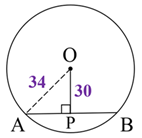
3. Radius of a circle is 34 cm and the distance of the chord from the centre is 30 cm, find the length of the chord.
Solution:
r = 34 cm ... (Given)
OP = 30 cm ... (Given)
Now, OP \(\perp\) AB
∴ \(\displaystyle \text {AP} = \frac{1}{2} \times \text{AB}\)
... (Perpendicular drawn from the centre of a circle to the chord bisects the chord)
Now, in right \(\triangle \text{OPA}\),
\(\displaystyle \text {OP}^2 + \text {AP}^2 = \text {OA}^2\) ... (Pythagoras’ Theorem)
∴ \(\displaystyle 30^2 + \text {AP}^2 = 34^2\)
∴ \(\displaystyle 900 + \text {AP}^2 = 1156\)
∴ \(\displaystyle \text {AP}^2 = 1156 - 900\)
∴ \(\displaystyle \text {AP}^2 = 256\)
∴ \(\displaystyle \text {AP} = \sqrt{256}\)
∴ \(\displaystyle \text {AP} = 16\) cm... (i)
∴ AB = 2 × AP = 2 × 16 = 32 cm ... (ii)
∴ The length of the chord is 32 cm.
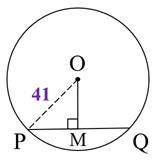
4. Radius of a circle with centre O is 41 units. Length of a chord PQ is 80 units, find the distance of the chord from the centre of the circle.
Solution:
PQ = 80 units ... (Given)
And OM \(\perp\) PQ ... (Given)
∴ \(\displaystyle \text{PM} = \frac{1}{2} \times \text{PQ}\)
... (Perpendicular drawn from the centre of a circle to the chord bisects the chord)
∴ \(\displaystyle \text{PM} = \displaystyle \frac{1}{2} \times 80\)
∴ \(\displaystyle \text{PM} = \displaystyle \text{ 40 units}\) ... (i)
Now, in right \(\triangle \text{OMP}\),
\(\displaystyle \text {OP}^2 = \text {OM}^2 + \text {PM}^2\) ... (Pythagoras’ Theorem)
∴ \(\displaystyle 41^2 = 40^2 + \text {OM}^2\)
∴ \(\displaystyle 1681 = 1600 + \text {OM}^2\)
∴ \(\displaystyle 1681 - 1600 = \text {OM}^2\)
∴ \(\displaystyle 81 = \text {OM}^2\)
i.e. \(\displaystyle \text {OM}^2 = 81\)
∴ \(\displaystyle \text {OM} = \sqrt{81}\)
∴ \(\displaystyle \text {OM} = 9\) units... (ii)
∴ The distance of the chord from the centre of the circle is 9 units.
5. In figure 6.9, the centre of two circles is O. Chord AB of bigger circle intersects the smaller circle in points P and Q. Show that AP = BQ.
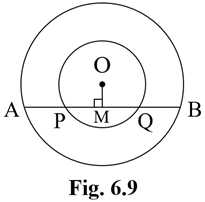
Draw OM ⊥ AB.
A perpendicular drawn from the centre of a circle on its chord, bisects the chord. ... (Theorem)
∴ In the larger circle, OM bisects the chord AB.
∴ \(\displaystyle \text{AM} = \text{BM}\) ... (i)
and in the smaller circle, OM bisects the chord PQ.
∴ \(\displaystyle \text{PM} = \text{QM}\) ... (ii)
∴ Subtracting (ii) from (i),
\(\displaystyle \text{AM} - \text{PM} = \text{BM} - \text{QM}\)
∴ \(\displaystyle \text{AP} = \text{BQ}\)
6. Prove that, if a diameter of a circle bisects two chords of the circle then those two chords are parallel to each other.
Proof:
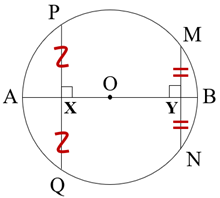
Given:
AB is a diameter of a circle with centre O.
Diameter AB bisects chords PQ and MN in points X and Y respectively.
To Prove:
Chord PQ \(\text{| |}\) Chord MN
Proof:
X is the midpoint of chord PQ. ... (Given)
Diameter AB bisects chord PQ at point X.
∴ seg OX \(\perp\) chord PQ ... (Theorem)
∴ \(\angle \text{OXP} = 90^\circ\) ... (i)
Also, Y is the midpoint of chord MN. ... (Given)
∴ seg OY \(\perp\) chord MN ... (Theorem)
∴ \(\angle \text{OYM} = 90^\circ\) ... (ii)
Adding (i) and (ii):
\(\angle \text{OXP} + \angle \text{OYM} = 90^\circ + 90^\circ\)
∴ \(\angle \text{OXP} + \angle \text{OYM} = 180^\circ\)
∴ Chord PQ \(\text{| |}\) Chord MN ... (Interior angles test)
∴ If a diameter of a circle bisects two chords of the circle then those two chords are parallel to each other.
This page was last modified on
10 March 2026 at 22:28