1. Radius of a circle is 10 cm. There are two chords of length 16 cm each. What will be the distance of these chords from the centre of the circle?
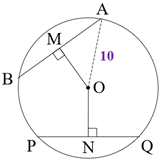
Solution:
OM \(\perp\) AB ... (Given)
∴ \(\text{AM} = \displaystyle \frac{1}{2} \times \text{AB}\) ... (Theorem)
∴ \(\text{AM} = \displaystyle \frac{1}{2} \times 16\)
∴ \(\text{AM} = 8\) ... (i)
Now, in right \(\triangle\)OMA,
\(\text{OM}^2 + \text{AM}^2 = \text{OA}^2\) ... (Pythagoras’ Theorem)
∴ \(\text{OM}^2 + 8^2 = 10^2\)
∴ \(\text{OM}^2 + 64 = 100\)
∴ \(\text{OM}^2 = 100 - 64\)
∴ \(\text{OM}^2 = 36\)
∴ \(\text{OM} = \sqrt{36}\)
∴ \(\text{OM} = 6\) cm ... (ii)
Now, congruent chords of a circle are equidistant from the centre. ... (Theorem)
∴ ON = OM
∴ ON = 6 cm ... (iii)
The distance of the chords from the centre of the circle is 6 cm.
2. In a circle with radius 13 cm, two equal chords are at a distance of 5 cm from the centre. Find the lengths of the chords.
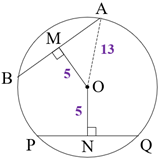
Solution:
In right \(\triangle\)OMA,
\(\text{OA}^2 = \text{OM}^2 + \text{AM}^2\) ... (Pythagoras’ Theorem)
∴ \(13^2 = 5^2 + \text{AM}^2\)
∴ \(169 = 25 + \text{AM}^2\)
∴ \(169 - 25 = \text{AM}^2\)
∴ \(144 = \text{AM}^2\)
i.e. \(\text{AM}^2 = 144\)
∴ \(\text{AM} = \sqrt{144}\)
∴ \(\text{AM} = 12\) cm ... (i)
Now, OM \(\perp\) AB ... (Given)
∴ \(\text{AB} = 2\text{AM}\) ... (Theorem)
∴ \(\text{AB} = 2 \times 12 = 24\) cm ... (ii)
Now, the chords of a circle equidistant from the centre are congruent. ... (Theorem)
∴ PQ = AB
∴ PQ = 24 cm ... (iii)
The lengths of the chords are 24 cm each.
3. Seg PM and seg PN are congruent chords of a circle with centre C. Show that the ray PC is the bisector of \(\angle\)NPM.
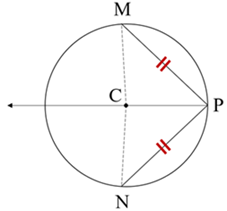
Proof:
Draw seg CM and seg CN.
In \(\triangle\)CMP and \(\triangle\)CNP,
seg CM = seg CN ... (Radii of the same circle)
seg PM = seg PN ... (Given)
seg CP = seg CP ... (Common side)
∴ \(\triangle\)CMP \(\cong\) \(\triangle\)CNP ... (SSS Test)
∴ \(\angle\)MPC = \(\angle\)NPC ... (c. a. c. t.)
∴ Ray PC is the bisector of \(\angle\)NPM. ... (Definition of Angle Bisector)
This page was last modified on
11 March 2026 at 22:22