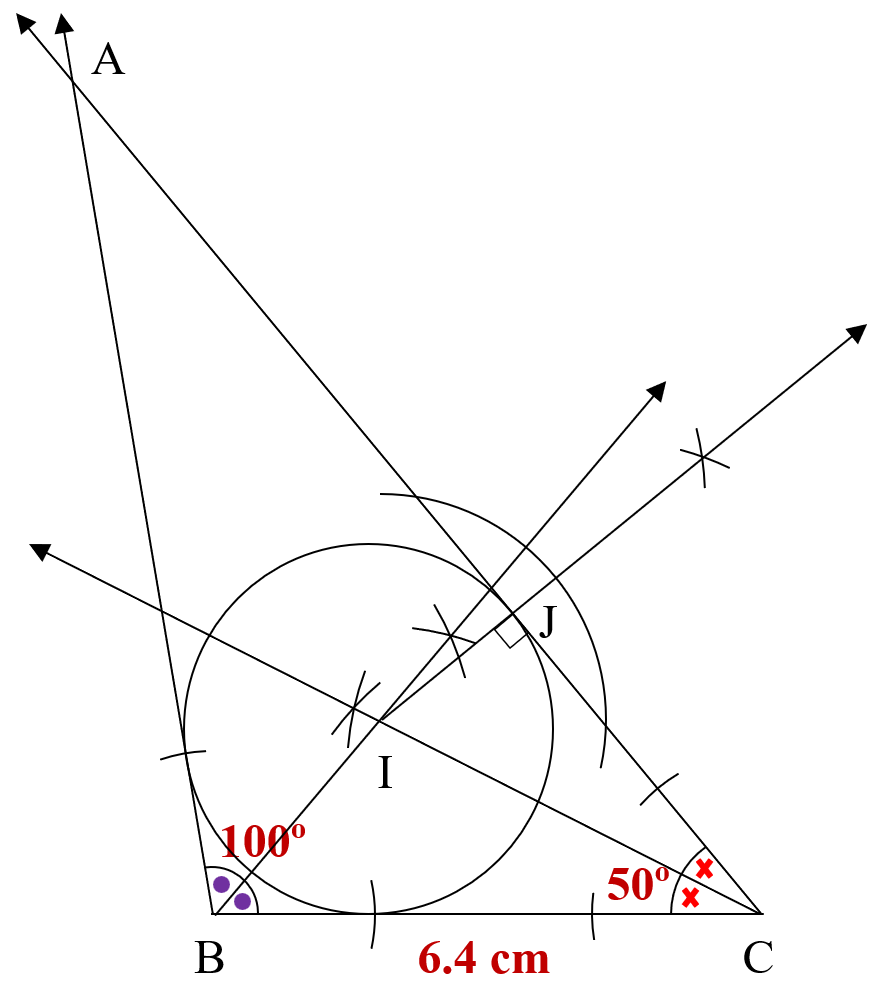
1. Construct \(\triangle \text{ABC}\) such that \(\angle \text{B} = 100^\circ\), \(\text {BC} = 6.4 \, \text{ cm}\), \(\angle \text{C} = 50^\circ\) and construct its incircle.
Solution:
- Draw BC = 6.4 cm
- At point B, make an angle of 100°
- At point C, make an angle of 50°
- Let the rays intersect at point A
- Thus, \(\triangle\)ABC is drawn
- Draw angle bisectors of \(\angle\)B and \(\angle\)C
- Let the bisectors intersect at point I
- Draw IJ \(\perp\) BC
- With I as centre, and IJ as radius, draw a circle.
- This is the required incircle.
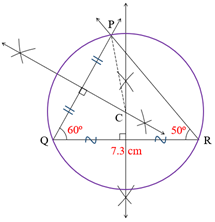
2. Construct \(\triangle \text{PQR}\) such that \(\angle \text{P} = 70^\circ\), \(\angle \text{R} = 50^\circ\), and \(\text{QR} = 7.3 \, \text{cm}\). Construct its circumcircle.
Solution:
In \(\triangle\)PQR,
∴ \(\angle\)P + \(\angle\)Q + \(\angle\)R = 180° ... (Theorem)
∴ 70° + \(\angle\)Q + 50° = 180°
∴ 120° + \(\angle\)Q = 180°
∴ \(\angle\)Q = 180° − 120° = 60°
∴ \(\angle\)Q = 60° ... (i)
Now, we can construct the triangle.
- Draw QR = 7.3 cm
- At point Q, make an angle of 60°
- At point R, make an angle of 50°
- Let the rays intersect at point P
- Thus, \(\triangle\)PQR is drawn
- Draw perpendicular bisector of side QR
- Draw perpendicular bisector of side PQ
- Let the bisectors intersect at point C.
- With C as centre and CP as radius, draw a circle.
- This is the required circumcircle.
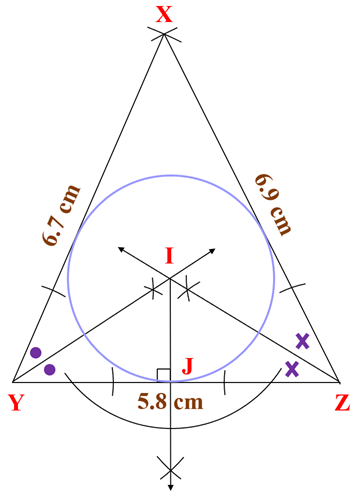
3. Construct \(\triangle \text{XYZ}\) such that XY = 6.7 cm, YZ = 5.8 cm, XZ = 6.9 cm. Construct its incircle.
Solution:
- Draw YZ = 5.8 cm
- With Y as centre and radius 6.7 cm, draw an arc
- With Z as centre and radius 6.9 cm, draw an arc intersecting the previous arc at X
- Draw \(\triangle\)XYZ
- Draw angle bisectors of \(\angle\)Y and \(\angle\)Z
- Let the bisectors intersect at point I
- Draw IJ \(\perp\) YZ
- With I as centre, and IJ as radius, draw a circle.
- This is the required incircle.
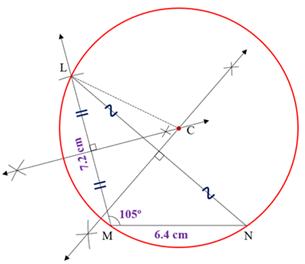
4. In \(\triangle\)LMN, LM = 7.2 cm, \(\angle\)M = 105°, MN = 6.4 cm, then draw \(\triangle\)LMN and construct its circumcircle.
Solution:
- Draw MN = 6.4 cm
- Make an angle of 105° at point M.
- Take a distance of 7.2 cm in the compass. With M as centre, draw an arc on the ray drawn in the previous step. Name the point L.
- Draw seg LN.
- Thus, \(\triangle\)LMN is constructed.
- Draw the perpendicular bisector of LM.
- Draw the perpendicular bisector of LN.
- Let the bisectors intersect at point C.
- With C as centre and CL as radius, draw a circle.
- This is the required circumcircle.
5. Construct \(\triangle\)DEF such that DE = EF = 6 cm, \(\angle\)F = 45° and construct its circumcircle.
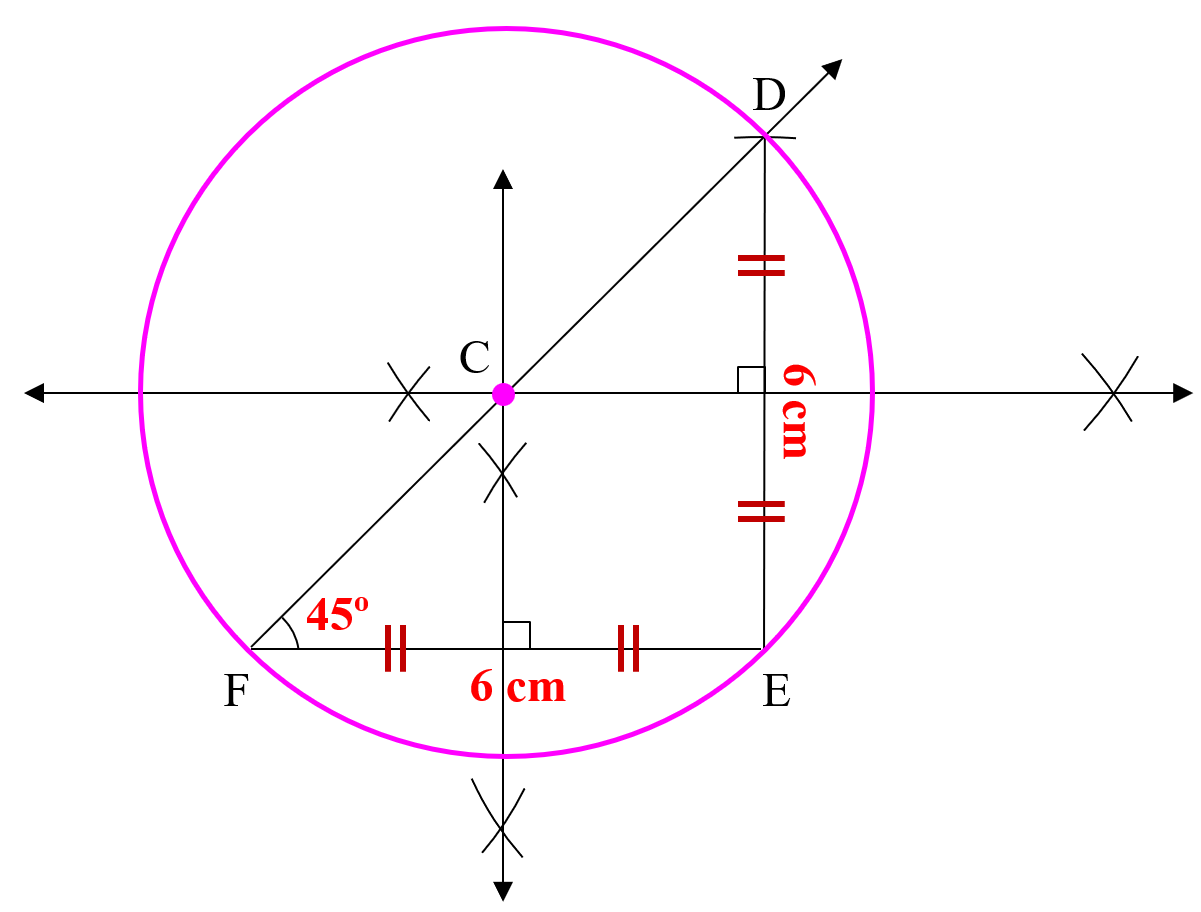
Solution:
- Draw FE = 6 cm
- At point F, make an angle of 45°
- With E as centre and radius 6 cm, draw an arc intersecting the ray drawn in the previous step. Name the point D.
- Draw seg DE.
- Thus, \(\triangle\)DEF is constructed.
- Draw the perpendicular bisector of FE.
- Draw the perpendicular bisector of DE.
- Let the bisectors intersect at point C.
- With C as centre and CF as radius, draw a circle.
- This is the required circumcircle.
This page was last modified on
13 March 2026 at 08:55