- Choose correct alternative answer and fill in the blanks:
Click on the question to view the answer
Click on the question to view the answer
Solution:
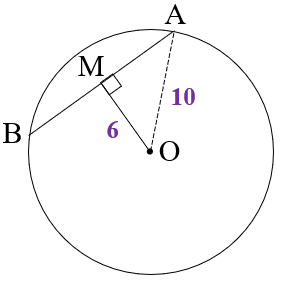
In right \(\triangle\)AMO,
OA² = OM² + AM² ... (Pythgoras’ Theorem)
∴ 10² = 6² + AM²
∴ 100 = 36 + AM²
∴ 100 − 36 = AM²
∴ 64 = AM²
i.e. AM² = 64
∴ AM = \(\sqrt{64}\)
∴ AM = 8 cm ... (i)
Now, AB = 2AM
∴ AB = 2 × 8
∴ AB = 16 cm ... (ii)
∴ The correct option is: (C) 16 cm
The correct option is: (C) incentre
The correct option is: (A) circumcircle
Solution:
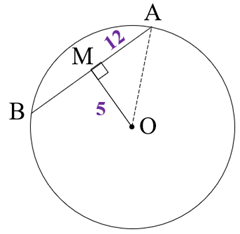
AB = 24 cm ... (Given)
And OM \(\perp\) AB ... (Given)
∴ AM = \(\displaystyle \frac{1}{2}\) AB ... (Perpendicular drawn from the centre of a circle to a chord bisects the chord)
∴ AM = \(\displaystyle \frac{1}{2}\) AB
∴ AM = \(\displaystyle \frac{1}{2}\) × 24
∴ AM = 12 cm ... (i)
In right \(\triangle\)AMO,
OA² = OM² + AM² ... (Pythgoras’ Theorem)
∴ OA² = 5² + 12²
∴ OA² = 25 + 144
∴ OA² = 169
∴ OA = \(\sqrt{169}\)
∴ OA = 13 cm
∴ The correct option is: (B) 13 cm
Solution:
The longest chord of a circle is its diameter.
Diameter = 2 × Radius
Diameter = 2 × 2.9 cm
Diameter = 5.8 cm
∴ The correct option is: (D) 5.8 cm
Solution:
Radius of the circle = 4 cm
Distance of point P from the centre O = l(OP) = 4.2 cm
Since, 4.2 cm > 4 cm, point P lies outside the circle.
∴ The correct option is: (C) Outside the circle
Solution:
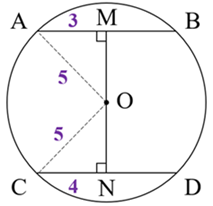
AB = 6 cm ... (Given)
And OM \(\perp\) AB ... (Given)
∴ AM = \(\displaystyle \frac{1}{2}\) AB ... (Perpendicular drawn from the centre of a circle to a chord bisects the chord)
∴ AM = \(\displaystyle \frac{1}{2}\) AB
∴ AM = \(\displaystyle \frac{1}{2}\) × 6
∴ AM = 3 cm ... (i)
Also, CD = 8 cm ... (Given)
And ON \(\perp\) CD ... (Given)
∴ CN = \(\displaystyle \frac{1}{2}\) CD ... (Perpendicular drawn from the centre of a circle to a chord bisects the chord)
∴ CN = \(\displaystyle \frac{1}{2}\) × 8
∴ CN = 4 cm ... (ii)
Now, in right \(\triangle\)AMO,
OA² = OM² + AM² ... (Pythgoras’ Theorem)
∴ 5² = OM² + 3²
∴ 25 = OM² + 9
∴ 25 − 9 = OM²
∴ 16 = OM²
i.e. OM² = 16
∴ OM = \(\sqrt{16}\)
∴ OM = 4 cm ... (iii)
and, in right \(\triangle\)CNO,
OA² = ON² + CN² ... (Pythgoras’ Theorem)
∴ 5² = ON² + 4²
∴ 25 = ON² + 16
∴ 25 − 16 = ON²
∴ 9 = ON²
i.e. ON² = 9
∴ ON = \(\sqrt{9}\)
∴ ON = 3 cm ... (iv)
Now, M – O – N is a straight line.
∴ MN = OM + ON
∴ MN = 4 + 3 ... [From (iii) and (iv)]
∴ MN = 7 cm ... (v)
∴ The correct option is: (D) 7 cm
2. Construct incircle and circumcircle of an equilateral \(\triangle\)DSP with side 7.5 cm. Measure the radii of both the circles and find the ratio of radius of circumcircle to the radius of incircle.
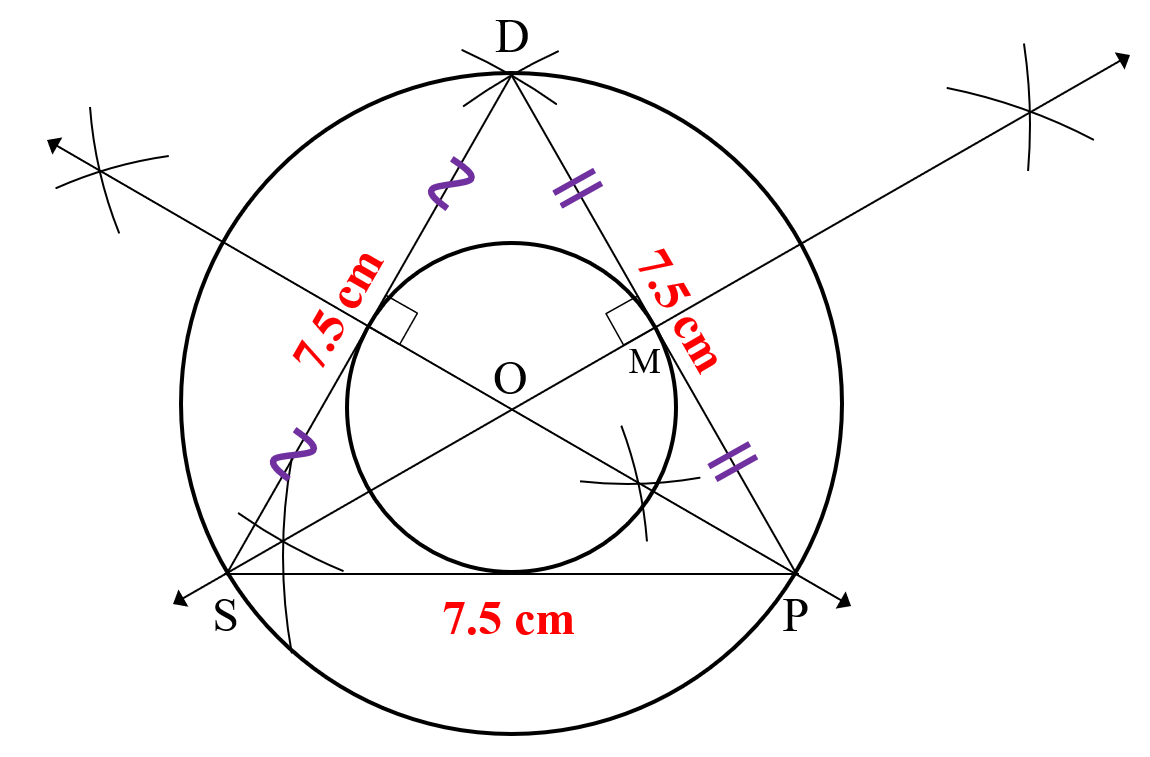
Solution:
- Draw SP = 7.5 cm.
- Centre S, radius 7.5 cm, draw an arc.
- Centre P, radius 7.5 cm, draw an arc intersecting the previous arc at point D
- Draw seg DS and seg DP.
- Thus, \(\triangle\)DSP is drawn
- Draw perpendicular bisector of side DS
- Draw perpendicular bisector of side DP
- Let the bisectors intersect at point O.
- With O as centre and OS as radius, draw a circle.
- This is the required circumcircle.
- With O as centre and OM as radius, draw a circle.
- This is the required incircle.
- Measure the radius of circumcircle (OS) and incircle (OM).
- OS = 4.4 cm and OM = 2.2 cm
Ratio of radius of circumcircle to the radius of incircle
\(\displaystyle = \frac{\text{OS}}{\text{OM}}\)
\(\displaystyle = \frac{4.4}{2.2}\)
\(\displaystyle = \frac{44}{22}\)
\(\displaystyle = \frac{2}{1}\)
∴ The ratio of radius of circumcircle to the radius of incircle is 2 ∶ 1.
3. Construct \(\triangle\)NTS where NT = 5.7 cm, TS = 7.5 cm and \(\angle\)NTS = 110° and draw incircle and circumcircle of it.
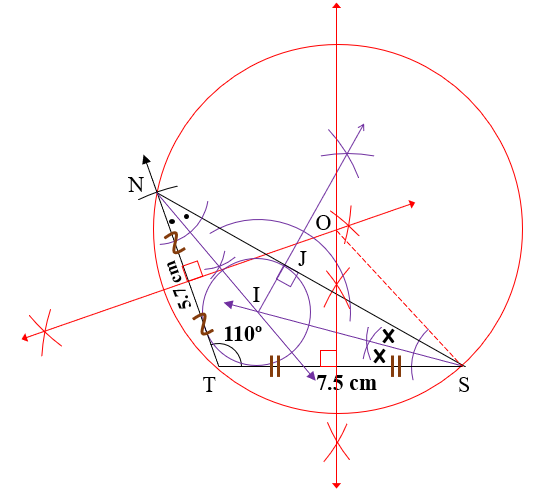
Solution:
- Draw TS = 7.5 cm.
- At point T, make an angle of 110°.
- With T as centre and radius 5.7 cm, draw an arc on the ray drawn in the previous step. Name the point N.
- Draw seg NS.
- Thus, \(\triangle\)NTS is constructed.
- Draw the perpendicular bisector of NT.
- Draw the perpendicular bisector of TS.
- Let the bisectors intersect at point O.
- With O as centre and OS as radius, draw a circle.
- This is the required circumcircle.
- Draw bisector of \(\angle\)N.
- Draw bisector of \(\angle\)S.
- Let the bisectors intersect at point I.
- Draw IJ \(\perp\) NS.
- With I as centre and IJ as radius, draw a circle.
- This is the required incircle.
4. In the figure 6.19, C is the centre of the circle. seg QT is a diameter. CT = 13, CP = 5, find the length of chord RS.
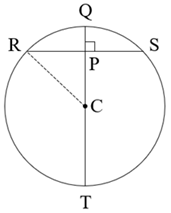
Solution:
Draw seg CR.
Now, CR = CT ... (Radii of the same circle)
But, CT = 13 ... (Given)
∴ CR = 13 units ... (i)
Now, in right \(\triangle\)CPR,
CR² = CP²+ PR² ... (Pythgoras’ Theorem)
∴ 13² = 5² + PR²
∴ 169 = 25 + PR²
∴ 169 − 25 = PR²
∴ 144 = PR²
i.e. PR² = 144
∴ PR = \(\sqrt{144}\)
∴ PR = 12 units
Also, CP \(\perp\) RS ... (Given)
∴ RS = 2 × PR ... (Theorem)
∴ RS = 2 × 12
∴ RS = 24 units ... (iii)
∴ The length of chord RS is 24 units.
5. In the figure 6.20, P is the centre of the circle. Chord AB and chord CD intersect on the diameter at the point E. If \(\angle\)AEP \(\cong\) \(\angle\)DEP then, prove that AB = CD.
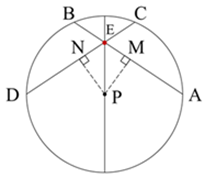
Proof:
Draw PM \(\perp\) AB and PN \(\perp\) CD.
In \(\triangle\)PME and \(\triangle\)PNE,
seg PE = seg PE ... (Common side)
\(\angle\)PME = \(\angle\)PNE ... (90° each – Construction)
∴ \(\angle\)MEP \(\cong\) \(\angle\)NEP ... (Given)
∴ \(\triangle\)PME \(\cong\) \(\triangle\)PNE ... (SAA test)
∴ seg PM = seg PN ... (c s c t)
Now, the chords of a circle equidistant from the centre of a circle are congruent. ... (Theorem)
∴ AB = CD ... (Chords equidistant from the centre are equal)
6. In the figure 6.21, CD is a diameter of the circle with centre O. Diameter CD is perpendicular to chord AB at point E. Show that \(\triangle\)ABC is an isosceles triangle.
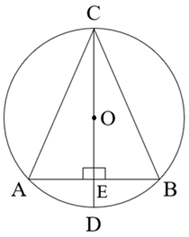
Proof:
OE \(\perp\) AB ... (Given)
∴ AE = BE ... (Theorem) ... (i)
Now, in \(\triangle\)ACE and \(\triangle\)BCE,
seg CE = seg CE ... (Common side)
\(\angle\)CEA = \(\angle\)CEB ... [(90° each – (Given)])
seg AE = seg BE ... [From (i)]
∴ \(\triangle\)ACE \(\cong\) \(\triangle\)BCE ... (SAS test)
∴ seg CA = seg CB ... (c s c t)
∴ \(\triangle\)ABC is an isosceles triangle.
This page was last modified on
16 March 2026 at 18:54