Exercises
- Complete the following sentences by choosing the appropriate words from the brackets. (Inheritance, sexual reproduction, asexual reproduction, chromosomes, DNA, RNA, gene)
Click on the question to view the answer
Click on the question to view the answer
Hereditary characters are transferred from parents to offsprings by gene, hence they are said to be structural and functional units of heredity.
Organisms produced by asexual reproduction show minor variations.
The component which is in the nuclei of cells and carries the hereditary characteristics is called Chromosome.
Chromosomes are mainly made up of DNA.
Organisms produced through sexual reproduction show major variations.
- Explain the following:
Click on the question to view the answer
Click on the question to view the answer
Coming Soon ...
| Monohybrid cross | Dihybrid cross |
|---|---|
|
|
|
|
|
|
|
|
Coming Soon ...
- Answers the following questions in your own words:
- The structure in the nucleus of cells that carries the hereditary characteristics is called the chromosome.
- It is made up mainly of nucleic acids and proteins.
- ‘Genes’ which contain the information about hereditary characteristics in coded form are located on chromosomes.
- Each chromosome is made up of DNA and has a constricted region called the ‘Primary constriction’ or ‘Centromere’.
- Types of chromosomes can be easily identified during cell division.
- Depending upon the specific position of the centromere, there are four types of chromosomes:
- Metacentric: The centromere is exactly at the mid-point in this chromosome. The arms of this chromosome are equal in length.
- Sub-metacentric: The centromere is somewhere near the mid-point. One arm is slightly shorter than the other.
- Acrocentric: The centromere is near one end of this chromosome. One arm is much smaller than other.
- Telocentric: The centromere is right at the end of this chromosome. This chromosome consists of only one arm.
- If the pair consists of similar chromosomes by shape and organization, they are called ‘homologous chromosomes’ and if they are not similar they are called ‘heterologous chromosomes’.
- There is a pair of ‘sex chromosomes’ or ‘allosomes’ and all other chromosomes are called ‘autosomes’.
- Chromosomes are mainly made up of DNA.
- As per Watson and Crick’s model, two parallel threads of nucleotides are coiled around each other. This arrangement is called a ‘double helix’.
- Each strand in the molecule of DNA is made up of many small molecules known as ‘nucleotide’.
- There are four types of nitrogenous bases adenine, guanine, cytosine and thymine.
- Adenine and guanine are called as ‘purines’ while cytosine and thymine are called ‘pyrimidines’’.
- In the structure of the nucleotide, a molecule of a nitrogenous base and phosphoric acid are each joined to a molecule of sugar.
- Nucleotides are arranged like a chain, in a molecule of DNA.
- The two threads of the DNA molecule are made up of alternately joined molecules of sugar and phosphoric acid.
- Each rung of the ladder is a pair of nitrogenous bases joined by hydrogen bonds.
- Adenine always pairs with thymine and cytosine always pairs with guanine.
- The sequence of genes in the DNA is unique to every person.
- It is like fingerprint and is useful for identifying criminals.
- DNA fingerprinting is useful in case of parental dispute.
- It can prove very useful to study evolution.
- It has great uses in anthropology.
- We can also learn about the secrets of the past using DNA fingerprinting.
- RNA is made up of ribose sugar, phosphate molecules and four types of nitrogenous bases adenine, guanine, cytosine and uracil.
- The nucleotide of the chain of the RNA molecule is formed by combination of a ribose sugar, phosphate molecule and one of the nitrogenous bases.
- Large numbers of nucleotides are bonded together to form the macromolecule of RNA.
- There are three types of RNA. They are:
- Ribosomal RNA (rRNA): Ribosomal RNA (rRNA): The molecule of RNA which is a component of the ribosome organelle is called a ribosomal RNA. Ribosomes perform the function of protein synthesis.
- Messenger RNA (mRNA): Messenger RNA (mRNA): The RNA molecule that carries the information of protein synthesis from genes i.e. DNA chain in the cell nucleus to ribosomes in the cytoplasm which produce the proteins, is called messenger RNA.
- Transfer RNA (tRNA): Transfer RNA (tRNA): The RNA molecule that transports specific amino acids to the ribosomes during protein synthesis is called transfer RNA.
- It is necessary for people to have their blood examined before marriage to detect any genetic disorders or diseases that could be passed on to offspring.
- Sickle-cell anaemia is a hereditary disease.
- It occurs due to changes in genes during conception.
- If the father and mother are both affected by sickle-cell anaemia or if they are carriers of this disorder, their offspring are likely to suffer from this disease.
- Hence, marriages between the persons who are carriers of or suffering from sickle-cell anaemia should be avoided.
- If a parent is suffering from a dreadful disease like AIDS or Hepatitis, it is likely to be transmitted to the child.
- Genetic abnormalities give rise to Turner syndrome in women and Klinefelter syndrome in men causing sterility.
- Therefore, it is necessary to have blood examined before marriage.
- Write a brief note on each:
- Down syndrome is a disorder arising due to chromosomal abnormality.
- This is the first discovered and described chromosomal disorder in human beings.
- This disorder is characterised by the presence of 47 chromosomes.
- It is described as trisomy of the 21st chromosome.
- Infants with this disorder have one extra chromosome with the 21st pair in every cell of their body. Therefore they have 47 chromosomes instead of 46.
- Children suffering from Down’s syndrome are usually mentally retarded and have a short lifespan.
- Mental retardation is the most prominent characteristic.
- Other symptoms include short height, short wide neck, flat nose, short fingers, scanty hair, single horizontal crease on palm, and a life expentancy of about 16 – 20 years.
- Disorders or diseases occurring due to mutation in any single gene into a defective one are called monogenic disorders.
- Approximately 4000 different disorders of this type are now known.
- Due to abnormal genes, their products are either produced in insufficient quantity or not at all.
- This causes abnormal metabolism that may lead to death at a tender age.
- Examples of such disorders are Hutchinson’s disease, Tay-Sachs disease, galactosaemia, phenylketonuria, sickle cell anaemia, cystic fibrosis, albinism haemophilia, night blindness, etc.
- Even minor changes in molecular structure of proteins and DNA may lead to diseases or disorders.
- Normal haemoglobin has glutamic acid as the 6th amino acid in its molecular structure. However, if it is replaced by valine, the shape/structure of the haemoglobin molecule changes.
- Due to this, the erythrocytes or red blood corpuscles (RBC), which are normally biconcave become sickle-shaped. This condition is called ‘sickle-cell anaemia’.
- The oxygen carrying capacity of haemoglobin in such individuals is very low. In this condition, clumping and thereby destruction of erythrocytes occurs most often. As a result blood vessels are obstructed and the circulatory system, brain, lungs, kidneys, etc. are damaged.
- Sickle-cell anaemia is a hereditary disease. It occurs due to changes in genes during conception. If the father and mother are both affected by sickle-cell anaemia or if they are carriers of this disorder, their offspring are likely to suffer from this disease. Hence, marriages between the persons who are carriers of or suffering from sickle-cell anaemia should be avoided.
- A person suffering from sickle cell anaemia should take a tablet of folic acid daily.
- Other preventive measures include regular health check-ups, vaccinations to prevent infections, and avoiding triggers such as extreme temperatures and high altitudes.
- How are the items in groups A, B and C inter-releated?
| A | B | C |
|---|---|---|
| Leber hereditary optic neuropathy | 44 + XXY | Pale skin, white hairs |
| Diabetes | 45 + X | Men are sterile |
| Albinism | Mitochondrial disorder | Women are sterile |
| Turner syndrome | Polygenic disorder | This disorder arises during development of zygote |
| Klinefelter syndrome | Monogenic disorder | Effect on blood-glucose level |
- Fill in the blanks based on the given realationship:
Klinefelter syndrome
Dihybrid Cross
Klinefelter syndrome
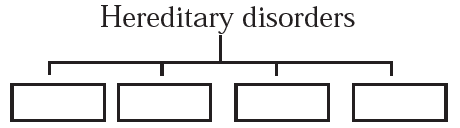
- Complete the tree diagram below based on types of hereditary disorders.
Coming soon ....