(1) Two numbers differ by 3. The sum of twice the smaller number and thrice the greater number is 19. Find the numbers.
Solution:
Let, the greater number be \(x\) and the smaller number be \(y\).
From the first condition,
\(x - y = 3\) ... (i)
From the second condition,
\(2y + 3x = 19\)
i.e. \(3x + 2y = 19\) ... (ii)
Multiplying equation (i) by 2,
\(2x - 2y = 6\) ... (iii)
Adding (ii) and (iii),
| 3x | + | 2y | = | 19 | ... (ii) | |||
+ |
2x | − | 2y | = | 6 | ... (iii) | ||
| 5x | = | 25 |
\(\displaystyle \therefore a = \frac {\cancelto{5}{25}}{\cancelto{1}{5}}\)
\(\displaystyle \therefore x = 5\) ... (iv)
Substituting the value of \(x\) in equation (i),
\(x - y\) = 3 ... (i)
∴ \(5 - y = 3\)
∴ \(- y = 3 - 5\)
∴ \(- y = - 2\)
i.e. \(y = 2\) ... (v)
∴ The greater number is 5 and the smaller number is 2.
(2) Complete the following:
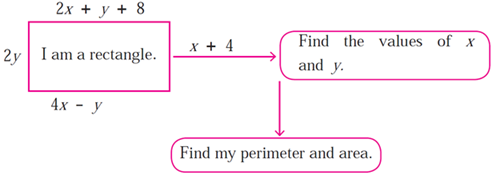
Solution:
The opposite sides of a rectangle are congruent. ... (Theorem)
∴ \(2x + y + 8 = 4x - y\)
∴ \(y + y = 4x - 2x - 8\)
∴ \(2y = 2x - 8\) ... (i)
Also,
\(2y = x + 4\) ... (ii)
From (i) and (ii),
\(2x - 8 = x + 4\)
∴ \(2x - x = 4 + 8\)
∴ \(x = 12\) ... (iii)
Substituting the value of \(x\) in (ii),
\(2y = x + 4\) ... (ii)
∴ \(2y = 12 + 4\)
∴ \(2y = 16\)
∴ \(\displaystyle y = \frac {\cancelto {8}{16}}{\cancelto {1}{2}}\)
∴ \(y = 8\) ... (iv)
∴ The length of that rectangle
= \(4x - y\)
= \(4 \times 12 - 8\)
= \(48 - 8\)
= \(40\) units
∴ The length of that rectangle = \(40\) units ... (v)
And, the breadth of that rectangle
= \(2y\)
= \(2 \times 8\)
= \(16\) units
∴ The breadth of that rectangle = \(16\) units ... (vi)
Finally, perimeter of a rectangle
= \(2(l + b)\)
= \(2(40 + 16)\)
= \(2 \times 56\)
= \(112\) units
∴ The perimeter of that rectangle = \(112\) units ... (vii)
And, area of a rectangle
= \(l \times b\)
= \(40 \times 16\)
= \(640\) square units
∴ The area of that rectangle = \(640\) square units ... (viii)
(3) The sum of father’s age and twice the age of his son is 70. If we double the age of the father and add it to the age of his son the sum is 95. Find their present ages.
Solution:
Let the present age of father be \(x\) years and the present age of the son be \(y\) years.
From the first condition,
\(x + 2y = 70\) ... (i)
From the second condition,
\(2x + y = 95\) ... (ii)
∴ \(y = 95 - 2x\) ... (iii)
Substituting the value of \(y\) in equation (i),
\(x + 2y = 70\) ... (i)
∴ \(x + 2 \times (95 - 2x) = 70\)
∴ \(x + 190 - 4x = 70\)
∴ \(- 3x = 70 - 190\)
∴ \(- 3x = - 120\)
i.e. \(3x = 120\)
∴ \(\displaystyle x = \frac {\cancelto {3}{120}}{\cancelto {1}{3}}\)
∴ \(x = 40\) years ... (iv)
Substituting the value of \(x\) in equation (iii),
\(y = 95 - 2x\) ... (iii)
∴ \(y = 95 - 2 \times 40\)
∴ \(y = 95 - 80\)
∴ \(y = 15\) years ... (v)
∴ The present age of father is 40 years and the present age of son is 15 years.
(4) The denominator of a fraction is 4 more than twice its numerator. Denominator becomes 12 times the numerator, if both the numerator and the denominator are reduced by 6. Find the fraction.
Solution:
Let the numerator be \(n\) and the denominator be \(d\).
From the first condition,
\(d = 4 + 2n\)
\(-\:2n + d = 4\) ... (i)
From the second condition,
\(d - 6 = 12(n - 6)\)
∴ \(d - 6 = 12n - 72\)
∴ \(- 6 + 72 = 12n - d\)
∴ \(66 = 12n - d\) ... (ii)
i.e. \(12n - d = 66\) ... (ii)
Adding (i) and (ii),
| − | 2n | + | d | = | 4 | ... (i) | ||
+ |
12n | − | d | = | 66 | ... (ii) | ||
| 10n | = | 70 |
∴ \(\displaystyle n = \frac {\cancelto {7}{70}}{\cancelto {1}{10}}\)
∴ \(n = 7\) ... (iii)
Substituting the value of \(n\) in equation (i),
\(- 2n + d = 4\) ... (i)
∴ \(- 2 \times 7 + d = 4\)
∴ \(- 14 + d = 4\)
∴ \(d = 4 + 14\)
∴ \(d = 18\) ... (iv)
∴ That fraction is \(\displaystyle \frac {7}{18}\).
(5) Two types of boxes A, B are to be placed in a truck having capacity of 10 tons. When 150 boxes of type A and 100 boxes of type B are loaded in the truck, it weighs 10 tons. But when 260 boxes of type A are loaded in the truck, it can still accommodate 40 boxes of type B, so that it is fully loaded. Find the weight of each type of box.
1 ton = 1000 kg
∴ 10 ton = 10000 kg
Solution:
Let the weight of A type of box be \(x\) kg and the weight of B type of box be \(y\) kg.
From the first condition,
\(150x + 100y = 10000\)
Dividing both sides by 50,
\(3x + 2y = 200\) ... (i)
From the second condition,
\(260x + 40y = 10000\)
Dividing both sides by 20,
∴ \(13x + 2y = 500\) ... (ii)
Subtracting (i) from (ii),
| 13x | + | 2y | = | 500 | ... (ii) | |||
− |
⊕ | 3x | ⊕ | 2y | = | ⊕ | 200 | ... (i) |
| − | − | − | ||||||
| 10x | = | 300 |
∴ \(\displaystyle x = \frac {\cancelto {30}{300}}{\cancelto {1}{10}}\)
∴ \(x = 30\) kg ... (iii)
Substituting the value of \(x\) in equation (i),
\(3x + 2y = 200\) ... (i)
∴ \(3 \times 30 + 2y = 200\)
∴ \(90 + 2y = 200\)
∴ \(2y = 200 - 90\)
∴ \(2y = 110\)
∴ \(\displaystyle y = \frac {\cancelto {55}{110}}{\cancelto {1}{2}}\)
∴ \(y = 55\) kg ... (iv)
∴ The weight of A type of box is 30 kg and the weight of B type box is 55 kg.
(6) Out of 1900 km, Vishal travelled some distance by bus and some by aeroplane. Bus travels with average speed 60 km/hr and the average speed of aeroplane is 700 km/hr. It takes 5 hours to complete the journey. Find the distance, Vishal travelled by bus.
Solution:
Let the distance travelled by bus be \(x\) km and the distance travelled by aeroplane be \(y\) km.
From the first condition,
\(x + y = 1900\)
∴\(y = 1900 - x\) ... (i)
\(\text{Distance} = \text{Speed} \times \text{Time}\)
\(\displaystyle \frac{\text{Distance}}{\text{Speed}} = \text{Time}\)
From the second condition,
\(\displaystyle \frac {x}{60} + \frac {y}{700} = 5\)
Taking LCM (LCM = 2100),
\(\displaystyle \frac {35x}{2100} + \frac {3y}{2100} = 5\)
∴ \(\displaystyle \frac {35x + 3y}{2100} = 5\)
∴ \(35x + 3y = 5 \times 2100\)
∴ \(35x + 3y = 10500\) ... (ii)
Substituting the value of \(y\) in equation (ii),
\(35x + 3y = 10500\) ... (ii)
∴ \(35x + 3(1900 - x) = 10500\)
∴ \(35x + 5700 - 3x = 10500\)
∴ \(32x + 5700 = 10500\)
∴ \(32x = 10500 - 5700\)
∴ \(32x = 4800\)
∴ \(\displaystyle x = \frac {\cancelto {150}{4800}}{\cancelto {1}{32}}\)
∴ \(x = 150\) km ... (iii)
∴ Vishal travelled 150 km by bus.