- Choose correct alternative for each of the following questions:
Click on the question to view the answer
Click on the question to view the answer
Solution:
\(4x + 5y = 19\) and \(x = 1\)
∴ \(4 \times 1 + 5y = 19\)
∴ \(4 + 5y = 19\)
∴ \(5y = 19 - 4\)
∴ \(5y = 15\)
∴ \(\displaystyle y = \frac {\cancelto {3}{15}}{\cancelto {1}{5}}\)
∴ \(y = 3\)
∴ The correct option is: (B) 3
Solution:
\(\displaystyle x = \frac {D_{x}}{D}\)
∴ \(\displaystyle x = \frac {49}{7}\)
∴ \(x = 7\)
∴ The correct option is: (A) 7
Solution:
\(\begin{eqnarray} \left| \begin{array}{rrr} 5 & 3 \\ - 7 & - 4 \\ \end{array} \right| \end{eqnarray}\)
= \(5 \times (-4) - 3 \times (-7)\)
= \(-20 - (-21)\)
= \(-20 + 21\)
= \(1\)
∴ The correct option is: (D) 1
Solution:
First let’s express the given equations in the standard form:
\(x + y = 3\)
and \(3x - 2y = 4\)
Comparing with the standard form:
\(a_{1} = 1, b_{1} = 1, c_{1} = 3,\\a_{2} = 3, b_{2} = \:-\:2, c_{2} = 4\)
Now, \(D = \begin{vmatrix} a_{1} & b_{1} \\ a_{2} & b_{2} \end{vmatrix}\)
∴ \(\begin{eqnarray} D = \left| \begin{array}{rrr} 1 & 1 \\ 3 & - 2 \\ \end{array} \right| \end{eqnarray}\)
∴ \(D = 1 \times (\:-\:2)\:-\:1 \times 3\)
∴ \(D = \:-\:2 \:-\:3\)
∴ \(D = \:-\:5\)
∴ The correct option is: (C) − 5
Solution:
Comparing with the standard form, we get:
\(a_{1} = a, b_{1} = b, c_{1} = c,\\a_{2} = m, b_{2} = n, c_{2} = d\)
Now, \(D = \begin{vmatrix} a_{1} & b_{1} \\ a_{2} & b_{2} \end{vmatrix}\)
∴ \(D = \begin{vmatrix} a & b \\ m & n \end{vmatrix}\)
∴ \(D = a \times n\:-\:b \times m\)
∴ \(D = an\:-\:bm\)
But, \(an\:-\:bm \ne 0\) ... (Given)
∴ The given equations have only one common solution.
∴ The correct option is: (A) Only one common solution
2. Complete the following table to draw the graph of \(2x - 6y = 3\):
| x | − 5 | |
|---|---|---|
| y | 0 | |
| (x, y) |
Solution:
\(2x - 6y = 3\)
Substituting \(x = - 5\) in the given equation,
\(2 \times - 5 - 6y = 3\)
∴ \(- 10 - 6y = 3\)
∴ \(- 10 - 3 = 6y\)
∴ \(- 13 = 6y\)
i.e. \(6y = - 13\)
∴ \(\displaystyle y = - \frac {13}{6}\) ... (i)
Also,
\(2x - 6y = 3\)
Substituting \(y = 0\) in the given equation,
\(2x - 6 \times 0 = 3\)
∴ \(2x - 0 = 3\)
∴ \(2x = 3\)
∴ \(\displaystyle x = \frac {3}{2}\) ... (ii)
The completed table is given below:
| x | − 5 | \(\displaystyle \color {#ee82ff}{\frac {3}{2}}\) |
|---|---|---|
| y | \(\displaystyle \color {#ee82ff}{-\:\frac {13}{6}}\) | 0 |
| (x, y) | \(\displaystyle \color {#ee82ff}{\left(-\:5,\ -\:\frac {13}{6}\right)}\) | \(\displaystyle \color {#ee82ff}{\left(\frac {3}{2},\ 0\right)}\) |
4. Find the values of each of the following determinants:
(1) \(\begin{eqnarray} \left| \begin{array}{rrr} 4 & 3 \\ 2 & 7 \\ \end{array} \right| \end{eqnarray}\)
Solution:
\(\begin{eqnarray} \left| \begin{array}{rrr} 4 & 3 \\ 2 & 7 \\ \end{array} \right| \end{eqnarray}\)
= \(4 \times 7 - 3 \times 2\)
= \(28 - 6\)
= \(22\)
(2) \(\begin{eqnarray} \left| \begin{array}{rrr} 5 & - 2 \\ - 3 & 1 \\ \end{array} \right| \end{eqnarray}\)
Solution:
\(\begin{eqnarray} \left| \begin{array}{rrr} 5 & - 2 \\ - 3 & 1 \\ \end{array} \right| \end{eqnarray}\)
= \(5 \times 1 - (- 2) \times (- 3)\)
= \(5 - 6\)
= \(- 1\)
(3) \(\begin{eqnarray} \left| \begin{array}{rrr} 3 & - 1 \\ 1 & 4 \\ \end{array} \right| \end{eqnarray}\)
Solution:
\(\begin{eqnarray} \left| \begin{array}{rrr} 3 & - 1 \\ 1 & 4 \\ \end{array} \right| \end{eqnarray}\)
= \(3 \times 4 - (- 1) \times 1\)
= \(12 + 1\)
= \(13\)
(5) Solve the following equations by Cramer’s method:
(1) \(6x - 3y = - 10;\ 3x + 5y - 8 = 0\)
Solution:
First let’s express the given equations in the standard form:
\(6x - 3y = - 10\)
and \(3x + 5y = 8\)
Comparing with the standard form:
\(a_{1} = 6, b_{1} =\:-\:3, c_{1} = \:-\:10,\\a_{2} = 3, b_{2} = 5, c_{2} = 8\)
\(D = \begin{vmatrix} a_{1} & b_{1} \\ a_{2} & b_{2} \end{vmatrix}\)
∴ \(\begin{eqnarray} D = \left| \begin{array}{rrr} 6 & - 3 \\ 3 & 5 \\ \end{array} \right| \end{eqnarray}\)
∴ \(D = 6 \times 5\:-\:(\:-\:3) \times 3\)
∴ \(D = 30 + 9\)
∴ \(D = 39\) ... (i)
Also, \(D_{x} = \begin{vmatrix} c_{1} & b_{1} \\ c_{2} & b_{2} \end{vmatrix}\)
∴ \(\begin{eqnarray} D_{x} = \left| \begin{array}{rrr} - 10 & - 3 \\ 8 & 5 \\ \end{array} \right| \end{eqnarray}\)
∴ \(D_{x} = \:-\:10 \times 5\:-\:(\:-\:3) \times 8\)
∴ \(D_{x} = \:-\:50 + 24\)
∴ \(D_{x} = \:-\:26\) ... (ii)
And, \(D_{y} = \begin{vmatrix} a_{1} & c_{1} \\ a_{2} & c_{2} \end{vmatrix}\)
∴ \(\begin{eqnarray} D_{y} = \left| \begin{array}{rrr} 6 & - 10 \\ 3 & 8 \\ \end{array} \right| \end{eqnarray}\)
∴ \(D_{y} = 6 \times 8\:-\:(\:-\:10) \times 3\)
∴ \(D_{y} = 48 + 30\)
∴ \(D_{y} = 78\) ... (iii)
Now, using Cramer’s Rule:
\(\displaystyle x = \frac{D_{x}}{D}\)
∴ \(\displaystyle x = \frac{\cancelto{- 2}{\:-\:26}}{\cancelto{3}{39}}\)
∴ \(\displaystyle x = - \frac {2}{3}\) ... (iv)
Also, \(\displaystyle y = \frac{D_{y}}{D}\)
∴ \(\displaystyle y = \frac{\cancelto{2}{78}}{\cancelto{1}{39}}\)
∴ \(\displaystyle y = 2\) ... (v)
∴ The solution is \(\displaystyle (x, y) = \left(- \frac {2}{3},\ 2\right)\)
(2) \(4m - 2n = - 4;\ 4m + 3n = 16\)
Solution:
Comparing with the standard form:
\(a_{1} = 4, b_{1} =\:-\:2, c_{1} = \:-\:4,\\a_{2} = 4, b_{2} = 3, c_{2} = 16\)
\(D = \begin{vmatrix} a_{1} & b_{1} \\ a_{2} & b_{2} \end{vmatrix}\)
∴ \(\begin{eqnarray} D = \left| \begin{array}{rrr} 4 & - 2 \\ 4 & 3 \\ \end{array} \right| \end{eqnarray}\)
∴ \(D = 4 \times 3\:-\:(\:-\:2) \times 4\)
∴ \(D = 12 + 8\)
∴ \(D = 20\) ... (i)
Also, \(D_{m} = \begin{vmatrix} c_{1} & b_{1} \\ c_{2} & b_{2} \end{vmatrix}\)
∴ \(\begin{eqnarray} D_{m} = \left| \begin{array}{rrr} - 4 & - 2 \\ 16 & 3 \\ \end{array} \right| \end{eqnarray}\)
∴ \(D_{m} = \:-\:4 \times 3\:-\:(\:-\:2) \times 16\)
∴ \(D_{m} = \:-\:12 + 32\)
∴ \(D_{m} = 20\) ... (ii)
And, \(D_{n} = \begin{vmatrix} a_{1} & c_{1} \\ a_{2} & c_{2} \end{vmatrix}\)
∴ \(\begin{eqnarray} D_{n} = \left| \begin{array}{rrr} 4 & - 4 \\ 4 & 16 \\ \end{array} \right| \end{eqnarray}\)
∴ \(D_{n} = 4 \times 16\:-\:(\:-\:4) \times 4\)
∴ \(D_{n} = 64 + 16\)
∴ \(D_{n} = 80\) ... (iii)
Now, using Cramer’s Rule:
\(\displaystyle m = \frac{D_{m}}{D}\)
∴ \(\displaystyle m = \frac{\cancelto{1}{20}}{\cancelto{1}{20}}\)
∴ \(m = 1\) ... (iv)
Also, \(\displaystyle n = \frac{D_{n}}{D}\)
∴ \(\displaystyle n = \frac{\cancelto{4}{80}}{\cancelto{1}{20}}\)
∴ \(n = 4\) ... (v)
∴ The solution is \(\displaystyle (m, n) = (1, 4)\)
(3) \(\displaystyle 3x - 2y = \frac {5}{2};\ \frac {1}{3}x + 3y = - \frac {4}{3}\)
Solution:
\(\displaystyle 3x - 2y = \frac {5}{2}\) ... (i)
and \(\displaystyle \frac {1}{3}x + 3y = - \frac {4}{3}\) ... (ii)
Multiplying equation (i) by 2,
\(\displaystyle 3x \times 2 - 2y \times 2 = \frac {5}{\cancel {2}} \times \cancel {2}\)
∴ \(6x - 4y = 5\) ... (iii)
Multiplying equation (ii) by 3,
\(\displaystyle \frac {1}{\cancel{3}}x \times \cancel{3} + 3y \times 3 = - \frac {4}{\cancel{3}} \times \cancel{3}\)
∴ \(x + 9y = - 4\) ... (iv)
Comparing with the standard form:
\(a_{1} = 6, b_{1} =\:-\:4, c_{1} = 5,\\a_{2} = 1, b_{2} = 9, c_{2} = -4\)
\(\displaystyle D = \begin{vmatrix} a_{1} & b_{1} \\ a_{2} & b_{2} \end{vmatrix}\)
∴ \(\begin{eqnarray} D = \left| \begin{array}{rrr} 6 & - 4 \\ - 4 & 9 \\ \end{array} \right| \end{eqnarray}\)
∴ \(\displaystyle D = 6 \times 9\:-\:(\:-\:4) \times 1\)
∴ \(\displaystyle D = 54 + 4\)
∴ \(\displaystyle D = 58\) ... (v)
Also, \(\displaystyle D_{x} = \begin{vmatrix} c_{1} & b_{1} \\ c_{2} & b_{2} \end{vmatrix}\)
∴ \(\begin{eqnarray} D_{x} = \left| \begin{array}{rrr} 5 & - 4 \\ - 4 & 9 \\ \end{array} \right| \end{eqnarray}\)
∴ \(D_{x} = 5 \times 9\:-\:(\:-\:4) \times (-4)\)
∴ \(D_{x} = 45 - 16\)
∴ \(D_{x} = 29\) ... (vi)
And, \(D_{y} = \begin{vmatrix} a_{1} & c_{1} \\ a_{2} & c_{2} \end{vmatrix}\)
∴ \(\begin{eqnarray} D_{y} = \left| \begin{array}{rrr} 6 & 5 \\ 1 & - 4 \\ \end{array} \right| \end{eqnarray}\)
∴ \(D_{y} = 6 \times (-4)\:-\:(5) \times 1\)
∴ \(D_{y} = -24 - 5\)
∴ \(D_{y} = - 29\) ... (vii)
Now, using Cramer’s Rule:
\(\displaystyle x = \frac{D_{x}}{D}\)
∴ \(\displaystyle x = \frac{\cancelto{1}{29}}{\cancelto{2}{58}}\)
∴ \(\displaystyle x = \frac{1}{2}\) ... (viii)
Also, \(\displaystyle y = \frac{D_{y}}{D}\)
∴ \(\displaystyle y = \frac{\cancelto{- 1}{- 29}}{\cancelto{2}{58}}\)
∴ \(\displaystyle y = -\frac{1}{2}\) ... (ix)
∴ The solution is \(\displaystyle (x, y) = \left(\frac{1}{2}, -\frac{1}{2}\right)\)
(4) \(\displaystyle 7x + 3y = 15;\ 12y - 5x = 39\)
Solution:
Let’s express the given equations in the standard form:
\(\displaystyle 7x + 3y = 15\) ... (i)
and \(\displaystyle - 5x + 12y = 39\) ... (ii)
Comparing with the standard form:
\(a_{1} = 7, b_{1} = 3, c_{1} = 15,\\a_{2} = - 5, b_{2} = 12, c_{2} = 39\)
\(\displaystyle D = \begin{vmatrix} a_{1} & b_{1} \\ a_{2} & b_{2} \end{vmatrix}\)
∴ \(\begin{eqnarray} D = \left| \begin{array}{rrr} 7 & 3 \\ - 5 & 12 \\ \end{array} \right| \end{eqnarray}\)
∴ \(\displaystyle D = 7 \times 12\:-\:3 \times (- 5)\)
∴ \(\displaystyle D = 84 + 15\)
∴ \(\displaystyle D = 99\) ... (iii)
Also, \(\displaystyle D_{x} = \begin{vmatrix} c_{1} & b_{1} \\ c_{2} & b_{2} \end{vmatrix}\)
∴ \(\begin{eqnarray} D_{x} = \left| \begin{array}{rrr} 15 & 3 \\ 39 & 12 \\ \end{array} \right| \end{eqnarray}\)
∴ \(D_{x} = 15 \times 12\:-\:3 \times 39\)
∴ \(D_{x} = 180 - 117\)
∴ \(D_{x} = 63\) ... (iv)
And, \(D_{y} = \begin{vmatrix} a_{1} & c_{1} \\ a_{2} & c_{2} \end{vmatrix}\)
∴ \(\begin{eqnarray} D_{y} = \left| \begin{array}{rrr} 7 & 15 \\ - 5 & 39 \\ \end{array} \right| \end{eqnarray}\)
∴ \(D_{y} = 7 \times 39\:-\:(15) \times (- 5)\)
∴ \(D_{y} = 273 + 75\)
∴ \(D_{y} = 348\) ... (v)
Now, using Cramer’s Rule:
\(\displaystyle x = \frac{D_{x}}{D}\)
∴ \(\displaystyle x = \frac{\cancelto {7}{63}}{\cancelto {11}{99}}\)
∴ \(\displaystyle x = \frac{7}{11}\) ... (vi)
Also, \(\displaystyle y = \frac{D_{y}}{D}\)
∴ \(\displaystyle y = \frac{\cancelto {116}{348}}{\cancelto {33}{99}}\)
∴ \(\displaystyle y = \frac{116}{33}\) ... (vii)
∴ The solution is \(\displaystyle (x, y) = \left(\frac{7}{11}, \frac{116}{33}\right)\)
(5) \(\displaystyle \frac {x + y - 8}{2} = \frac {x + 2y - 14}{3} = \frac {3x - y}{4}\)
Solution:
First, let’s prepare two simultaneous equations from the given relations:
\(\displaystyle \bbox[yellow, 5pt, border: 2px dotted red]{\frac {x + y - 8}{2} = \frac {x + 2y - 14}{3}} = \frac {3x - y}{4}\)
∴\(\displaystyle \frac {x + y - 8}{2} = \frac {x + 2y - 14}{3}\)
By cross multiplication,
\(3(x + y - 8) = 2(x + 2y - 14)\)
∴ \(3x + 3y - 24 = 2x + 4y - 28\)
∴ \(3x + 3y - 2x - 4y = - 28 + 24\)
∴ \(x - y = - 4\) ... (i)
Also, \(\displaystyle \frac {x + y - 8}{2} = \bbox[yellow, 5pt, border: 2px dotted red]{\frac {x + 2y - 14}{3} = \frac {3x - y}{4}}\)
∴ \(\displaystyle \frac {x + 2y - 14}{3} = \frac {3x - y}{4}\)
By cross multiplication,
\(4(x + 2y - 14) = 3(3x - y)\)
∴ \(4x + 8y - 56 = 9x - 3y\)
∴ \(4x + 8y - 9x + 3y = 56\)
∴ \(- 5x + 11y = 56\) ... (ii)
Now, comparing with the standard form:
\(a_{1} = 1, b_{1} = - 1, c_{1} = - 4,\\a_{2} = - 5, b_{2} = 11, c_{2} = 56\)
\(\displaystyle D = \begin{vmatrix} a_{1} & b_{1} \\ a_{2} & b_{2} \end{vmatrix}\)
∴ \(\begin{eqnarray} D = \left| \begin{array}{rrr} 1 & - 1 \\ - 5 & 11 \\ \end{array} \right| \end{eqnarray}\)
∴ \(\displaystyle D = 1 \times 11\:-\:(- 1) \times (- 5)\)
∴ \(\displaystyle D = 11 - 5\)
∴ \(\displaystyle D = 6\) ... (iii)
Also, \(\displaystyle D_{x} = \begin{vmatrix} c_{1} & b_{1} \\ c_{2} & b_{2} \end{vmatrix}\)
∴ \(\begin{eqnarray} D_{x} = \left| \begin{array}{rrr} - 4 & - 1 \\ 56 & 11 \\ \end{array} \right| \end{eqnarray}\)
∴ \(D_{x} = (- 4) \times 11\:-\:(- 1) \times 56\)
∴ \(D_{x} = - 44 + 56\)
∴ \(D_{x} = 12\) ... (iv)
And, \(D_{y} = \begin{vmatrix} a_{1} & c_{1} \\ a_{2} & c_{2} \end{vmatrix}\)
∴ \(\begin{eqnarray} D_{x} = \left| \begin{array}{rrr} 1 & - 4 \\ - 5 & 56 \\ \end{array} \right| \end{eqnarray}\)
∴ \(D_{y} = 1 \times 56\:-\:(- 4) \times (- 5)\)
∴ \(D_{y} = 56 - 20\)
∴ \(D_{y} = 36\) ... (v)
Now, using Cramer’s Rule:
\(\displaystyle x = \frac{D_{x}}{D}\)
∴ \(\displaystyle x = \frac{\cancelto {2}{12}}{\cancelto {1}{6}}\)
∴ \(\displaystyle x = 2\) ... (vi)
Also, \(\displaystyle y = \frac{D_{y}}{D}\)
∴ \(\displaystyle y = \frac{\cancelto {6}{36}}{\cancelto {1}{6}}\)
∴ \(y = 6\) ... (vii)
∴ The solution is \((x, y) = (2, 6)\)
6. Solve the following simultaneous equations:
(1) \(\displaystyle \frac {2}{x} + \frac {2}{3y} = \frac {1}{6};\ \frac {3}{x} + \frac {2}{y} = 0\)
Solution:
\(\displaystyle \frac {2}{x} + \frac {2}{3y} = \frac {1}{6}\) ... (i)
and \(\displaystyle \frac {3}{x} + \frac {2}{y} = 0\) ... (ii)
Let \(\displaystyle \frac {1}{x} = a\) and \(\displaystyle \frac {1}{y} = b\),
∴ The given equations:
\(\displaystyle 2a + \frac {2b}{3} = \frac {1}{6}\) ... (iii)
and \(3a + 2b = 0\) ... (iv)
Multiplying equation (iii) by 6,
\(\displaystyle 2a \times 6 + \frac {2b}{\cancelto {1}{3}} \times \cancelto {2}{6} = \frac {1}{\cancel{6}} \times \cancel{6}\)
∴ \(12a + 4b = 1\) ... (v)
Multiplying equation (iv) by 2,
\(3a \times 2 + 2b \times 2 = 0 \times 2\)
∴ \(6a + 4b = 0\) ... (vi)
Subtracting (vi) from (v),
| 12a | + | 4b | = | 1 | ... (v) | |||
− |
⊕ | 6a | ⊕ | 4b | = | ⊕ | 0 | ... (vi) |
| − | − | − | ||||||
| 6a | = | 1 |
∴ \(\displaystyle a = \frac {1}{6}\) ... (vii)
Substituting the value of \(a\) in (vi),
\(6a + 4b = 0\) ... (vi)
∴ \(\displaystyle \cancel {6} \times \frac {1}{\cancel {6}} + 4b = 0\)
∴ \(1 + 4b = 0\)
∴ \(4b = - 1\)
∴ \(\displaystyle b = - \frac {1}{4}\) ... (viii)
Replacing the value of \(a\),
\(\displaystyle \frac {1}{x} = a\)
∴ \(\displaystyle \frac {1}{x} = \frac {1}{6}\)
By invertendo,
\(x = 6\) ... (ix)
Replacing the value of \(b\),
\(\displaystyle \frac {1}{y} = b\)
∴ \(\displaystyle \frac {1}{y} = - \frac {1}{4}\)
By invertendo,
\(y = - 4\) ... (x)
∴ The solution is \((x, y) = (6, - 4)\)
(2) \(\displaystyle \frac {7}{2x + 1} + \frac {13}{y + 2} = 27;\ \frac {13}{2x + 1} + \frac {7}{y + 2} = 33\)
Solution:
\(\displaystyle \frac {7}{2x + 1} + \frac {13}{y + 2} = 27\) ... (i)
and \(\displaystyle \frac {13}{2x + 1} + \frac {7}{y + 2} = 33\) ... (ii)
Let \(\displaystyle \frac {1}{2x + 1} = a\) and \(\displaystyle \frac {1}{y + 2} = b\),
∴ The given equations:
\(7a + 13b = 27\) ... (iii)
and \(13a + 7b = 33\) ... (iv)
Adding (iii) and (iv),
| 7a | + | 13b | = | 27 | ... (iii) | |||
+ |
13a | + | 7b | = | 33 | ... (iv) | ||
| 20a | + | 20b | = | 60 |
Dividing both sides by 20,
and \(a + b = 3\) ... (v)
Subtracting (iv) from (iii),
| 7a | + | 13b | = | 27 | ... (iii) | |||
− |
⊕ | 13a | ⊕ | 7b | = | ⊕ | 33 | ... (iv) |
| − | − | − | ||||||
| − | 6a | + | 6b | = | − | 6 |
Dividing both sides by − 6,
and \(a − b = 1\) ... (vi)
Adding (v) and (vi),
| a | + | b | = | 3 | ... (v) | |||
+ |
a | − | b | = | 1 | ... (vi) | ||
| 2a | = | 4 |
∴ \(\displaystyle a = \frac {\cancelto {2}{4}}{\cancelto {1}{2}}\)
∴ \(a = 2\) ... (vii)
Substituting the value of \(a\) in equation (v),
\(a + b = 3\) ... (v)
∴ \(2 + b = 3\)
∴ \(b = 3 − 2\)
∴ \(b = 1\) ... (viii)
Replacing the value of \(a\),
\(\displaystyle \frac {1}{2x + 1} = a\)
∴ \(\displaystyle \frac {1}{2x + 1} = 2\)
∴ \(1 = 2(2x + 1)\)
∴ \(1 = 4x + 2\)
∴ \(1 - 2 = 4x\)
∴ \(- 1 = 4x\)
∴ \(4x = - 1\)
∴ \(\displaystyle x = - \frac {1}{4}\) ... (ix)
Replacing the value of \(b\),
\(\displaystyle \frac {1}{y + 2} = b\)
∴ \(\displaystyle \frac {1}{y + 2} = 1\)
∴ \(1 = 1(y + 2)\)
∴ \(1 = y + 2\)
∴ \(1 - 2 = y\)
∴ \(- 1 = y\)
i.e. \(y = - 1\) ... (x)
∴ The solution is \(\displaystyle (x, y) = \left(- \frac {1}{4}, - 1\right)\)
(3) \(\displaystyle \frac {148}{x} + \frac {231}{y} = \frac {527}{xy};\ \frac {231}{x} + \frac {148}{y} = \frac {610}{xy}\)
Solution:
\(\displaystyle \frac {148}{x} + \frac {231}{y} = \frac {527}{xy}\) ... (i)
and \(\displaystyle \frac {231}{x} + \frac {148}{y} = \frac {610}{xy}\) ... (ii)
Multiplying equation (i) by \(xy\),
\(\displaystyle \frac {148}{\cancel{x}} \times \cancel{x}y + \frac {231}{\cancel{y}} \times x\cancel{y} = \frac {527}{\cancel{xy}} \times \cancel{xy}\)
∴ \(148y + 231x = 527\) ... (iii)
Multiplying equation (ii) by \(xy\),
\(\displaystyle \frac {231}{\cancel{x}} \times \cancel{x}y + \frac {148}{\cancel{y}} \times x\cancel{y} = \frac {610}{\cancel{xy}} \times \cancel{xy}\)
∴ \(231y + 148x = 610\) ... (iv)
Adding (iii) and (iv),
| 148y | + | 231x | = | 527 | ... (iii) | |||
+ |
231y | + | 148x | = | 610 | ... (iv) | ||
| 379y | + | 379x | = | 1137 |
Dividing both sides by 379,
and \(y + x = 3\) ... (v)
Subtracting (iv) from (iii),
| 148y | + | 231x | = | 527 | ... (iii) | |||
− |
⊕ | 231y | ⊕ | 148x | = | ⊕ | 610 | ... (iv) |
| − | − | − | ||||||
| − | 83y | + | 83x | = | − | 83 |
Dividing both sides by − 83,
and \(y − x = 1\) ... (vi)
Adding (v) and (vi),
| y | + | x | = | 3 | ... (v) | |||
+ |
y | − | x | = | 1 | ... (vi) | ||
| 2y | = | 4 |
∴ \(\displaystyle y = \frac {\cancelto {2}{4}}{\cancelto {1}{2}}\)
∴ \(y = 2\) ... (vii)
Substituting the value of \(y\) in equation (iii),
\(y + x = 3\) ... (iii)
∴ \(2 + x = 3\)
∴ \(x = 3 − 2\)
∴ \(x = 1\) ... (viii)
∴ The solution is \((x, y) = (1, 2)\)
(4) \(\displaystyle \frac {7x - 2y}{xy} = 5;\ \frac {8x + 7y}{xy} = 15\)
Solution:
\(\displaystyle \frac {7x - 2y}{xy} = 5\) ... (i)
∴ \(\displaystyle \frac {7\cancel{x}}{\cancel{x}y} - \frac {2\cancel{y}}{x\cancel{y}} = 5\)
∴ \(\displaystyle \frac {7}{y} - \frac {2}{x} = 5\) ... (ii)
and \(\displaystyle \frac {8x + 7y}{xy} = 15\) ... (iii)
∴ \(\displaystyle \frac {8\cancel{x}}{\cancel{x}y} + \frac {7\cancel{y}}{x\cancel{y}} = 15\)
∴ \(\displaystyle \frac {8}{y} + \frac {7}{x} = 15\) ... (iv)
Substituting \(\displaystyle \frac {1}{y} = a\) and \(\displaystyle \frac {1}{x} = b\)
The given equations:
\(7a - 2b = 5\) ... (v)
and \(8a + 7b = 15\) ... (vi)
Multiplying equation (v) by 7,
\(49a - 14b = 35\) ... (vii)
Multiplying equation (vi) by 2,
\(16a + 14b = 30\) ... (viii)
Adding (vii) and (viii),
| 49a | − | 14b | = | 35 | ... (vii) | |||
+ |
16a | + | 14b | = | 30 | ... (viii) | ||
| 65a | = | 65 |
∴ \(\displaystyle a = \frac {\cancel{65}}{\cancel{65}}\)
∴ \(a = 1\) ... (ix)
Substituting the value of \(a\) in (vi),
\(8a + 7b = 15\) ... (vi)
∴ \(8 \times 1 + 7b = 15\)
∴ \(8 + 7b = 15\)
∴ \(7b = 15 - 8\)
∴ \(7b = 7\)
∴ \(\displaystyle b = \frac {\cancel{7}}{\cancel{7}}\)
∴ \(b = 1\) ... (x)
Replacing the value of \(a\),
\(\displaystyle \frac {1}{y} = a\)
∴ \(\displaystyle \frac {1}{y} = 1\)
∴ \(1 = y\)
i.e. \(y = 1\) ... (xi)
Replacing the value of \(b\),
\(\displaystyle \frac {1}{x} = b\)
∴ \(\displaystyle \frac {1}{x} = 1\)
∴ \(1 = x\)
i.e. \(x = 1\) ... (xii)
∴ The solution is \((x, y) = (1, 1)\)
(5) \(\displaystyle \frac {1}{2(3x + 4y)} + \frac {1}{5(2x - 3y)} = \frac {1}{4};\ \frac {5}{(3x + 4y)} - \frac {2}{(2x - 3y)} = - \frac {3}{2}\)
Solution:
\(\displaystyle \frac {1}{2(3x + 4y)} + \frac {1}{5(2x - 3y)} = \frac {1}{4}\) ... (i)
\(\displaystyle \frac {5}{(3x + 4y)} - \frac {2}{(2x - 3y)} = - \frac {3}{2}\) ... (ii)
Substituting \(\displaystyle \frac {1}{3x + 4y} = a\) and \(\displaystyle \frac {1}{2x - 3y} = b\)
The given equations:
\(\displaystyle \frac {a}{2} + \frac {b}{5} = \frac {1}{4}\) ... (iii)
and \(\displaystyle 5a - 2b = - \frac {3}{2}\) ... (iv)
Multiplying equation (iii) by 20,
\(\displaystyle \frac {a}{\cancelto {1}{2}} \times \cancelto {10}{20} + \frac {b}{\cancelto {1}{5}} \times \cancelto {4}{20} = \frac {1}{\cancelto {1}{4}} \times \cancelto {5}{20} \)
\(10a + 4b = 5\) ... (v)
Multiplying equation (iv) by 2,
\(\displaystyle 5a \times {2} - 2b \times {2} = - \frac {3}{\cancel {2}} \times {\cancel {2}}\)
\(10a - 4b = - 3\) ... (vi)
Adding (v) and (vi),
| 10a | + | 4b | = | 5 | ... (v) | |||
+ |
10a | − | 4b | = | − | 3 | ... (vi) | |
| 20a | = | 2 |
∴ \(\displaystyle a = \frac {\cancelto {1}{2}}{\cancelto {10}{20}}\)
∴ \(\displaystyle a = \frac {1}{10}\) ... (vii)
Substituting the value of \(a\) in (v),
\(10a + 4b = 5\) ... (v)
∴ \(\displaystyle \cancel {10} \times \frac {1}{\cancel {10}} + 4b = 5\)
∴ \(1 + 4b = 5\)
∴ \(4b = 5 - 1\)
∴ \(4b = 4\)
∴ \(\displaystyle b = \frac {\cancel{4}}{\cancel{4}}\)
∴ \(b = 1\) ... (viii)
Replacing the value of \(a\),
\(\displaystyle \frac {1}{3x + 4y} = a\)
∴ \(\displaystyle \frac {1}{3x + 4y} = \frac {1}{10}\)
By Invertendo,
\(3x + 4y = 10\) ... (ix)
Replacing the value of \(b\),
\(\displaystyle \frac {1}{2x - 3y} = b\)
∴ \(\displaystyle \frac {1}{2x - 3y} = 1\)
By Invertendo,
\(2x - 3y = 1\) ... (x)
Multiplying equation (ix) by 3,
\(9x + 12y = 30\) ... (xi)
Multiplying equation (x) by 4,
\(8x - 12y = 4\) ... (xii)
Adding (xi) and (xii),
| 9x | + | 12y | = | 30 | ... (xi) | |||
+ |
8x | − | 12y | = | 4 | ... (xii) | ||
| 17x | = | 34 |
∴ \(\displaystyle x = \frac {\cancelto {2}{34}}{\cancelto {1}{17}}\)
∴ \(x = 2\) ... (xiii)
Substituting the value of \(x\) in equation (ix),
\(3x + 4y = 10\) ... (ix)
∴ \(3 \times 2 + 4y = 10\)
∴ \(6 + 4y = 10\)
∴ \(4y = 10 - 6\)
∴ \(4y = 4\)
∴ \(\displaystyle y = \frac {\cancelto {1}{4}}{\cancelto {1}{4}}\)
∴ \(y = 1\) ... (xiv)
∴ The solution is \((x, y) = (2, 1)\)
7. Solve the following word problems:
(1) A two digit number and the number with digits interchanged add up to 143. In the given number the digit in unit’s place is 3 more than the digit in the ten’s place. Find the original number.
Solution:
Let the digit in unit’s place be \(x\) and that in the ten’s place be \(y\).
∴ The number = \(\bbox[white, 5pt, border: 2px solid red]{10}y + x\).
The number obtained by interchanging the digits is \(\bbox[white, 5pt, border: 2px solid red]{10}x + y\).
According to first condition:
two digit number + the number obtained by interchanging the digits = 143
∴ \(\bbox[white, 5pt, border: 2px solid red]{10y + x} + \bbox[white, 5pt, border: 2px solid red]{10x + y}\) = 143
∴ \(\bbox[white, 5pt, border: 2px solid red]{11x} + \bbox[white, 5pt, border: 2px solid red]{11y}\) = 143
∴ \(11(x + y)= 143\)
Dividing both sides by 11,
\(x + y = \bbox[white, 5pt, border: 2px solid red]{13}\) ... (I)
From the second condition,
the digit in unit’s place = digit in the ten’s place + 3
∴ \(x = \bbox[white, 5pt, border: 2px solid red]{y} + 3\)
∴ \(x - y = 3\) ... (II)
Adding equations (I) and (II),
| x | + | y | = | 13 | ... (I) | |||
+ |
x | − | y | = | 3 | ... (II) | ||
| 2x | = | 16 |
∴ \(\displaystyle x = \frac {\cancelto {8}{16}}{\cancelto {1}{2}}\)
∴ \(\bbox[white, 5pt, border: 2px solid red]{x = 8}\)
Putting this value of \(x\) in equation (I),
\(x + y = 13\) ... (I)
∴ \(8 + \bbox[white, 5pt, border: 2px solid red]{y} = 13\)
∴ \(y = 13 - 8\)
∴ \(y = \bbox[white, 5pt, border: 2px solid red]{5}\)
Now, the original number is \(10y + x\)
= \(10 \times {5} + 8\)
= \(\bbox[white, 5pt, border: 2px solid red]{50} + 8\)
= \(58\)
(2) Kantabai bought \(\displaystyle 1\frac {1}{2}\) kg tea and 5 kg sugar from a shop. She paid ₹ 50 as return fare for rickshaw. Total expense was ₹ 700. Then she realised that by ordering online, the goods can be bought with free home delivery at the same price. So next month she placed the order online for 2 kg tea and 7 kg sugar. She paid ₹ 880 for that. Find the rate of sugar and tea per kg.
Solution:
Let, the rate of 1 kg tea be ₹ \(x\) and that of 1 kg sugar be ₹ \(y\).
[Here, we are assuming that the rates at both the places are same.]
From the first condition:
\(1.5x + 5y + 50 = 700\)
∴ \(1.5x + 5y = 700 - 50\)
∴ \(1.5x + 5y = 650\) ... (i)
From the second condition:
\(2x + 7y = 880\) ... (ii)
Multiplying equation (i) by 4,
\(6x + 20y = 2600\) ... (iii)
Multiplying equation (ii) by 3,
\(6x + 21y = 2640\) ... (iv)
Subtracting (iv) from (iii),
| 6x | + | 20y | = | 2600 | ... (iii) | |||
− |
⊕ | 6x | ⊕ | 21y | = | ⊕ | 2640 | ... (iv) |
| − | − | − | ||||||
| − | y | = | − | 40 |
i.e. \(y = 40\) ... (v)
Substituting the value of \(y\) in equation (ii),
\(2x + 7y = 880\) ... (ii)
∴ \(2x + 7 \times {40} = 880\)
∴ \(2x + 280 = 880\)
∴ \(2x = 880 - 280\)
∴ \(2x = 600\)
∴ \(\displaystyle x = \frac {\cancelto {300}{600}}{\cancelto {1}{2}}\)
∴ \(\displaystyle x = 300\) ... (vi)
∴ The rate of sugar is ₹ 40 per kg and the rate of tea is ₹ 300 per kg.
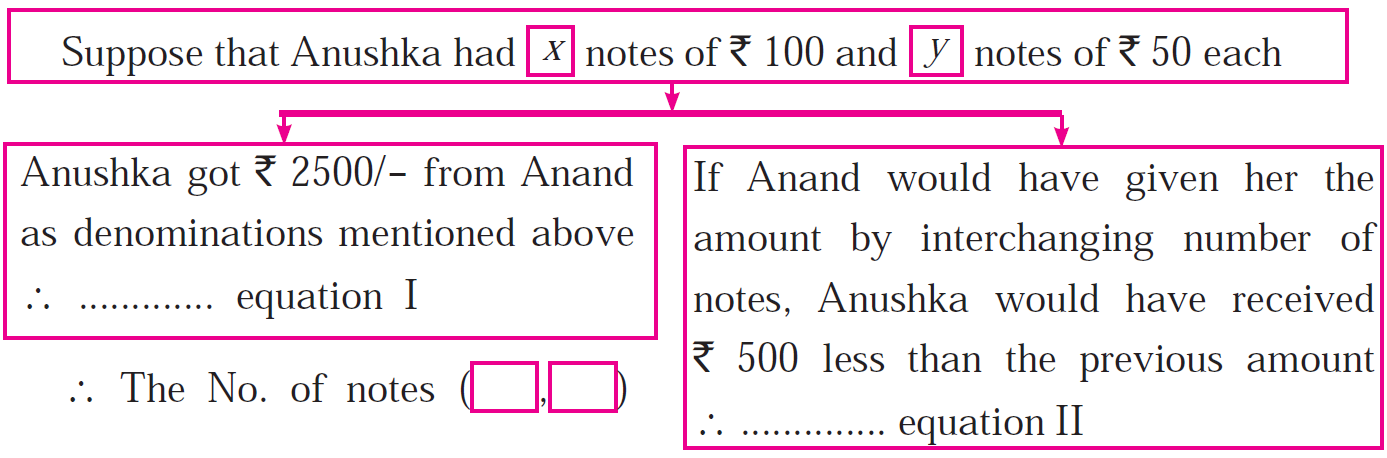
(3) To find number of notes that Anushka had, complete the following activity:
Solution:
[As the blanks given in the question are ambiguous, we will rephrase the question and solve it. Then you can fill in the blanks as told in your school.]
Question: Anand gave some ₹ 100 and some ₹ 50 notes to Anushka. The total amount was ₹ 2500. If Anand would have given her the amount by interchanging number of notes, Anushka would have received ₹ 500 less than the previous amount Find the number of ₹ 100 and ₹ 50 notes given to Anushka.
Answer:
Suppose Anushka was given \(x\) notes of ₹ 100, and \(y\) notes of ₹ 50.
From the first condition,
\(100x + 50y = 2500\) ... (i)
From the second condition,
\(50x + 100y = 2000\) ... (ii)
Adding (i) and (ii),
| 100x | + | 50y | = | 2500 | ... (i) | |||
+ |
50x | + | 100y | = | 2000 | ... (ii) | ||
| 150x | + | 150y | = | 4500 |
Dividing both sides by 150,
\(x + y = 30\) ... (iii)
Subtracting (ii) from (i),
| 100x | + | 50y | = | 2500 | ... (i) | |||
− |
⊕ | 50x | ⊕ | 100y | = | ⊕ | 2000 | ... (ii) |
| − | − | − | ||||||
| 50x | − | 50y | = | 500 |
Dividing both sides by 50,
\(x - y = 10\) ... (iv)
Adding (iii) and (iv),
| x | + | y | = | 30 | ... (iii) | |||
+ |
x | − | y | = | 10 | ... (iv) | ||
| 2x | = | 40 |
∴ \(\displaystyle x = \frac {\cancelto {20}{40}}{\cancelto {1}{2}}\)
∴ \(x = 20\) ... (v)
Substituting the value of \(x\) in equation (iii),
\(x + y = 30\) ... (iii)
∴ \(20 + y = 30\)
∴ \(y = 30 - 20\)
∴ \(y = 10\) ... (vi)
∴ 20 notes of ₹ 100 and 10 notes of ₹ 50 were given to Anushka.
(4) Sum of the present ages of Manish and Savita is 31. Manish’s age 3 years ago was 4 times the age of Savita. Find their present ages.
Solution:
Let the present age of Manish be \(x\) years and the present age of Savita be \(y\) years.
According to the first condition:
\(x + y = 31\) ... (i)
According to the second condition:
\(x - 3 = 4(y - 3)\)
∴ \(x - 3 = 4y - 12\)
∴ \(x - 4y = - 12 + 3\)
∴ \(x - 4y = - 9\) ... (ii)
Subtracting (ii) from (i),
| x | + | y | = | 31 | ... (i) | |||
− |
+ | x | ⊖ | 4y | = | ⊖ | 9 | ... (ii) |
| − | + | + | ||||||
| 5y | = | 40 |
∴ \(\displaystyle y = \frac {\cancelto {8}{40}}{\cancelto {1}{5}}\)
∴ \(y = 8\) ... (iii)
Substituting the value of \(y\) in equation (i),
\(x + y = 31\) ... (i)
∴ \(x + 8 = 31\)
∴ \(x = 31 - 8\)
∴ \(x = 23\) ... (iv)
∴ The present age of Manish is 23 years and the present age of Savita is 8 years.
(5)* In a factory, the ratio of salary of skilled and unskilled workers is 5 ∶ 3. Total salary of one day of both of them is ₹ 720. Find daily wages of skilled and unskilled workers.
Solution:
Let the salary of the skilled worker be ₹ \(x\) and that of the unskilled worker be ₹ \(y\).
From the first condition,
\(\displaystyle \frac {x}{y} = \frac {5}{3}\)
By cross multiplication
\(3x = 5y\)
∴ \(3x - 5y = 0\) ... (i)
From the second condition,
\(x + y = 720\) ... (ii)
Multiplying equation (ii) by 5,
\(5x + 5y = 3600\) ... (iii)
Adding (i) and (iii),
| 3x | − | 5y | = | 0 | ... (i) | |||
+ |
5x | + | 5y | = | 3600 | ... (iii) | ||
| 8x | = | 3600 |
∴ \(\displaystyle x = \frac {\cancelto {450}{3600}}{\cancelto {1}{8}}\)
∴ \(x = 450\) ... (iv)
Substituting the value of \(x\) in equation (ii),
\(x + y = 720\) ... (ii)
∴ \(450 + y = 720\)
∴ \(y = 720 - 450\)
∴ \(y = 270\) ... (v)
∴ The salary of the skilled worker is ₹ 450/- and that of the unskilled worker is ₹ 270/-.
(6)* Places A and B are 30 km apart and they are on a straight road. Hamid travels from A to B on bike. At the same time Joseph starts from B on bike, travels towards A. They meet each other after 20 minutes. If Joseph would have started from B at the same time but in the opposite direction (instead of towards A) Hamid would have caught him after 3 hours. Find the speed of Hamid and Joseph.
Solution:
Let, the speed of the bike starting from point ‘A’ be \(x\) km/hr and the speed of the bike starting from point ‘B’ be \(y\) km/hr.
Here, \(x \gt y\)
From the first condition,
\(\displaystyle x \times {\frac {20}{60}} + y \times {\frac {20}{60}} = 30\)
Multiplying both sides by 3,
\(\displaystyle x \times {\frac {\cancel {20}}{\cancel {60}}} \times {\cancel {3}} + y \times {\frac {\bcancel {20}}{\bcancel {60}}} \times {\bcancel{3}} = 30 \times {3}\)
∴ \(x + y = 90\) ... (i)
From the second condition,
\(3x - 3y = 30\) ... (ii)
Multiplying equation (i) by 3,
\(3x + 3y = 270\) ... (iii)
Adding (ii) and (iii),
| 3x | − | 3y | = | 30 | ... (ii) | |||
+ |
3x | + | 3y | = | 270 | ... (iii) | ||
| 6x | = | 300 |
∴ \(\displaystyle x = \frac {\cancelto {50}{300}}{\cancelto {1}{6}}\)
∴ \(x = 50\) km/hr ... (iv)
Substituting the value of \(x\) in equation (i),
\(x + y = 90\) ... (i)
∴ \(50 + y = 90\)
∴ \(y = 90 - 50\)
∴ \(y = 40\) km/hr ... (v)
∴ Hamid’s speed is 50 km/hr and Joseph’s speed is 40 km/hr.