1. Compare the given quadratic equations to the general form and write values of \(a, b, c\):
(1) \(x^{2} - 7x + 5 = 0\)
Solution:
\(x^{2} - 7x + 5 = 0\)
Comparing with \(ax^{2} + bx + c = 0\),
\(a = 1,\ b = - 7,\ c = 5\)
(2) \(2m^{2} = 5m - 5\)
Solution:
\(2m^{2} = 5m - 5\)
∴ \(2m^{2} - 5m + 5 = 0\)
Comparing with \(am^{2} + bm + c = 0\),
\(a = 2,\ b = - 5,\ c = 5\)
(3) \(y^{2} = 7y\)
Solution:
\(y^{2} = 7y\)
∴ \(y^{2} - 7y + 0 = 0\)
Comparing with \(ay^{2} + by + c = 0\),
\(a = 1,\ b = - 7,\ c = 0\)
2. Solve using formula:
(1) \(x^{2} + 6x + 5 = 0\)
Solution:
\(x^{2} + 6x + 5 = 0\)
Comparing with \(ax^{2} + bx + c = 0\),
\(a = 1,\ b = 6,\ c = 5\)
Now, \(b^{2} - 4ac\)
= \(6^{2} - 4 \times 1 \times 5\)
= \(36 - 20\)
= \(16\)
∴ \(b^{2} - 4ac = 16\)
Now, using Quadratic Formula,
\(\displaystyle x = \frac {- b \pm \sqrt {b^{2} - 4ac}}{2a}\)
∴ \(\displaystyle x = \frac {- 6 \pm \sqrt {16}}{2 \times 1}\)
∴ \(\displaystyle x = \frac {- 6 \pm 4}{2}\)
∴ \(\displaystyle x = \frac {- 6 + 4}{2}\) or \(\displaystyle x = \frac {- 6 - 4}{2}\)
∴ \(\displaystyle x = \frac {\cancelto {- 1}{- 2}}{\cancelto {1}{2}}\) or \(\displaystyle x = \frac {\cancelto {- 5}{- 10}}{\cancelto {1}{2}}\)
∴ \(x = - 1\) or \(x = - 5\)
The roots of the given quadratic equation are \( - 1\) and \( - 5\).
(2) \(x^{2} - 3x - 2 = 0\)
Solution:
\(x^{2} - 3x - 2 = 0\)
Comparing with \(ax^{2} + bx + c = 0\),
\(a = 1,\ b = - 3,\ c = - 2\)
Now, \(b^{2} - 4ac\)
= \((- 3)^{2} - 4 \times 1 \times - 2\)
= \(9 + 8\)
= \(17\)
∴ \(b^{2} - 4ac = 17\)
Now, using Quadratic Formula,
\(\displaystyle x = \frac {- b \pm \sqrt {b^{2} - 4ac}}{2a}\)
∴ \(\displaystyle x = \frac {- (- 3) \pm \sqrt {17}}{2 \times 1}\)
∴ \(\displaystyle x = \frac {3 \pm \sqrt {17}}{2}\)
∴ \(\displaystyle x = \frac {3 + \sqrt {17}}{2}\) or \(\displaystyle x = \frac {3 - \sqrt {17}}{2}\)
The roots of the given quadratic equation are \(\displaystyle \frac {3 + \sqrt {17}}{2}\) and \(\displaystyle \frac {3 - \sqrt {17}}{2}\).
(3) \(3m^{2} + 2m - 7 = 0\)
Solution:
\(3m^{2} + 2m - 7 = 0\)
Comparing with \(am^{2} + bm + c = 0\),
\(a = 3,\ b = 2,\ c = - 7\)
Now, \(b^{2} - 4ac\)
= \(2^{2} - 4 \times 3 \times - 7\)
= \(4 + 84\)
= \(88\)
∴ \(b^{2} - 4ac = 88\)
Now, using Quadratic Formula,
\(\displaystyle m = \frac {- b \pm \sqrt {b^{2} - 4ac}}{2a}\)
∴ \(\displaystyle m = \frac {- 2 \pm \sqrt {88}}{2 \times 3}\)
∴ \(\displaystyle m = \frac {- 2 \pm \sqrt {4 \times 22}}{6}\)
∴ \(\displaystyle m = \frac {- 2 \pm 2\sqrt {22}}{6}\)
∴ \(\displaystyle m = \frac {\cancelto {1}{2}(- 1 \pm \sqrt {22})}{\cancelto {3}{6}}\)
∴ \(\displaystyle m = \frac {- 1 \pm \sqrt {22}}{3}\)
∴ \(\displaystyle m = \frac {- 1 + \sqrt {22}}{3}\) or \(\displaystyle m = \frac {- 1 - \sqrt {22}}{3}\)
∴ The roots of the given quadratic equation are \(\displaystyle \frac {- 1 + \sqrt {22}}{3}\) and \(\displaystyle \frac {- 1 - \sqrt {22}}{3}\).
(4) \(5m^{2} - 4m - 2 = 0\)
Solution:
\(5m^{2} - 4m - 2 = 0\)
Comparing with \(am^{2} + bm + c = 0\),
\(a = 5,\ b = - 4,\ c = - 2\)
Now, \(b^{2} - 4ac\)
= \((- 4)^{2} - 4 \times 5 \times - 2\)
= \(16 + 40\)
= \(56\)
∴ \(b^{2} - 4ac = 56\)
Now, using Quadratic Formula,
\(\displaystyle m = \frac {- b \pm \sqrt {b^{2} - 4ac}}{2a}\)
∴ \(\displaystyle m = \frac {- (- 4) \pm \sqrt {56}}{2 \times 5}\)
∴ \(\displaystyle m = \frac {4 \pm \sqrt {4 \times 14}}{10}\)
∴ \(\displaystyle m = \frac {4 \pm 2\sqrt {14}}{10}\)
∴ \(\displaystyle m = \frac {\cancelto {1}{2}(2 \pm \sqrt {14})}{\cancelto {5}{10}}\)
∴ \(\displaystyle m = \frac {2 \pm \sqrt {14}}{5}\)
∴ \(\displaystyle m = \frac {2 + \sqrt {14}}{5}\) or \(\displaystyle m = \frac {2 - \sqrt {14}}{5}\)
∴ The roots of the given quadratic equation are\(\displaystyle \frac {2 + \sqrt {14}}{5}\) and \(\displaystyle \frac {2 - \sqrt {14}}{5}\)
(5) \(\displaystyle y^{2} + \frac {1}{3}y = 2\)
Solution:
\(\displaystyle y^{2} + \frac {1}{3}y = 2\)
Multiplying both sides by 3,
\(\displaystyle y^{2} \times 3 + \frac {1}{\cancel {3}}y \times \cancel {3} = 2 \times 3\)
∴ \(\displaystyle 3y^{2} + y = 6\)
∴ \(\displaystyle 3y^{2} + y - 6 = 0\)
Comparing with \(ay^{2} + by + c = 0\),
\(a = 3,\ b = 1,\ c = - 6\)
Now, \(b^{2} - 4ac\)
= \(1^{2} - 4 \times 3 \times - 6\)
= \(1 + 72\)
= \(73\)
∴ \(b^{2} - 4ac = 73\)
Now, using Quadratic Formula,
\(\displaystyle y = \frac {- b \pm \sqrt {b^{2} - 4ac}}{2a}\)
∴ \(\displaystyle y = \frac {- 1 \pm \sqrt {73}}{2 \times 3}\)
∴ \(\displaystyle y = \frac {- 1 \pm \sqrt {73}}{6}\)
∴ \(\displaystyle y = \frac {- 1 + \sqrt {73}}{6}\) or \(\displaystyle y = \frac {- 1 - \sqrt {73}}{6}\)
∴ The roots of the given quadratic equation are\(\displaystyle \frac {- 1 + \sqrt {73}}{6}\) and \(\displaystyle \frac {- 1 - \sqrt {73}}{6}\)
(6) \(5x^{2} + 13x + 8 = 0\)
Solution:
\(5x^{2} + 13x + 8 = 0\)
Comparing with \(ax^{2} + bx + c = 0\),
\(a = 5,\ b = 13,\ c = 8\)
Now, \(b^{2} - 4ac\)
= \(13^{2} - 4 \times 5 \times 8\)
= \(169 - 160\)
= \(9\)
∴ \(b^{2} - 4ac = 9\)
Now, using Quadratic Formula,
\(\displaystyle x = \frac {- b \pm \sqrt {b^{2} - 4ac}}{2a}\)
∴ \(\displaystyle x = \frac {- 13 \pm \sqrt {9}}{2 \times 5}\)
∴ \(\displaystyle x = \frac {- 13 \pm 3}{10}\)
∴ \(\displaystyle x = \frac {- 13 + 3}{10}\) or \(\displaystyle x = \frac {- 13 - 3}{10}\)
∴ \(\displaystyle x = \frac {\cancelto {- 1}{- 10}}{\cancelto {1}{10}}\) or \(\displaystyle x = \frac {\cancelto {- 8}{- 16}}{\cancelto {5}{10}}\)
∴ \(\displaystyle x = - 1\) or \(\displaystyle x = - \frac {8}{5}\)
∴ The roots of the given quadratic equation are \( - 1\) and \(\displaystyle - \frac {8}{5}\).
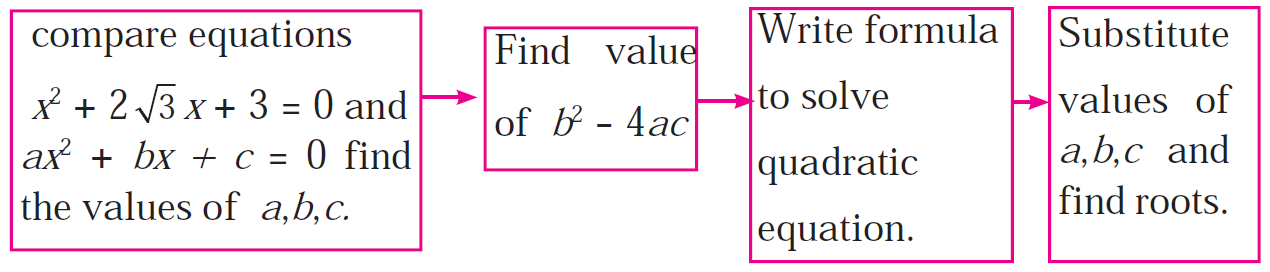
(3) With the help of the flow chart given below solve the equation
\(x^{2} + 2\sqrt {3}x + 3 = 0\) using the formula.
Solution:
\(x^{2} + 2\sqrt {3}x + 3 = 0\)
Comparing with \(ax^{2} + bx + c = 0\),
\(a = 1,\ b = 2\sqrt {3},\ c = 3\)
Now, \(b^{2} - 4ac\)
= \((2\sqrt {3})^{2} - 4 \times 1 \times 3\)
= \(12 - 12\)
= \(0\)
∴ \(b^{2} - 4ac = 0\)
Now, using Quadratic Formula,
\(\displaystyle x = \frac {- b \pm \sqrt {b^{2} - 4ac}}{2a}\)
∴ \(\displaystyle x = \frac {- 2\sqrt {3} \pm \sqrt {0}}{2 \times 1}\)
∴ \(\displaystyle x = \frac {- 2\sqrt {3} \pm 0}{2}\)
∴ \(\displaystyle x = \frac {\cancelto {- 1}{- 2}\sqrt {3}}{\cancelto {1}{2}}\)
∴ \(\displaystyle x = - \sqrt {3}\)
∴ The roots of the given quadratic equation are \( - \sqrt {3}\) and \(\displaystyle - \sqrt {3}\).