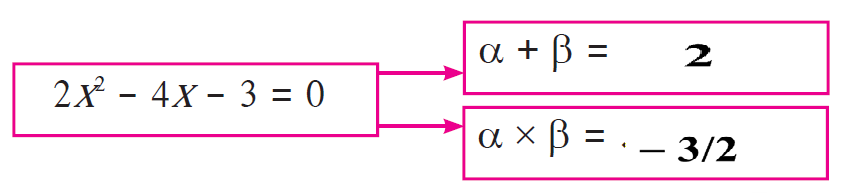
1. Activity: Fill in the gaps and complete:
(1)

(2)

(3) If α, β are roots of quadratic equation
2. Find the value of the discriminant:
(1) \(x^{2} + 7x - 1 = 0\)
Solution:
\(x^{2} + 7x - 1 = 0\)
Comparing with \(ax^{2} + bx + c = 0\),
\(a = 1,\ b = 7,\ c = -\:1\)
Now, discriminant
= \(b^{2} - 4ac\)
= \(7^{2} - 4 \times 1 \times -\:1\)
= \(49 + 4\)
= \(53\)
∴ Discriminant = 53
(2) \(2y^{2} - 5y + 10 = 0\)
Solution:
\(2y^{2} - 5y + 10 = 0\)
Comparing with \(ay^{2} + by + c = 0\),
\(a = 2,\ b = -\:5,\ c = 10\)
Now, discriminant
= \(b^{2} - 4ac\)
= \((-\:5)^{2} - 4 \times 2 \times 10\)
= \(25 -\:80\)
= \(-\:55\)
∴ Discriminant = − 55
(3) \(\sqrt {2}x^{2} + 4x + 2\sqrt {2} = 0\)
Solution:
\(\sqrt {2}x^{2} + 4x + 2\sqrt {2} = 0\)
Comparing with \(ax^{2} + bx + c = 0\),
\(a = \sqrt {2},\ b = 4,\ c = 2\sqrt {2}\)
Now, discriminat
= \(b^{2} - 4ac\)
= \(4^{2} - 4 \times \sqrt {2} \times 2\sqrt {2}\)
= \(16 - 8 \times 2\)
= \(16 - 16\)
= \(0\)
∴ Discriminant = 0
(3) Determine the nature of roots of the following quadratic equations:
(1) \(x^{2} - 4x + 4 = 0\)
Solution:
\(x^{2} - 4x + 4 = 0\)
Comparing with \(ax^{2} + bx + c = 0\),
\(a = 1,\ b = - 4,\ c = 4\)
Now, \(\Delta = b^{2} - 4ac\)
∴ \(\Delta = (- 4)^{2} - 4 \times 1 \times 4\)
∴ \(\Delta = 16 - 16\)
∴ \(\Delta = 0\)
∴ The roots are real and equal.
(2) \(2y^{2} - 7y + 2 = 0\)
Solution:
\(2y^{2} - 7y + 2 = 0\)
Comparing with \(ay^{2} + by + c = 0\),
\(a = 2,\ b = -\:7,\ c = 2\)
Now, \(\Delta = b^{2} - 4ac\)
∴ \(\Delta = (- 7)^{2} - 4 \times 2 \times 2\)
∴ \(\Delta = 49 - 16\)
∴ \(\Delta = 33\)
∴ \(\Delta \gt 0\)
Since, \(\Delta \gt 0\), the roots are real and unequal.
(3) \(m^{2} + 2m + 9 = 0\)
Solution:
\(m^{2} + 2m + 9 = 0\)
Comparing with \(am^{2} + bm + c = 0\),
\(a = 1,\ b = 2,\ c = 9\)
Now, \(\Delta = b^{2} - 4ac\)
∴ \(\Delta = 2^{2} - 4 \times 1 \times 9\)
∴ \(\Delta = 4 -\:36\)
∴ \(\Delta = -\:32\)
∴ \(\Delta \lt 0\)
Since, \(\Delta \lt 0\), the roots are not real.
(4) Form the quadratic equations from the roots given below:
(1) 0 and 4
Solution:
Let, \(\alpha = 0 \text { and } \beta = 4\)
Now, the required equation:
\(x^{2} - (\alpha + \beta)x + \alpha \beta = 0\)
∴ \(x^{2} - (0 + 4)x + 0 \times 4 = 0\)
∴ \(x^{2} - 4x + 0 = 0\)
∴ \(x^{2} - 4x = 0\)
∴ The required quadratic equation is \(x^{2} - 4x = 0\).
(2) 3 and − 10
Solution:
Let, \(\alpha = 3 \text { and } \beta = -\:10\)
Now, the required equation:
\(x^{2} - (\alpha + \beta)x + \alpha \beta = 0\)
∴ \(x^{2} - (3 -\:10)x + 3 \times -\:10 = 0\)
∴ \(x^{2} - (-\:7)x -\:30 = 0\)
∴ \(x^{2} + 7x -\:30 = 0\)
∴ The required quadratic equation is \(x^{2} + 7x -\:30 = 0\).
(3) \(\displaystyle \frac {1}{2}\), \(\displaystyle -\:\frac {1}{2}\)
Solution:
Let, \(\displaystyle \alpha = \frac {1}{2} \text { and } \beta = -\:\frac {1}{2}\)
Now, the required equation:
\(x^{2} - (\alpha + \beta)x + \alpha \beta = 0\)
∴ \(\displaystyle x^{2} - \left(\cancel {\frac {1}{2}} -\:\cancel {\frac {1}{2}}\right)x + \frac {1}{2} \times -\:\frac {1}{2} = 0\)
∴ \(\displaystyle x^{2} - 0x - \frac {1}{4} = 0\)
∴ \(\displaystyle x^{2} - \frac {1}{4} = 0\)
∴ The required quadratic equation is \(\displaystyle x^{2} - \frac {1}{4} = 0\).
(4) \(2 - \sqrt{5}\), \(2 + \sqrt{5}\)
Solution:
Let, \(2 - \sqrt{5} \text { and } \beta = 2 + \sqrt{5}\)
Now, the required equation:
\(x^{2} - (\alpha + \beta)x + \alpha \beta = 0\)
∴ \(x^{2} - (2 - \cancel {\sqrt{5}} + 2 + \cancel {\sqrt{5}})x + (2 - \sqrt{5})(2 + \sqrt{5}) = 0\)
∴ \(x^{2} - 4x + 4 - 5 = 0\)
∴ \(x^{2} - 4x - 1 = 0\)
∴ The required quadratic equation is \(x^{2} - 4x - 1 = 0\).
(5)* Sum of the roots of a quadratic equation is double their product. Find \(k\) if that equation is \(x^{2} - 4kx + k + 3 = 0\).
Solution:
\(x^{2} - 4kx + k + 3 = 0\)
Comparing with \(ax^{2} + bx + c = 0\),
\(a = 1,\ b = -\:4k,\ c = k + 3\)
Now, \(\displaystyle \alpha + \beta = - \frac {b}{a}\)
∴ \(\displaystyle \alpha + \beta = - \frac {-\:4k}{1}\)
∴ \(\displaystyle \alpha + \beta = 4k\) ... (i)
And, \(\displaystyle \alpha \beta = \frac {c}{a}\)
∴ \(\displaystyle \alpha \beta = \frac {k + 3}{1}\)
∴ \(\displaystyle \alpha \beta = k + 3\) ... (ii)
Also, from the given condition,
\(\alpha + \beta = 2\alpha \beta\)
∴ \(4k = 2(k + 3)\) ... [From (i) and (ii)]
∴ \(4k = 2k + 6\)
∴ \(4k - 2k = 6\)
∴ \(2k = 6\)
∴ \(\displaystyle k = \frac {\cancelto {3}{6}}{\cancelto {1}{2}}\)
∴ \(k = 3\)
(6)* If \(\alpha, \beta\) are the roots of \(y^{2} - 2y - 7 = 0\), find:
(1) \(\alpha^{2} + \beta^{2}\)
Solution:
\(y^{2} - 2y - 7 = 0\)
Comparing with \(ay^{2} + by + c = 0\),
\(a = 1,\ b = -\:2,\ c = -\:7\)
Now, \(\displaystyle \alpha + \beta = - \frac {b}{a}\)
∴ \(\displaystyle \alpha + \beta = - \frac {-\:2}{1}\)
∴ \(\displaystyle \alpha + \beta = 2\) ... (i)
And, \(\displaystyle \alpha \beta = \frac {c}{a}\)
∴ \(\displaystyle \alpha \beta = \frac {-\:7}{1}\)
∴ \(\displaystyle \alpha \beta = -\:7\) ... (ii)
Now, \(\alpha^{2} + \beta^{2} = (\alpha + \beta)^{2} - 2\alpha\beta\)
∴ \(\alpha^{2} + \beta^{2} = (2)^{2} - 2\times -\:7\) ... [From (i) and (ii)]
∴ \(\alpha^{2} + \beta^{2} = 4 + 14\)
∴ \(\alpha^{2} + \beta^{2} = 18\) ... (iii)
(2) \(\alpha^{3} + \beta^{3}\)
Solution:
Now, \(\alpha^{3} + \beta^{3} = (\alpha + \beta)(\alpha^{2} + \beta^{2} - \alpha \beta)\)
∴ \(\alpha^{3} + \beta^{3} = 2[18 -\:(-\:7)]\) ... [From (i) (ii) and (iii)]
∴ \(\alpha^{3} + \beta^{3} = 2(18 + 7)\)
∴ \(\alpha^{3} + \beta^{3} = 2(25)\)
∴ \(\alpha^{3} + \beta^{3} = 50\) ... (iv)
(7) The roots of each of the following quadratic equations are real and equal, find \(k\).
(1) \(3y^{2} + ky + 12 = 0\)
Solution:
\(3y^{2} + ky + 12 = 0\)
Comparing with \(ay^{2} + by + c = 0\),
\(a = 3,\ b = k,\ c = 12\)
Now, the roots are real and equal. ... (Given)
∴ \(b^{2} - 4ac = 0\)
∴ \(k^{2} - 4 \times 3 \times 12 = 0\)
∴ \(k^{2} - 144 = 0\)
∴ \(k^{2} = 144\)
∴ \(k = \sqrt {144}\)
∴ \(k = \pm 12\)
∴ \(k = + 12\) or \(k = -\:12\).
(2) \(kx(x - 2) + 6 = 0\)
Solution:
\(kx(x - 2) + 6 = 0\)
∴ \(kx^{2} - 2kx + 6 = 0\)
Comparing with \(ax^{2} + bx + c = 0\),
\(a = k,\ b = - 2k,\ c = 6\)
Now, the roots are real and equal. ... (Given)
∴ \(b^{2} - 4ac = 0\)
∴ \((- 2k)^{2} - 4 \times k \times 6 = 0\)
∴ \(4k^{2} - 24k = 0\)
∴ \(4k(k - 6) = 0\)
∴ \(4k = 0\) or \(k - 6 = 0\)
∴ \(k = 0\) or \(k = 6\).
But, \(a = k\) and in a quadratic equation \(ax^{2} + bx + c = 0\), the value of \(a\) can not be \(0\).
∴ \(k = 6\)