1. Product of Pragati’s age 2 years ago and 3 years hence is 84. Find her present age.
Solution:
Let Pragati’s present age be \(x\) years.
∴ Two years ago:
Pragati’s age = \(x - 2\) years.
And Three years hence:
Pragati’s age = \(x + 3\) years.
From the given information,
\((x - 2)(x + 3) = 84\)
∴ \(x(x + 3) - 2(x + 3) = 84\)
∴ \(x^{2} + 3x - 2x - 6 = 84\)
∴ \(x^{2} + x - 6 = 84\)
∴ \(x^{2} + x - 6 - 84 = 0\)
∴ \(x^{2} + x - 90 = 0\)
∴ \(\underline {x^{2} + 10x}\ \underline {- 9x - 90} = 0\)
∴ \(x\underline {(x + 10)}\ - 9 \underline {(x + 10)} = 0\)
∴ \((x + 10)(x - 9) = 0\)
∴ \(x + 10 = 0 \text { OR } x - 9 = 0\)
∴ \(x = - 10 \text { OR } x = 9\)
But, \(x\) is Pragati’s present age.
∴ It can’t be negative.
∴ \(x = 9\) years ... (i)
∴ Pragati’s present age is 9 years.
2. The sum of squares of two consecutive even natural numbers is 244; find the numbers.
Solution:
Let, the smaller number be \(x\).
∴ The greater number = \(x + 2\).
From the given information,
\(x^{2} + (x + 2)^{2} = 244\)
∴ \(x^{2} + x^{2} + 4x + 4 = 244\)
∴ \(2x^{2} + 4x + 4 = 244\)
∴ \(2x^{2} + 4x + 4 - 244 = 0\)
∴ \(2x^{2} + 4x - 240 = 0\)
Dividing both sides by 2,
∴ \(x^{2} + 2x - 120 = 0\)
∴ \(\underline {x^{2} + 12x}\ \underline {- 10x - 120} = 0\)
∴ \(x\underline {(x + 12)}\ - 10 \underline {(x + 12)} = 0\)
∴ \((x + 12)(x - 10) = 0\)
∴ \(x + 12 = 0 \text { OR } x - 10 = 0\)
∴ \(x = - 12 \text { OR } x = 10\)
But, \(x\) is a natural number.
∴ It can’t be negative.
∴ \(x = 10\)
∴ The smaller number = \(x\) = 10 ... (i)
And, the greater nuber = \(x + 2\) = \(10 + 2\) = 12 ... (ii)
∴ Those numbers are 10 and 12.
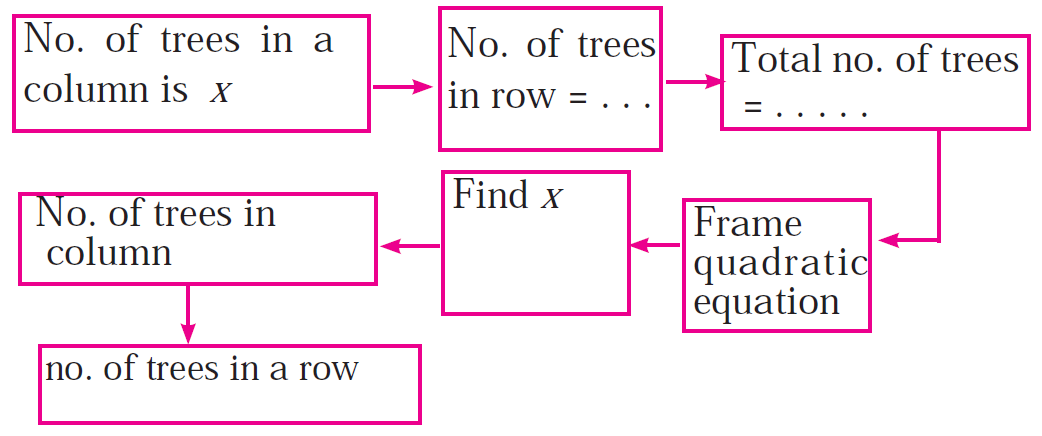
3. In the orange garden of Mr. Madhusudan there are 150 orange trees. The number of trees in each row is 5 more than that in each column. Find the number of trees in each row and each column with the help of following flow chart.
Solution:
Number of trees in a column is \(x\)
∴ Number of trees in a row = \(x + 5\)
∴ Total number of trees = \(x(x + 5)\)
∴ \(x(x + 5) = 150\)
∴ \(x^{2} + 5x = 150\)
∴ \(x^{2} + 5x - 150 = 0\)
∴ \(\underline {x^{2} + 15x}\ \underline {- 10x - 150} = 0\)
∴ \(x\underline {(x + 15)}\ - 10 \underline {(x + 15)} = 0\)
∴ \((x + 15)(x - 10) = 0\)
∴ \(x + 15 = 0 \text { OR } x - 10 = 0\)
∴ \(x = - 15 \text { OR } x = 10\)
But, \(x\) is a number of trees.
∴ It can’t be negative.
∴ \(x = 10\) ... (i)
∴ \(x + 5 = 10 + 5 = 15\) ... (ii)
∴ The number of trees in each column is 10 and the number of trees in each row is 15.
4. Vivek is older than Kishor by 5 years. The sum of the reciprocals of their ages is \(\displaystyle \frac {1}{6}\). Find their present ages.
Solution:
Let Kishor’s present age be \(x\) years.
∴ Vivek’s present age = \(x + 5\) years.
From the given information,
\(\displaystyle \frac {1}{x} + \frac {1}{x + 5} = \frac {1}{6}\)
∴ \(\displaystyle \frac {x + 5 + x}{x(x + 5)} = \frac {1}{6}\)
∴ \(\displaystyle \frac {2x + 5}{x^{2} + 5x} = \frac {1}{6}\)
By cross multiplication,
\(6(2x + 5) = 1(x^{2} + 5x)\)
∴ \(12x + 30 = x^{2} + 5x\)
∴ \(0 = x^{2} + 5x - 12x - 30\)
∴ \(0 = x^{2} - 7x - 30\)
i.e. \(x^{2} - 7x - 30 = 0\)
∴ \(\underline {x^{2} - 10x}\ \underline {+\ 3x - 30} = 0\)
∴ \(x\underline {(x - 10)}\ + 3 \underline {(x - 10)} = 0\)
∴ \((x - 10)(x + 3) = 0\)
∴ \(x - 10 = 0 \text { OR } x + 3 = 0\)
∴ \(x = 10 \text { OR } x = - 3\)
But, \(x\) is Kishor’s age.
∴ It can’t be negative.
∴ \(x = 10\) ... (i)
∴ Kishor’s present age = 10 years.
And Vivek’s present age = \(x + 5 = 10 + 5 = 15\) years. ... (ii)
∴ Kishor’s present age is 10 years and Vivek’s present age is 15 years.
5. Suyash scored 10 marks more in second test than that in the first. 5 times the score of the second test is the same as square of the score in the first test. Find his score in the first test.
Solution:
Let the marks scored by Suyash in the first test be \(x\).
∴ Marks scored by him in the second test = \(x + 10\).
From the given information,
\(5(x + 10) = x^{2}\)
∴ \(5x + 50 = x^{2}\)
∴ \(0 = x^{2} - 5x - 50\)
i.e. \(x^{2} - 5x - 50 = 0\)
∴ \(\underline {x^{2} - 10x}\ \underline {+\ 5x - 50} = 0\)
∴ \(x\underline {(x - 10)}\ + 5 \underline {(x - 10)} = 0\)
∴ \((x - 10)(x + 5) = 0\)
∴ \(x - 10 = 0 \text { OR } x + 5 = 0\)
∴ \(x = 10 \text { OR } x = - 5\)
But, \(x\) denotes Suyash’s marks.
∴ It \(x\) can’t be negative.
∴ \(x = 10\) ... (i)
∴ Suyash scored 10 marks in the first test.
6.* Mr. Kasam runs a small business of making earthen pots. He makes certain number of pots on daily basis. Production cost of each pot is ₹ 40 more than 10 times total number of pots, he makes in one day. If production cost of all pots per day is ₹ 600, find production cost of one pot and number of pots he makes per day.
Solution:
Let the production cost of each pot be ₹ \(x\).
∴ Number of pots made in a day = \(\displaystyle \frac {600}{x}\)
From the given information,
\(\displaystyle x = \frac {600}{x} \times {10} + 40\)
∴ \(\displaystyle x = \frac {6000}{x} + 40\)
Multiplying both sides by \(x\),
\(\displaystyle x \times x = \frac {6000}{\cancel {x}} \times \cancel {x} + 40 \times x\)
∴ \(\displaystyle x^{2} = 6000 + 40x\)
∴ \(\displaystyle x^{2} - 40x - 6000 = 0\)
∴ \(\underline {x^{2} - 100x}\ \underline {+\ 60x - 6000} = 0\)
∴ \(x\underline {(x - 100)}\ + 60 \underline {(x - 100)} = 0\)
∴ \((x - 100)(x + 60) = 0\)
∴ \(x - 100 = 0 \text { OR } x + 60 = 0\)
∴ \(x = 100 \text { OR } x = - 60\)
But, \(x\) is the production cost of each pot.
∴ It can’t be negative.
∴ \(x = 100\) ... (i)
∴ Production cost of one pot = ₹ 100.
And, number of pots he makes per day = \(\displaystyle \frac {600}{x} = \frac {\cancelto {6}{600}}{\cancelto {1}{100}} = 6\) ... (ii)
∴ Production cost of one pot is ₹ 100 and Kasam makes 6 pots per day.
7.* Pratik takes 8 hours to travel 36 km downstream and return to the same spot. The speed of boat in still water is 12 km. per hour. Find the speed of water current.
Solution:
Let the speed of the water current be \(x\) km/hr.
Now, speed of the boat in still water = 12 km/hr. ... (Given)
∴ Net speed of the boat while going downstream = \((12 + x)\) km/hr.
And net speed of the boat while going upstream = \((12 - x)\) km/hr.
\(\text{Distance} = \text{Speed} \times \text{Time}\)
\(\displaystyle \frac{\text{Distance}}{\text{Speed}} = \text{Time}\)
From the given information,
\(\displaystyle \frac {36}{12 + x} + \frac {36}{12 - x} = 8\)
Multiplying both sides by \(\displaystyle \frac {1}{36}\),
∴ \(\displaystyle \frac {\cancel {36}}{12 + x} \times \frac {1}{\cancel {36}} + \frac {\cancel {36}}{12 - x} \times \frac {1}{\cancel {36}}= \cancelto {2}{8} \times \frac {1}{\cancelto {9}{36}}\)
∴ \(\displaystyle \frac {1}{12 + x} + \frac {1}{12 - x} = \frac {2}{9}\)
∴ \(\displaystyle \frac {12 - \cancel {x} + 12 + \cancel {x}}{(12 + x)(12 - x)} = \frac {2}{9}\)
∴ \(\displaystyle \frac {24}{144 - x^{2}} = \frac {2}{9}\)
∴ \(\displaystyle \frac {\cancelto {12}{24} \times 9}{\cancelto {1}{2}} = 144 - x^{2}\)
∴ \(108 = 144 - x^{2}\)
∴ \(x^{2} = 144 - 108\)
∴ \(x^{2} = 36\)
Taking square roots of both sides,
\(x = \sqrt {36}\)
∴ \(x = \pm\ 6\)
∴ \(x = +\ 6 \text{ OR }x = -\ 6\)
But, \(x\) is the speed of the water current.
∴ It can’t be negative.
∴ \(x = 6\) ... (i)
∴ The speed of the water current is 6 km/hour.
8.* Pintu takes 6 days more than those of Nishu to complete certain work. If they work together they finish it in 4 days. How many days would it take to complete the work if they work alone.
Solution:
Let the time taken by Nishu to complete the work be \(x\) days.
∴ The time taken by Pintu to complete the same work = \((x + 6)\) days.
Work done by Nishu in one day = \(\displaystyle \frac {1}{x}\)
And, work done by Pintu in one day = \(\displaystyle \frac {1}{x + 6}\)
But, if they work together, they finish the work in 4 days.
From the given information,
\(\displaystyle 4\left(\frac {1}{x} + \frac {1}{x + 6}\right) = 1\)
∴ \(\displaystyle \frac {1}{x} + \frac {1}{x + 6} = \frac {1}{4}\)
∴ \(\displaystyle \frac {x + 6 + x}{x(x + 6)} = \frac {1}{4}\)
∴ \(\displaystyle \frac {2x + 6}{x^{2} + 6x} = \frac {1}{4}\)
By cross multiplication,
\(4(2x + 6) = 1(x^{2} + 6x)\)
∴ \(8x + 24 = x^{2} + 6x\)
∴ \(0 = x^{2} + 6x - 8x - 24\)
∴ \(0 = x^{2} - 2x - 24\)
i.e. \(x^{2} - 2x - 24 = 0\)
∴ \(\underline {x^{2} - 6x}\ \underline {+\ 4x - 24} = 0\)
∴ \(x\underline {(x - 6)}\ + 4 \underline {(x - 6)} = 0\)
∴ \((x - 6)(x + 4) = 0\)
∴ \(x - 6 = 0 \text { OR } x + 4 = 0\)
∴ \(x = 6 \text { OR } x = - 4\)
But, \(x\) is the time required to complete the work.
∴ It can’t be negative.
∴ \(x = 6\) ... (i)
∴ Time taken by Nishu to complete the work = 6 days.
And, time taken by Pintu to complete the work
= \(x + 6 = 6 + 6 = 12\) days. ... (ii)
∴ Nishu will complete the work in 6 days and Pintu will complete the same work in 12 days.
9.* If 460 is divided by a natural number, quotient is 6 more than five times the divisor and remainder is 1. Find quotient and diviser divisor.
Solution:
Let the divisor be \(x\).
Here,
Dividend = 460
Divisor = \(x\)
Quotient = \(5x + 6\)
Remainder = 1
\(\text{Dividend} = \text{Divisor} \times \text{Quotient} + \text{Remainder} \)
Now,
Dividend = Divisor × Quotient + Remainder
From the given information,
\(x(5x + 6) + 1 = 460\)
∴ \(5x^{2} + 6x + 1 = 460\)
∴ \(5x^{2} + 6x + 1 - 460 = 0\)
∴ \(5x^{2} + 6x - 459 = 0\)
∴ \(\underline {5x^{2} + 51x}\ \underline {-\ 45x - 459} = 0\)
∴ \(x\underline {(5x + 51)}\ - 9 \underline {(5x + 51)} = 0\)
∴ \((5x + 51)(x - 9) = 0\)
∴ \(5x + 51 = 0 \text { OR } x - 9 = 0\)
∴ \(5x = -\ 51 \text { OR } x = 9\)
∴ \(\displaystyle x = - \frac {51}{5} \text { OR } x = 9\)
But, \(x\) is a natural number.
∴ It can’t be a negative fraction.
∴ \(x = 9\) ... (i)
And \(x(5x + 6)\) = \(5 \times 9 + 6\) = \(51\) ... (ii)
∴ The divisor is 9 and the quotient is 51.
10.* In the adjoining figure, \(\square\)ABCD is a trapezium. AB | | CD and its area is 33 cm2. From the information given in the figure find the lengths of all sides of the \(\square\)ABCD. Fill in the empty boxes to get the solution.
Solution:

\(\square\)ABCD is a trapezium. ... (Given)
And AB | | CD ... (Given)
∴ \(\displaystyle \text{A}(\square \text{ABCD}) = \frac {1}{2}(\text{AB + CD}) \times \bbox[white, 5pt, border: 2px solid red]{\text{AM}}\)
∴ \(\displaystyle 33 = \frac {1}{2}(x + 2x + 1) \times \bbox[white, 5pt, border: 2px solid red]{(x - 4)}\)
∴ \(\bbox[white, 5pt, border: 2px solid red]{66} = (3x + 1) \times \bbox[white, 5pt, border: 2px solid red]{(x - 4)}\)
∴ \(66 = 3x^{2} - 12x + x - 4\)
∴ \(66 = 3x^{2} - 11x - 4\)
∴ \(0 = 3x^{2} - 11x - 4 - 66\)
∴ \(0 = 3x^{2} - 11x - 70\)
i.e. \(3x^{2} \bbox[white, 5pt, border: 2px solid red]{- 11x} - \bbox[white, 5pt, border: 2px solid red]{70} = 0\)
∴ \(\underline {3x^{2} - 21x}\ \underline {+\ 10x - 70} = 0\)
∴ \(3x\underline {(\bbox[white, 5pt, border: 2px solid red]{x - 7})}\ + 10 \underline {(\bbox[white, 5pt, border: 2px solid red]{x - 7})} = 0\)
∴ \((3x + 10)(\bbox[white, 5pt, border: 2px solid red]{x - 7}) = 0\)
∴ \((3x + 10) = 0 \text { OR } \bbox[white, 5pt, border: 2px solid red]{(x - 7)} = 0\)
∴ \(3x = - 10 \text { OR } x = 7\)
∴ \(\displaystyle x = - \frac {10}{3} \text { OR } x = \bbox[white, 5pt, border: 2px solid red]{7}\)
But, length is never negative.
∴ \(\displaystyle x \ne - \frac {10}{3} \therefore x = \bbox[white, 5pt, border: 2px solid red]{7}\)
∴ \(\text{AB }=\bbox[white, 5pt, border: 2px solid red]{7\:\text{cm}}, \text {CD } = \bbox[white, 5pt, border: 2px solid red]{15\text{\:cm}}, \text{AD = BC = }\bbox[white, 5pt, border: 2px solid red]{5\text{ cm}}\)