1. First term and common difference of an A. P. are 6 and 3 respectively; find \(S_{27}\). March ’20
Solution:
Here,
\(a = 6, d = 3, S_{27} = ?\)
\(\displaystyle S_n = \frac {n}{2}\left[\bbox[white, 5pt, border: 3px solid red]{\ 2a\ }+ (n - 1)d\right]\)
∴ \(\displaystyle S_{27} = \frac {27}{2}\left[12 + (27 - 1)\bbox[white, 5pt, border: 3px solid red]{3}\right]\)
\(\displaystyle = \frac {27}{2}\times \bbox[white, 5pt, border: 3px solid red]{90}\)
\(= 27 \times 45 = \bbox[white, 5pt, border: 3px solid red]{1215}\)
2. Find the sum of first 123 even natural numbers.
Solution:
Here,
\(a = 2, d = 2,\)
\(n = 123, S_{123} = ?\)
Now,
\(\displaystyle S_n = \frac {n}{2}[2a + (n - 1)d]\)
∴ \(\displaystyle S_{123} = \frac {123}{2}[2 \times 2 + (123 - 1) \times 2]\)
∴ \(\displaystyle S_{123} = \frac {123}{2}[4 + 122 \times 2]\)
∴ \(\displaystyle S_{123} = \frac {123}{2}[4 + 244]\)
∴ \(\displaystyle S_{123} = \frac {123}{\cancelto {1}{2}} \times \cancelto {124}{248}\)
∴ \(S_{123} = 123 \times 124\)
∴ \(S_{123} = 15252\)
∴ The sum of first 123 even natural numbers is 15252.
3. Find the sum of all even numbers from between 1 to 350.
Solution:
Here,
\(t_1 = a = 2, d = 2,\)
\(t_n = 348, n = ?, S_n = ?\)
Now, \(t_n = a + (n - 1)d\)
∴ \(348 = 2 + (n - 1)\times 2\)
∴ \(348 - 2 = (n - 1)\times 2\)
∴ \(346 = (n - 1)\times 2\)
i.e. \((n - 1)\times 2 = 346\)
∴ \(\displaystyle n - 1 = \frac {\cancelto {173}{346}}{\cancelto {1}{2}}\)
∴ \(n - 1 = 173\)
∴ \(n = 173 + 1\)
∴ \(n = 174\) ... (i)
Also,
\(\displaystyle S_n = \frac {n}{2}[2a + (n - 1)d]\)
∴ \(\displaystyle S_{174} = \frac {174}{2}[2 \times 2 + (174 - 1) \times 2]\)
∴ \(\displaystyle S_{174} = \frac {174}{2}[4 + 173 \times 2]\)
∴ \(\displaystyle S_{174} = \frac {174}{2}[4 + 346]\)
∴ \(\displaystyle S_{174} = \frac {174}{\cancelto {1}{2}} \times \cancelto {175}{350}\)
∴ \(S_{174} = 174 \times 175\)
∴ \(S_{174} = 30450\)
∴ The sum of all even numbers between 1 to 350 is 30450.
4. In an A. P. 19th term is 52 and 38th term is 128, find sum of first 56 terms.
Solution:
Here,
\(t_{19} = 52, t_{38} = 128, S_{56} = ?\)
Now, \(t_n = a + (n - 1)d\)
∴ \(t_{38} = a + (19 - 1)\times d\)
∴ \(52 = a + 18d\)
i.e. \(a + 18d = 52\) ... (i)
Also, \(t_n = a + (n - 1)d\)
∴ \(t_{38} = a + (38 - 1)\times d\)
∴ \(128 = a + 37d\)
i.e. \(a + 37d = 128\) ... (ii)
Adding (i) and (ii),
| a | + | 18d | = | 52 | ... (i) | |||
+ |
a | + | 37d | = | 128 | ... (ii) | ||
| 2a | + | 55d | = | 180 | ... (iii) |
And,
\(\displaystyle S_n = \frac {n}{2}[2a + (n - 1)d]\)
∴ \(\displaystyle S_{56} = \frac {56}{2}[2a + (56 - 1)d]\)
∴ \(\displaystyle S_{56} = \frac {\cancelto {28}{56}}{\cancelto {1}{2}}[2a + 55d]\)
∴ \(S_{56} = 28[2a + 55d]\) ... (iv)
Substituting the value from (iii),
∴ \(S_{56} = 28 \times 180\)
∴ \(S_{56} = 5040\)
∴ The sum of first 56 terms of that A. P. is 5040.
5. Complete the following activity to find the sum of natural numbers from 1 to 140 which are divisible by 4:
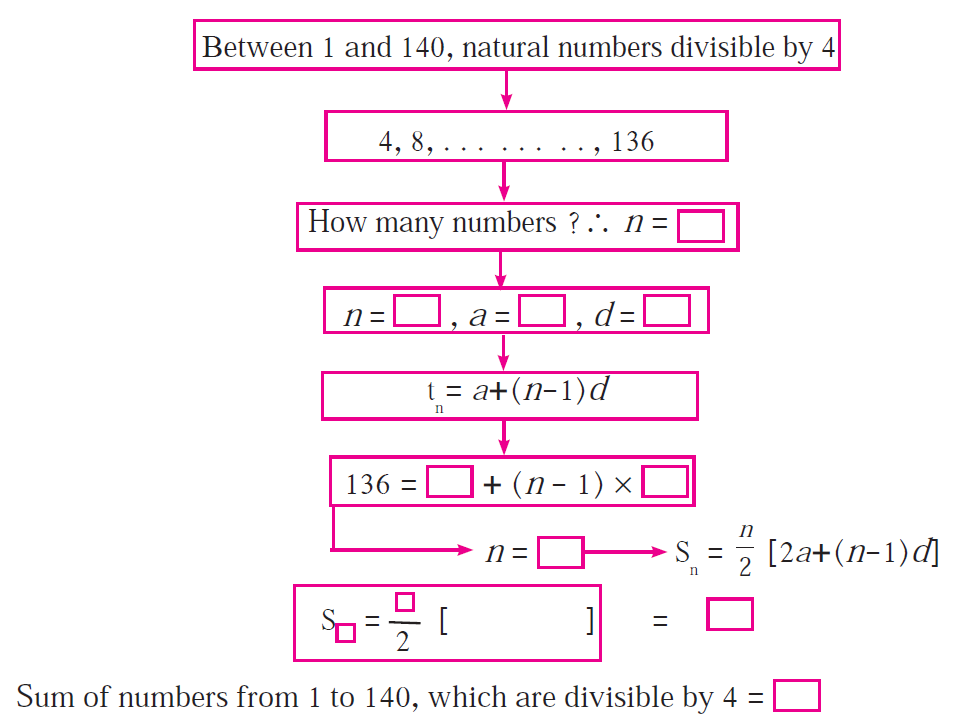
Solution:
[The example is solved below. You can fill in the blanks appropriately.]
Here,
\(t_1 = a = \bbox[white, 5pt, border: 3px solid red]{\ 4\ }, d = \bbox[white, 5pt, border: 3px solid red]{\ 4\ }, t_n = 136, n = \bbox[white, 5pt, border: 3px solid red]{\ ?\ }\)
Now, \(t_n = a + (n - 1)d\)
∴ \(136 = \bbox[white, 5pt, border: 3px solid red]{\ 4\ } + (n - 1)\times \bbox[white, 5pt, border: 3px solid red]{\ 4\ }\)
∴ \(136 - 4 = (n - 1)\times 4\)
∴ \(132 = (n - 1)\times 4\)
∴ \((n - 1)\times 4 = 132\)
\(\displaystyle n - 1 = \frac {\cancelto {33}{132}}{\cancelto {1}{4}}\)
∴ \(n - 1 = 33\)
∴ \(n = 33 + 1\)
∴ \(n = \bbox[white, 5pt, border: 3px solid red]{\ 34\ }\)
And,
\(\displaystyle S_n = \frac {n}{2}[2a + (n - 1)d]\)
∴ \(\displaystyle S_{\bbox[white, 5pt, border: 3px solid red]{\ 34\ }} = \frac {\bbox[white, 5pt, border: 3px solid red]{\ 34\ }}{2}[\bbox[white, 5pt, border: 3px solid red]{\ 2 \times 4 + (34 - 1) \times 4\ }]\)
∴ \(\displaystyle S_{34} = \frac {\cancelto {17}{34}}{\cancelto {1}{2}}[8 + 33 \times 4]\)
∴ \(\displaystyle S_{34} = 17 [8 + 132]\)
∴ \(\displaystyle S_{34} = 17 \times 140\)
∴ \(\displaystyle S_{34} = \bbox[white, 5pt, border: 3px solid red]{\ 2380\ }\)
∴ Sum of numbers from 1 to 140, which are divisible by 4 = \(\bbox[white, 5pt, border: 3px solid red]{\ 2380\ }\).
6.* Sum of first 55 terms in an A. P. is 3300, find its 28th term.
Solution:
Here,
\(n = 55, S_{55} = 3300, t_{28} = ?\)
And,
\(\displaystyle S_n = \frac {n}{2}[2a + (n - 1)d]\)
∴ \(\displaystyle 3300 = \frac {55}{2}[2a + (55 - 1)d]\)
∴ \(\displaystyle \frac {\cancelto {120}{3300} \times 2}{\cancelto {1}{55}} = 2a + 54d\)
∴ \(120 = 2(a + 27d)\)
∴ \(\displaystyle \frac {\cancelto {60}{120}}{\cancelto {1}{2}} = a + 27d\)
∴ \(60 = a + 27d\)
i.e. \(a + 27d = 60\) ... (i)
Also, \(t_n = a + (n - 1)d\)
∴ \(t_{28} = a + (28 - 1)\times d\)
∴ \(t_{28} = a + 27d\) ... (ii)
From (i) and (ii),
\(t_{28} = 60\)
∴ The 28th term of that A. P. is 60.
7.* In an A. P. sum of three consecutive terms is 27 and their product is 504, find the terms.
(Assume that three consecutive terms in A. P. are \(a - d\), \(a\), \(a\text{ }+\text{ }d\)). March ’20
Solution:
Let, those terms be
\(a - d\), \(a\) and \(a\text{ }+\text{ }d\).
From the first condition,
\(a - \cancel {d} + a + a + \cancel {d} = 27\)
∴ \(3a = 27\)
∴ \(\displaystyle a = \frac {\cancelto {9}{27}}{\cancelto {1}{9}}\)
∴ \(a = 9\) ... (i)
From the second condition,
\((a - d)\times a \times (a + d) = 504\)
∴ \((a^2 - d^2) \times a = 504\)
∴ \((9^2 - d^2) \times 9 = 504\)
∴ \(\displaystyle 81 - d^2 = \frac {\cancelto {56}{504}}{\cancelto {1}{9}}\)
∴ \(81 - d^2 = 56\)
∴ \(81 - 56 = d^2\)
∴ \(25 = d^2\)
i.e. \(d^2 = 25\)
∴ \(d = \sqrt {25}\)
∴ \(d = \pm 5\)
∴ \(d = + 5\) \(d = - 5\) ... (ii)
If \(d = + 5\), then those terms are:
\(a - d = 9 - 5 = 4\)
\(a = 9\)
\(a + d = 9 + 5 = 14\)
And if \(d = - 5\), then those terms are:
\(a - d = 9 - (- 5) = 9 + 5 = 14\)
\(a = 9\)
\(a + d = 9 + (- 5) = 9 - 5 = 4\)
∴ Those terms are 4, 9, 14 or 14, 9, 4.
8. Find four consecutive terms in an A.P. whose sum is 12 and sum of 3rd and 4th term is 14.
(Assume the four consecutive terms in A. P. are \(a - d,\ a,\ a + d,\ a + 2d\))
Solution:
Let, those terms be
\(a - d,\ a,\ a + d \text { and } a + 2d\)
From the first condition,
\(a - \cancel {d} + a + a + \cancel {d} + a + 2d = 12\)
∴ \(4a + 2d = 12\)
Dividing both sides by 2,
∴ \(2a + d = 6\) ... (i)
From the second condition,
\(a + d + a + 2d = 14\)
∴ \(2a + 3d = 14\) ... (ii)
Subtracting (i) from (ii),
| 2a | + | 3d | = | 14 | ... (ii) | |||
− |
⊕ | 2a | ⊕ | d | = | ⊕ | 6 | ... (i) |
| − | − | − | ||||||
| 2d | = | 8 |
∴ \(d = \displaystyle \frac {\cancelto {4}{8}}{\cancelto {1}{2}}\)
∴ \(d = 4\) ... (iii)
Substituting the value of \(d\) in (ii),
\(2a + 3d = 14\) ... (ii)
∴ \(2a + 3\times 4 = 14\)
∴ \(2a + 12 = 14\)
∴ \(2a = 14 - 12\)
∴ \(2a = 2\)
∴ \(a = \displaystyle \frac {\cancelto {1}{2}}{\cancelto {1}{2}}\)
∴ \(a = 1\) ... (iv)
∴ Those terms are:
\(a - d = 1 - 4 = - 3\)
\(a = 1\)
\(a + d = 1 + 4 = 5\)
\(a + 2d = 1 + 2 \times 4 = 1 + 8 = 9\)
∴ The four consecutive terms of that A. P. are − 3, 1, 5, 9.
9.* If the 9th term of an A. P. is zero, then show that the 29th term is twice the 19th term.
Solution:
Here,
\(t_9 = 0\),
To prove: \(t_{29} = 2t_{19}\)
Now, \(t_n = a + (n - 1)d\)
∴ \(t_9 = a + (9 - 1)\times d\)
∴ \(0 = a + 8d\) ... (Given)
i.e. \(a + 8d = 0\)
∴ \(a = - 8d\) ... (i)
Also, \(t_n = a + (n - 1)d\)
∴ \(t_{19} = a + (19 - 1)\times d\)
∴ \(t_{19} = a + 18d\)
∴ \(t_{19} = - 8d + 18d\) ... [From (i)]
∴ \(t_{19} = 10d\)
∴ 2\(t_{19} = 2 \times 10d\)
∴ 2\(t_{19} = 20d\) ... (ii)
And, \(t_n = a + (n - 1)d\)
∴ \(t_{29} = a + (29 - 1)\times d\)
∴ \(t_{29} = a + 28d\)
∴ \(t_{29} = - 8d + 28d\) ... [From (i)]
∴ \(t_{29} = 20d\) ... (iii)
From (ii) and (iii),
\(t_{29} = 2t_{19}\)